Marc De Vries – författare
Visar alla böcker från författaren Marc De Vries. Handla med fri frakt och snabb leverans.
7 produkter
7 produkter
188 kr
Skickas inom 5-8 vardagar
Philosophy of Technology
An Introduction for Technology and Business Students
Inbunden, Engelska, 2015
2 113 kr
Skickas inom 10-15 vardagar
Philosophy of Technology: An introduction for technology and business students is an accessible guide to technology’s changes , their ubiquitousness, and the many questions these raise. Designed for those with no philosophical background in mind, it is ideal for technology and engineering students or specialists who want to learn to think critically about how their work influences society and our daily lives.The technological, business environment and daily experiences are the starting point of the book and the authors’ reflect upon these practices from a philosophical point of view. The text goes on to present a critical analysis of the subject including development, manufacturing, sales and marketing and the use of technological products and services. The abstract ideas are made easier to grasp with a story-telling approach: a vivid history of the discipline and colourful portraits of the core thinkers in this domain, as well as four case studies drawing from various engineering disciplines to demonstrate how philosophy can and should influence technology in practice. The first comprehensive introduction to this vibrant young sub-discipline in over 20 years, this is an ideal textbook for students of technology and engineering beginning a course or project in the philosophy of their subject.
768 kr
Skickas inom 10-15 vardagar
Philosophy of Technology: An introduction for technology and business students is an accessible guide to technology’s changes , their ubiquitousness, and the many questions these raise. Designed for those with no philosophical background in mind, it is ideal for technology and engineering students or specialists who want to learn to think critically about how their work influences society and our daily lives.The technological, business environment and daily experiences are the starting point of the book and the authors’ reflect upon these practices from a philosophical point of view. The text goes on to present a critical analysis of the subject including development, manufacturing, sales and marketing and the use of technological products and services. The abstract ideas are made easier to grasp with a story-telling approach: a vivid history of the discipline and colourful portraits of the core thinkers in this domain, as well as four case studies drawing from various engineering disciplines to demonstrate how philosophy can and should influence technology in practice. The first comprehensive introduction to this vibrant young sub-discipline in over 20 years, this is an ideal textbook for students of technology and engineering beginning a course or project in the philosophy of their subject.
1 589 kr
Skickas inom 10-15 vardagar
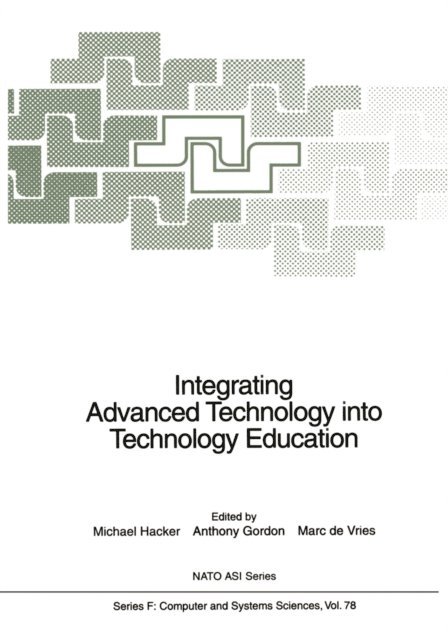
This volume provides a thorough examination of the use ofadvanced educational technology in the delivery oftechnology education at the school, college, and universitylevels. Based on a NATO Advanced Study Institute held atthe University of Salford, England, in August 1992, the bookfocuses on the following key elements:- The philosophical and educational foundation for the useof advanced educational technologies in the delivery oftechnology education,- Advanced educational technology research and practice,- The development of integrated implementation plansemploying research from both elements. The authors are selected leaders in the field of science andtechnology education, drawn from the practitioner level, thedoctoral and post-doctoral level, and decision makers inlocal and national administration and government in the NATOand Central and Eastern European countries. The bookindicates the issues to be addressed by all involved in theuse of advanced educational technology in the domain oftechnology education.
1 637 kr
Skickas inom 10-15 vardagar
The following forms the proceedings of the NATO-supported Advanced Study Institute held at the University of Salford, located near Manchester, England, during the period 16-28 August, 1992. The need for this Institute was stimulated by the 1 recommendations from the NATO-supported Research Workshop, held in 1990 , which stated that the role of advanced educational technology in the delivery of technology education be explored in considerable detail. The Institute focused on the key elements of: i) the philosophical and educational foundations for the use of advanced educational technologies in the delivery of technology education, ii) advanced educational technology, and iii) the development of integrated implementation plans employing research from both elements. The partiCipants comprised some 60 selected leaders in the field of science and technology education, drawn from the practitioner, doctoral and post-doctoral levels, and included decision-makers in local and national administration and government in the NATO and CEE (Central and Eastern European) countries. The participants were addressed by a number of keynote speakers expert in various fields. The papers presented and the responses on the participants to the issues developed through the poster sessions, are summarised in these procedings. It is hoped that the work encapsulated herein makes for interesting reading, and assists and educates those active in these areas of educational endeavour.
1 094 kr
Skickas inom 10-15 vardagar
Technology is a dynamic field in which new developments take place continuously. Education traditionally lacks behind the latest developments in this subject area. Therefore it is necessary to consider updating education regularly. The NATO Advanced Research Workshop "Integrating Advanced Technology into Technology Education" discussed necessary changes in technology education caused by new developments in technology. It was held in Eindhoven, The Netherlands, October 9-12, 1990. Our impression is that there was a fruitful interaction between educationalists, policy makers, and industrialists. These groups all have their own way of approaching technology education and the conference gave them an opportunity for sharing ideas that come from these various approaches. The participants felt that the issue of integrating advanced technology into technology education was quite relevant. There was a high degree of commitment in presentations and discussions. This led to the formulation of a number of recommendations to people in NATO countries who are involved in technology education. We as organizers appreciate the contributions of many people to this conference: NATO for financing it; Dr. Thomas Liao in particular for stimulating both NATO and us to realize it; the presenters for setting the scene for discussions; all participants for sharing ideas and perspectives; and finally Springer-Verlag for publishing the proceedings. April 1991 Michael Hacker Anthony Gordon Marc de Vries Introduction From the main theme of the conference --Integrating Advanced Technology into Technology Education --we distilled six questions: 1.
80 Years of Research at the Philips Natuurkundig Laboratorium (1914-1994)
The Role of the Nat. Lab. at Philips
Häftad, Engelska, 2005
659 kr
Skickas inom 10-15 vardagar
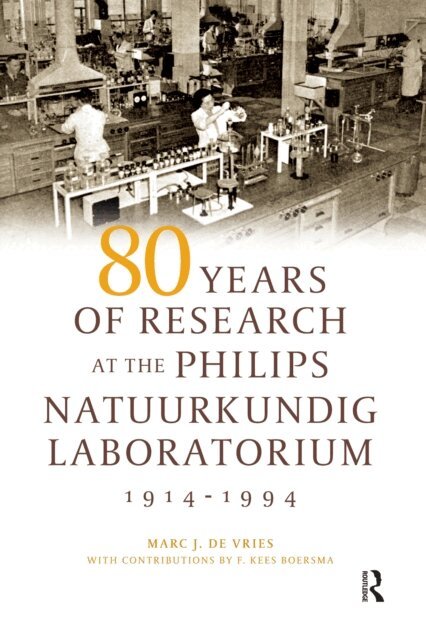
Histories of major industrial research laboratories are an essential contribution to the history of technology. This book offers a description of the way one of such laboratories has changed its ambitions and activities in the course of time. In the 80-year period that is described here, the Philips Natuurkundig Laboratorium has played different roles for the Philips company – today one of the world’s largest electronics company – which was founded in 1891 in the Netherlands. The history of this laboratory is described in three main periods, each characterized by its goals, available means, organizational structures, research culture, and external relations. For each period the general story line is alternated by case study descriptions.The Philips Natuurkundig Laboratorium was founded in 1914. The term ‘Natuurkundig’ (in English: of physics) indicated that the task of the new laboratory was to conduct research of physics. Initially this research was related to light bulbs. At that time the Philips company, led by the two Philips brothers Anton and Gerard, was primarily a light bulb producing company. Soon the Nat.Lab. (this is the commonly used abbreviation of the full name) became the main source of inventions that would support the company in extending its product portfolio. In the course of time the goal of the lab’s activities shifted in response to changes in its context, both within the Philips company and in a broader national and international context. Today the Philips Natuurkundig laboratorium is part of a worldwide research organization, Philips Research that generates options for new and improved products and processes and produces important patents in those electronics markets in which the company is active. It is still one of the world’s major private research organizations. A key characteristic is the wide range of disciplines that are represented: from electrical engineering and physics to chemistry, mathematics, mechanics, information technology and software.