Marc Sens – författare
Visar alla böcker från författaren Marc Sens. Handla med fri frakt och snabb leverans.
6 produkter
6 produkter
Häftad, Engelska, 2016
1 838 kr
Skickas inom 10-15 vardagar
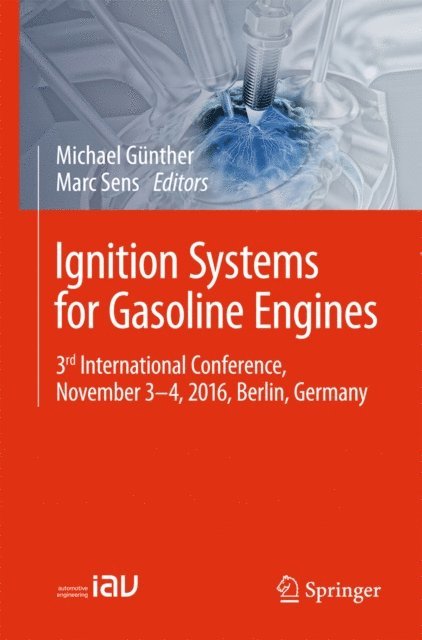
The volume includes selected and reviewed papers from the 3rd Conference on Ignition Systems for Gasoline Engines in Berlin in November 2016. Experts from industry and universities discuss in their papers the challenges to ignition systems in providing reliable, precise ignition in the light of a wide spread inmixture quality, high exhaust gas recirculation rates and high cylinder pressures. Classic spark plug ignition as well as alternative ignition systems are assessed, the ignition system being one of the key technologies to further optimizing the gasoline engine.
E-bok
Engelska, 20162 366 kr
Läs direkt efter köp
The volume includes selected and reviewed papers from the 3rd Conference on Ignition Systems for Gasoline Engines in Berlin in November 2016. Experts from industry and universities discuss in their papers the challenges to ignition systems in providing reliable, precise ignition in the light of a wide spread in mixture quality, high exhaust gas recirculation rates and high cylinder pressures. Classic spark plug ignition as well as alternative ignition systems are assessed, the ignition system being one of the key technologies to further optimizing the gasoline engine.
Häftad, Engelska, 2017
1 623 kr
Skickas inom 10-15 vardagar
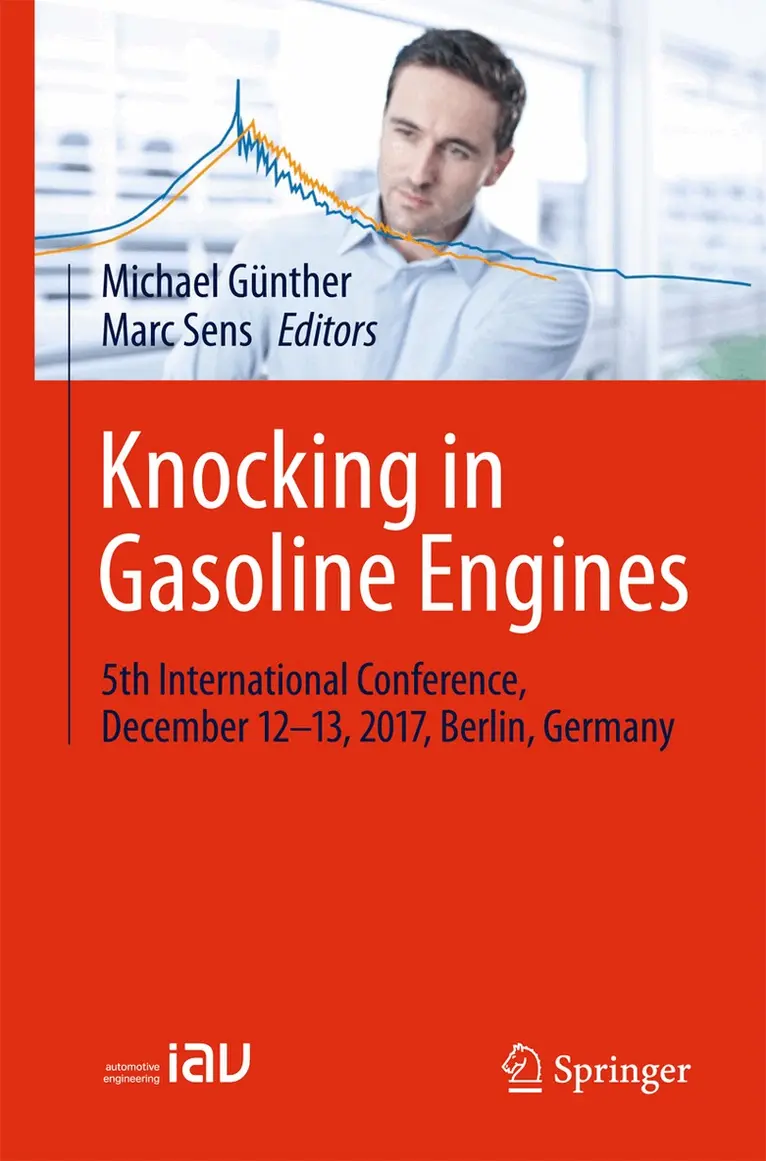
The book includes the papers presented at the conference discussing approaches to prevent or reliably control knocking and other irregular combustion events. The majority of today’s highly efficient gasoline engines utilize downsizing. High mean pressures produce increased knocking, which frequently results in a reduction in the compression ratio at high specific powers. Beyond this, the phenomenon of pre-ignition has been linked to the rise in specific power in gasoline engines for many years. Charge-diluted concepts with high compression cause extreme knocking, potentially leading to catastrophic failure. The introduction of RDE legislation this year will further grow the requirements for combustion process development, as residual gas scavenging and enrichment to improve the knock limit will be legally restricted despite no relaxation of the need to reach the main center of heat release as early as possible. New solutions in thermodynamics and control engineering are urgently needed to further increase the efficiency of gasoline engines.
E-bok
Engelska, 20172 049 kr
Läs direkt efter köp
The book includes the papers presented at the conference discussing approaches to prevent or reliably control knocking and other irregular combustion events. The majority of today’s highly efficient gasoline engines utilize downsizing. High mean pressures produce increased knocking, which frequently results in a reduction in the compression ratio at high specific powers. Beyond this, the phenomenon of pre-ignition has been linked to the rise in specific power in gasoline engines for many years. Charge-diluted concepts with high compression cause extreme knocking, potentially leading to catastrophic failure.
The introduction of RDE legislation this year will further grow the requirements for combustion process development, as residual gas scavenging and enrichment to improve the knock limit will be legally restricted despite no relaxation of the need to reach the main center of heat release as early as possible. New solutions in thermodynamics and control engineering are urgently needed to further increase the efficiency of gasoline engines.
E-bok
PDF, Engelska, 20241 669 kr
Läs direkt efter köp
In addition to the indisputably necessary electrification of the transport sector, which is currently being ramped up, internal combustion engines will still be urgently needed in the future. Otherwise, the demand for mobility in the on-road, off-road and non-road sectors cannot be met. There is no doubt that these internal combustion engines will have to be improved regarding efficiency plus lower emissions and nowadays more and more important upgraded for zero and low carbon fuels.Even though Spark Ignition (SI) engines have been around for more than a century, there is still a lot of room for improvement, particularly in terms of power density, ignition, combustion control, and preventing uncontrolled combustion.To offer all interested developers an inspiring exchange platform for the latest developments, IAV established two exciting conferences more than two decades ago, which are now held under the heading "Two Conferences - One Goal". This volume brings together the contributions to this conference.
E-bok
PDF, Engelska, 20221 545 kr
Läs direkt efter köp
For decades, scientists and engineers have been working to increase the efficiency of internal combustion engines. For spark-ignition engines, two technical questions in particular are always in focus:1. How can the air/fuel mixture be optimally ignited under all possible conditions?2. How can undesirable but recurrent early and self-ignitions in the air/fuel mixture be avoided?Against the background of the considerable efficiency increases currently being sought in the context of developments and the introduction of new fuels, such as hydrogen, methanol, ammonia and other hydrogen derivatives as well as biofuels, these questions are more in the focus than ever.In order to provide a perfect exchange platform for the community of combustion process and system developers from research and development, IAV has organized this combined conference, chaired by Marc Sens. The proceedings presented here represent the collection of all the topics presented at the event and are thus intended to serve as an inspiration and pool of ideas for all interested parties.