Marcin Wojciech Solarz - Böcker
Visar alla böcker från författaren Marcin Wojciech Solarz. Handla med fri frakt och snabb leverans.
6 produkter
6 produkter
616 kr
Skickas inom 10-15 vardagar
Globalization has, essentially, come to an end. It is, already, a victorious revolution. It has profoundly restructured the relationships between people and the world, often recreating them in a new geographical image.This book discovers and describes these relationships of new geographies, providing a comprehensive spatial guide to the globalized world of the 21st century. It considers a number of timely and important themes and insights for the present and future world, exploring topics such as population trends and migration; development, the urban; transportation; religion; our endangered planet; wars, conflicts and terrorism, and disease. As such it offers a cross-cutting synthesis of the modern world. It will be of interest to students and researches in humanities and social sciences, including geographers, economists, political scientists and IR specialists.
578 kr
Skickas inom 10-15 vardagar
The 1914–2024 War Atlas deconstructs the contemporary widespread and well-known image of the 20th and 21st centuries, arguing for the continuity of the historical process covering the period 1914–2024.The years between 1914 and 2024 constitute a period of unparalleled economic growth, scientific advancement, political development, and social change – in just over 100 years, human civilization has moved from an industrial to a digital age. However, they also cover some of the most dangerous, violent, and politically volatile years in human history. In these years, two world wars have been fought; weapons of mass destruction dropped; authoritarian and democratic regimes alike have risen and fallen; and regional conflicts have been almost continuous, effectively conjoining World War I, World War II, the Cold War, and the Russo-Ukrainian war. This volume indicates that the 1914 July Crisis set in motion a sequence of events that spanned over 100 years. Containing a range of colourful maps and charts, this book graphically illustrates the arguments presented in both an informative and visual way.This atlas will serve as a perfect textbook for students studying history, geography, politics, and international relations, as well as being a useful guide to contemporary world politics for researchers and for those interested in international relations and modern history.
2 027 kr
Skickas inom 10-15 vardagar
The 1914–2024 War Atlas deconstructs the contemporary widespread and well-known image of the 20th and 21st centuries, arguing for the continuity of the historical process covering the period 1914–2024.The years between 1914 and 2024 constitute a period of unparalleled economic growth, scientific advancement, political development, and social change – in just over 100 years, human civilization has moved from an industrial to a digital age. However, they also cover some of the most dangerous, violent, and politically volatile years in human history. In these years, two world wars have been fought; weapons of mass destruction dropped; authoritarian and democratic regimes alike have risen and fallen; and regional conflicts have been almost continuous, effectively conjoining World War I, World War II, the Cold War, and the Russo-Ukrainian war. This volume indicates that the 1914 July Crisis set in motion a sequence of events that spanned over 100 years. Containing a range of colourful maps and charts, this book graphically illustrates the arguments presented in both an informative and visual way.This atlas will serve as a perfect textbook for students studying history, geography, politics, and international relations, as well as being a useful guide to contemporary world politics for researchers and for those interested in international relations and modern history.
2 103 kr
Skickas inom 10-15 vardagar
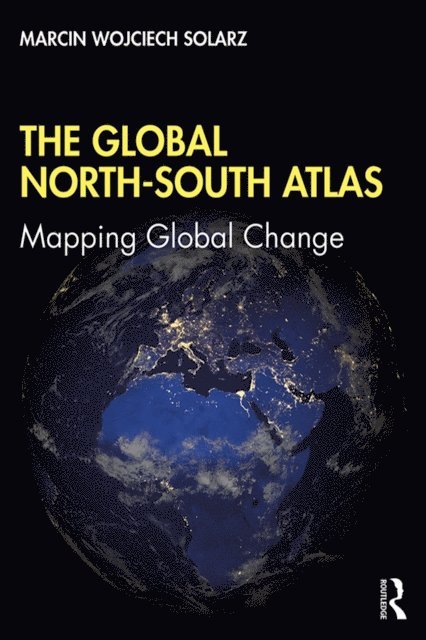
This innovative atlas deconstructs the contemporary image of the North–South divide between developed and underdeveloped countries which was established by the 1980 Brandt Line, and advocates the need for the international community to redraw the global map to be fit for the 21st century.Throughout the book a range of colorful maps and charts graphically demonstrate the ways in which the world has changed over the last 2,000 years. The atlas first analyzes the genesis and characteristics of the Brandt Line’s North–South divide, before going on to discuss its validity through the centuries, especially before and after 1980, and demonstrating the many definitions and philosophies of development that exist or may exist, which make it difficult to define a single notion of a Global North and South. The book concludes by proposing new schemes of categorization between developed and developing countries which might better fit our contemporary global society.This book will serve as a perfect textbook for students studying global divisions within geography, politics, economics, international relations, and development departments, as well as being a useful guide for researchers, and for those working in NGOs and government institutions.
724 kr
Skickas inom 10-15 vardagar
This innovative atlas deconstructs the contemporary image of the North–South divide between developed and underdeveloped countries which was established by the 1980 Brandt Line, and advocates the need for the international community to redraw the global map to be fit for the 21st century.Throughout the book a range of colorful maps and charts graphically demonstrate the ways in which the world has changed over the last 2,000 years. The atlas first analyzes the genesis and characteristics of the Brandt Line’s North–South divide, before going on to discuss its validity through the centuries, especially before and after 1980, and demonstrating the many definitions and philosophies of development that exist or may exist, which make it difficult to define a single notion of a Global North and South. The book concludes by proposing new schemes of categorization between developed and developing countries which might better fit our contemporary global society.This book will serve as a perfect textbook for students studying global divisions within geography, politics, economics, international relations, and development departments, as well as being a useful guide for researchers, and for those working in NGOs and government institutions.
2 103 kr
Skickas inom 10-15 vardagar
Globalization has, essentially, come to an end. It is, already, a victorious revolution. It has profoundly restructured the relationships between people and the world, often recreating them in a new geographical image.This book discovers and describes these relationships of new geographies, providing a comprehensive spatial guide to the globalized world of the 21st century. It considers a number of timely and important themes and insights for the present and future world, exploring topics such as population trends and migration; development, the urban; transportation; religion; our endangered planet; wars, conflicts and terrorism, and disease. As such it offers a cross-cutting synthesis of the modern world. It will be of interest to students and researches in humanities and social sciences, including geographers, economists, political scientists and IR specialists.