Marco A. R. Ferreira – författare
693 kr
Skickas inom 10-15 vardagar
1 826 kr
Skickas inom 10-15 vardagar
917 kr
Läs direkt efter köp
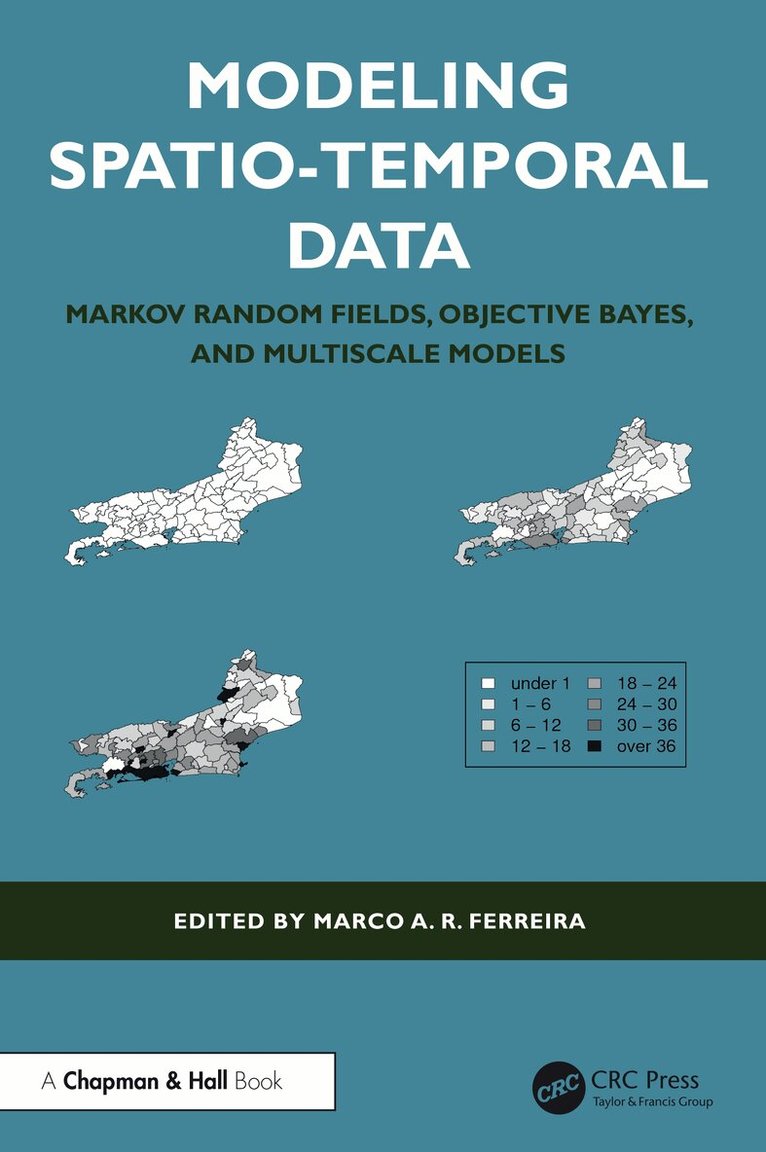
Several important topics in spatial and spatio-temporal statistics developed in the last 15 years have not received enough attention in textbooks. Modeling Spatio-Temporal Data: Markov Random Fields, Objectives Bayes, and Multiscale Models aims to fill this gap by providing an overview of a variety of recently proposed approaches for the analysis of spatial and spatio-temporal datasets, including proper Gaussian Markov random fields, dynamic multiscale spatio-temporal models, and objective priors for spatial and spatio-temporal models. The goal is to make these approaches more accessible to practitioners, and to stimulate additional research in these important areas of spatial and spatio-temporal statistics.
Key topics:
Proper Gaussian Markov random fields and their uses as building blocks for spatio-temporal models and multiscale models. Hierarchical models with intrinsic conditional autoregressive priors for spatial random effects, including reference priors, results on fast computations, and objective Bayes model selection. Objective priors for state-space models and a new approximate reference prior for a spatio-temporal model with dynamic spatio-temporal random effects. Spatio-temporal models based on proper Gaussian Markov random fields for Poisson observations. Dynamic multiscale spatio-temporal thresholding for spatial clustering and data compression. Multiscale spatio-temporal assimilation of computer model output and monitoring station data. Dynamic multiscale heteroscedastic multivariate spatio-temporal models. The M-open multiple optima paradox and some of its practical implications for multiscale modeling. Ensembles of dynamic multiscale spatio-temporal models for smooth spatio-temporal processes.The audience for this book are practitioners, researchers, and graduate students in statistics, data science, machine learning, and related fields. Prerequisites for this book are master''s-level courses on statistical inference, linear models, and Bayesian statistics. This book can be used as a textbook for a special topics course on spatial and spatio-temporal statistics, as well as supplementary material for graduate courses on spatial and spatio-temporal modeling.
909 kr
Läs direkt efter köp
Several important topics in spatial and spatio-temporal statistics developed in the last 15 years have not received enough attention in textbooks. Modeling Spatio-Temporal Data: Markov Random Fields, Objectives Bayes, and Multiscale Models aims to fill this gap by providing an overview of a variety of recently proposed approaches for the analysis of spatial and spatio-temporal datasets, including proper Gaussian Markov random fields, dynamic multiscale spatio-temporal models, and objective priors for spatial and spatio-temporal models. The goal is to make these approaches more accessible to practitioners, and to stimulate additional research in these important areas of spatial and spatio-temporal statistics.
Key topics:
Proper Gaussian Markov random fields and their uses as building blocks for spatio-temporal models and multiscale models. Hierarchical models with intrinsic conditional autoregressive priors for spatial random effects, including reference priors, results on fast computations, and objective Bayes model selection. Objective priors for state-space models and a new approximate reference prior for a spatio-temporal model with dynamic spatio-temporal random effects. Spatio-temporal models based on proper Gaussian Markov random fields for Poisson observations. Dynamic multiscale spatio-temporal thresholding for spatial clustering and data compression. Multiscale spatio-temporal assimilation of computer model output and monitoring station data. Dynamic multiscale heteroscedastic multivariate spatio-temporal models. The M-open multiple optima paradox and some of its practical implications for multiscale modeling. Ensembles of dynamic multiscale spatio-temporal models for smooth spatio-temporal processes.The audience for this book are practitioners, researchers, and graduate students in statistics, data science, machine learning, and related fields. Prerequisites for this book are master''s-level courses on statistical inference, linear models, and Bayesian statistics. This book can be used as a textbook for a special topics course on spatial and spatio-temporal statistics, as well as supplementary material for graduate courses on spatial and spatio-temporal modeling.
1 336 kr
Skickas inom 10-15 vardagar
795 kr
Läs direkt efter köp
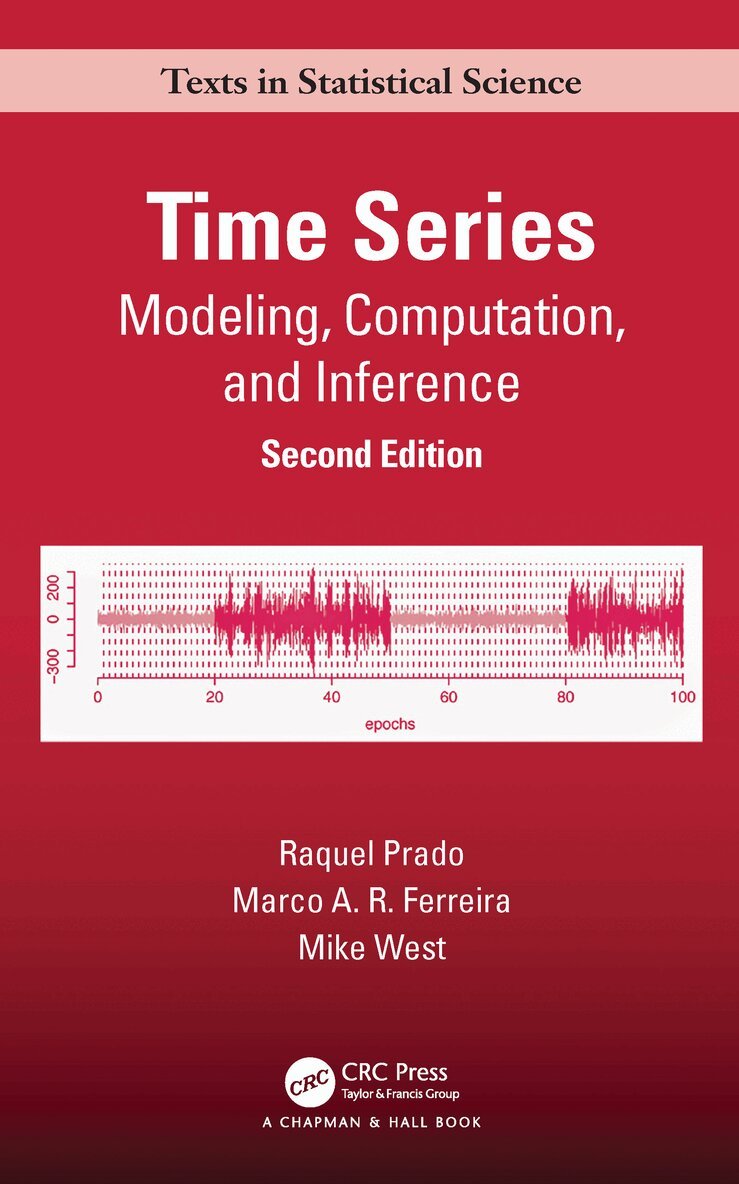
Focusing on Bayesian approaches and computations using analytic and simulation-based methods for inference, Time Series: Modeling, Computation, and Inference, Second Edition integrates mainstream approaches for time series modeling with significant recent developments in methodology and applications of time series analysis. It encompasses a graduate-level account of Bayesian time series modeling, analysis and forecasting, a broad range of references to state-of-the-art approaches to univariate and multivariate time series analysis, and contacts research frontiers in multivariate time series modeling and forecasting.
It presents overviews of several classes of models and related methodology for inference, statistical computation for model fitting and assessment, and forecasting. It explores the connections between time- and frequency-domain approaches and develop various models and analyses using Bayesian formulations and computation, including use of computations based on Markov chain Monte Carlo (MCMC) and sequential Monte Carlo (SMC) methods. It illustrates the models and methods with examples and case studies from a variety of fields, including signal processing, biomedicine, environmental science, and finance.
Along with core models and methods, the book represents state-of-the art approaches to analysis and forecasting in challenging time series problems. It also demonstrates the growth of time series analysis into new application areas in recent years, and contacts recent and relevant modeling developments and research challenges.
New in the second edition:
Expanded on aspects of core model theory and methodology.
Multiple new examples and exercises.
Detailed development of dynamic factor models.
Updated discussion and connections with recent and current research frontiers.