Marco Pistore – författare
Visar alla böcker från författaren Marco Pistore. Handla med fri frakt och snabb leverans.
4 produkter
4 produkter
Häftad, Engelska, 2008
566 kr
Skickas inom 10-15 vardagar
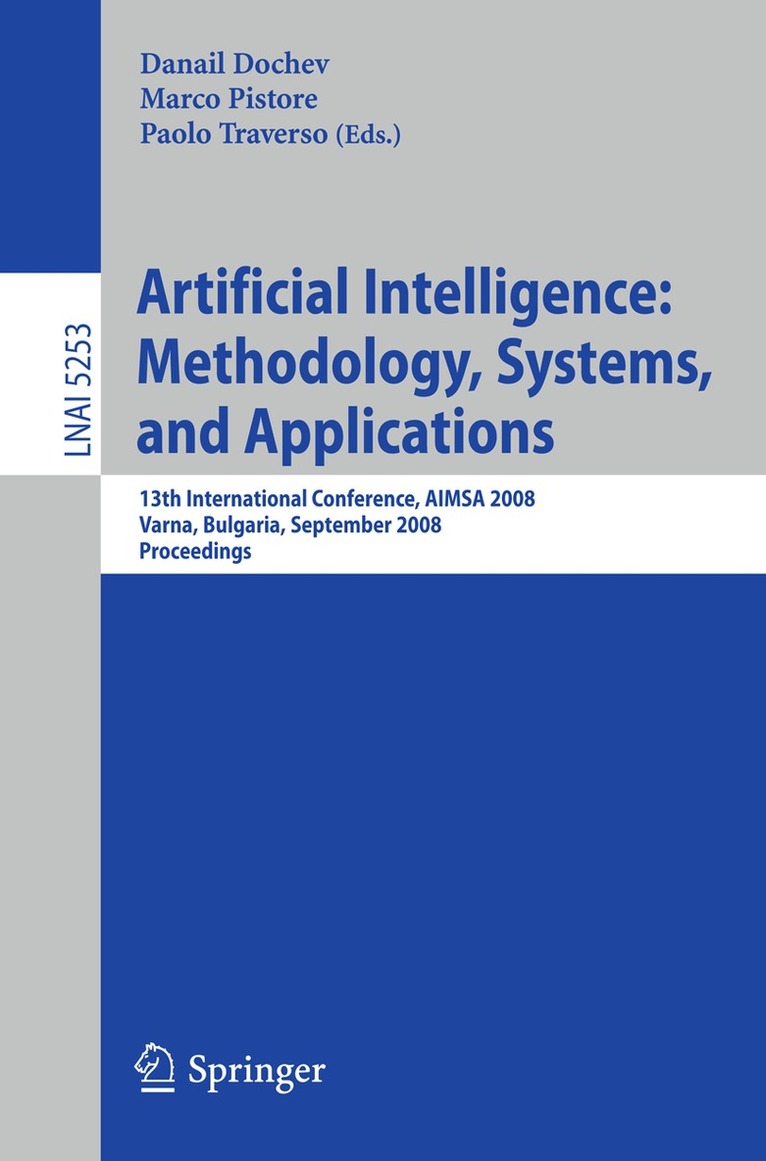
This book constitutes the refereed proceedings of the 13th International Conference on Artificial Intelligence: Methodology, Systems, and Applications, AIMSA 2008, held in Varna, Bulgaria in September 2008. The 30 revised full papers presented together with the 10 posters were carefully reviewed and selected from 109 submissions. The papers are organized in topical sections on agents; natural language processing and text analysis; machine learning and information retrieval; knowledge representation and reasoning; constraints, heuristics and search; applications; posters.
E-bok
PDF, Engelska, 2008708 kr
Läs direkt efter köp
This book constitutes the refereed proceedings of the 13th International Conference on Artificial Intelligence: Methodology, Systems, and Applications, AIMSA 2008, held in Varna, Bulgaria in September 2008. The 30 revised full papers presented together with the 10 posters were carefully reviewed and selected from 109 submissions. The papers are organized in topical sections on agents; natural language processing and text analysis; machine learning and information retrieval; knowledge representation and reasoning; constraints, heuristics and search; applications; posters.
Häftad, Engelska, 2010
566 kr
Skickas inom 10-15 vardagar
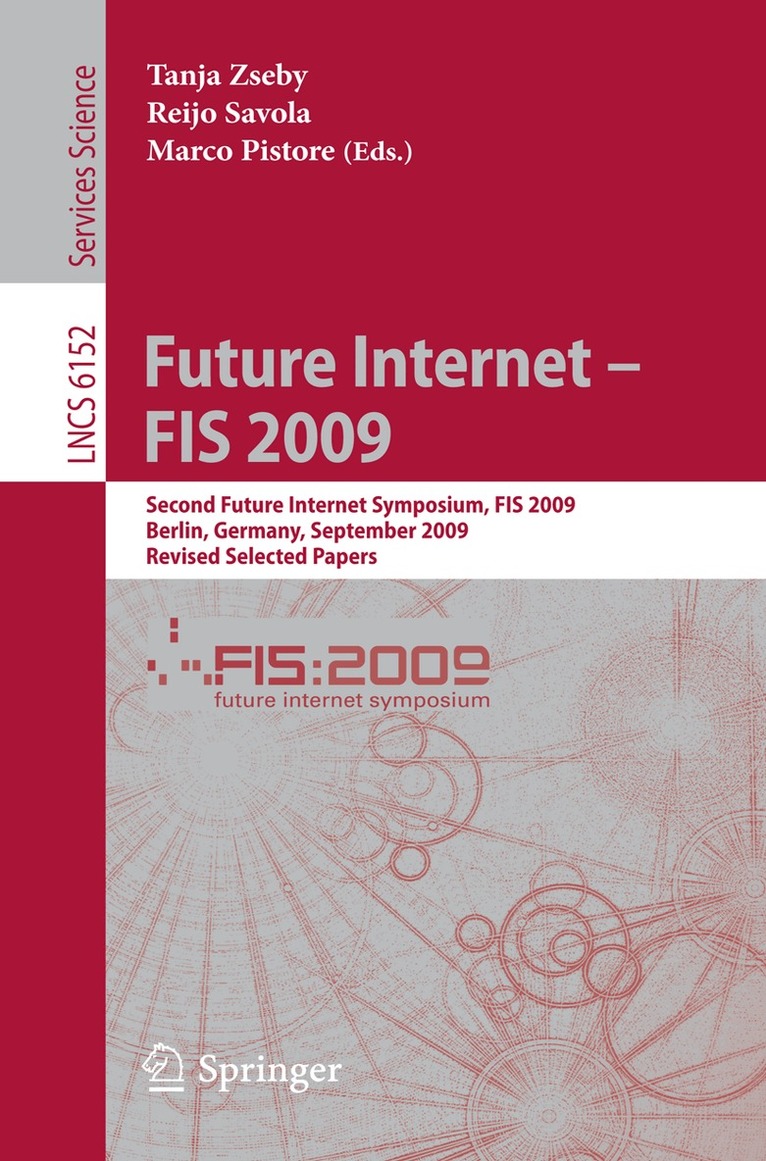
The Second Future Internet Symposium washeld during September 1-3, 2009 in Berlin, Germany. FIS 2009 provided a forum for leading researchers and pr- titioners to meet and discuss the wide-ranging scienti?c and technical issues related to the design of a new Internet. This second edition of the symposium con?rmed the sentiment shared during the First Future Internet Symposium, held in Vienna in 2008: designing the Future Internet is a very exciting and challenging task, and a new research community needs to be built around it. With overa billionusers,today’s Internet is arguablythe most successful- man artifact ever created. The Internet’s physical infrastructure, software, and content now play an integral part of the lives of everyoneon the planet, whether they interact with it directly or not. Now nearing its ?fth decade, the Int- net has shown remarkable resilience and ?exibility in the face of ever-increasing numbers of users, data volume, and changing usage patterns, but faces growing challenges in meeting the needs of our knowledge society. Yet, Internet access moves increasingly from ?xed to mobile, the trend towards mobile usage is - deniable and predictions are that by 2014 about 2 billion users will access the Internet via mobile broadband services. This adds a new layer of complexity to the already immense challenges. Globally, many major initiatives are underway to address the need for more scienti?c research, physical infrastructure inve- ment, better education, and better utilization of the Internet. Japan, the USA andEuropeareinvestingheavilyin this area.
E-bok
PDF, Engelska, 2010734 kr
Läs direkt efter köp
The Second Future Internet Symposium washeld during September 1-3, 2009 in Berlin, Germany. FIS 2009 provided a forum for leading researchers and pr- titioners to meet and discuss the wide-ranging scienti?c and technical issues related to the design of a new Internet. This second edition of the symposium con?rmed the sentiment shared during the First Future Internet Symposium, held in Vienna in 2008: designing the Future Internet is a very exciting and challenging task, and a new research community needs to be built around it. With overa billionusers,today’s Internet is arguablythe most successful- man artifact ever created. The Internet’s physical infrastructure, software, and content now play an integral part of the lives of everyoneon the planet, whether they interact with it directly or not. Now nearing its ?fth decade, the Int- net has shown remarkable resilience and ?exibility in the face of ever-increasing numbers of users, data volume, and changing usage patterns, but faces growing challenges in meeting the needs of our knowledge society. Yet, Internet access moves increasingly from ?xed to mobile, the trend towards mobile usage is - deniable and predictions are that by 2014 about 2 billion users will access the Internet via mobile broadband services. This adds a new layer of complexity to the already immense challenges. Globally, many major initiatives are underway to address the need for more scienti?c research, physical infrastructure inve- ment, better education, and better utilization of the Internet. Japan, the USA andEuropeareinvestingheavilyin this area.