Marcus Miller - Böcker
Visar alla böcker från författaren Marcus Miller. Handla med fri frakt och snabb leverans.
6 produkter
6 produkter
Del 2 - Global Economic Institutions
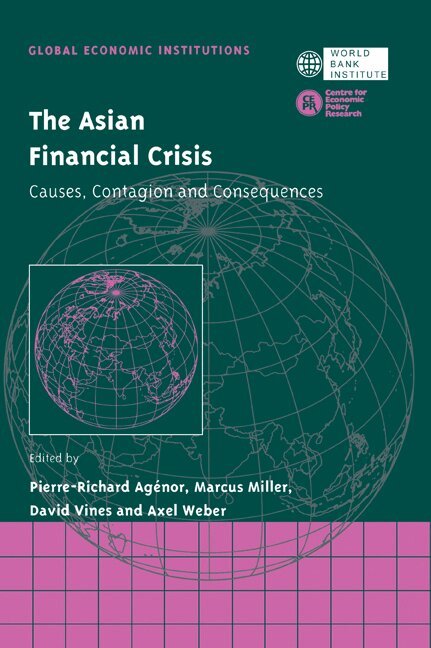
The Asian Financial Crisis
Causes, Contagion and Consequences
Häftad, Engelska, 2006
523 kr
Skickas inom 7-10 vardagar
Presents the first theoretical analysis of the Asian financial crisis and draws out the general lessons of an event whose potential long term effects have been likened to those of the Crash of 1929. Part I presents a factual and analytic overview of what happened: the role of 'vulnerability'; the interconnection between currency crises and financial crises; and why crisis turned into collapse. Part II considers more detailed issues, including how the inflation of non-traded goods prices created vulnerability, welfare-reducing capital inflow owing to under-regulated financial markets, and the onset of speculative attacks. Part III assesses all aspects of contagion, in particular the role of geographic proximity. The final section addresses policy issues. Joseph Stiglitz argues that there is much that can be done to reduce the frequency of crises and to mitigate the severity of crises when they happen. The book finishes with a round-table discussion of policy issues.
509 kr
Skickas inom 7-10 vardagar
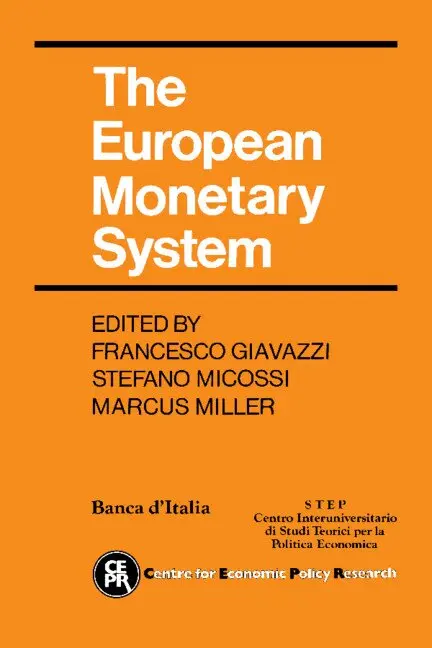
The European Monetary System (EMS) has, since its inception in 1979, provided a fascinating example of policy co-ordination in practice. As concern about exchange-rate instability and global economic imbalances has grown, both academic researchers and policy-makers have looked to the EMS for lessons about co-operation on a wider scale. This volume contains the papers and proceedings of an October 1987 conference organised by the Centre for Economic Policy Research in co-operation with the Banca d'Italia and the Centro Interuniversitario di Studi Teorici per la Politica Economica (STEP). The conference brought together distinguished academics and practitioners from eleven European central banks. The papers offer a timely summary of current research, while the concluding panel discussion provides a valuable perspective on the concerns of policy-makers. This will be the definitive publication on the EMS for some years to come, and hence a basic reference for anyone interested in the international monetary system and policy co-ordination.
550 kr
Skickas inom 7-10 vardagar
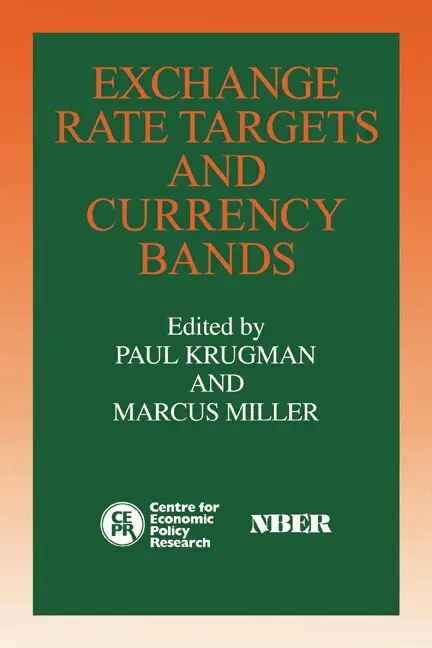
Research programmes in economics usually emerge from the intersection between a new analytical approach and a real economic problem. In the last few years, such a programme has emerged in international monetary economics, which is underpinned by a theoretical framework grounded in stochastic calculus and the increasing prominence in the real world of the international monetary arrangements under which national monetary authorities attempt to keep exchange rates within bands or 'target zones'. This new programme of research also covers switches in exchange rate regimes. This volume from the Centre for economic Policy Research and the National Bureau of Economic Research includes contributions - as authors or discussants - from most of the active participants in the development of this new field, and will serve as a useful introduction and basic text for this new research programme. It opens with an account of the basic economic model of a currency band developed by Paul Krugman, which is followed by two papers that extend this approach. Other chapters study the regime switches entailed in Britain's return to the gold standard in 1925 and the preannounced entry of a floating currency into a band such as the EMS. Essays on sustainability and realignment consider the possible outcomes of speculative attacks on such bands, and the volume ends with a paper on econometric testing of models of this type.
Del 2 - Global Economic Institutions
The Asian Financial Crisis
Causes, Contagion and Consequences
Inbunden, Engelska, 1999
1 783 kr
Skickas inom 7-10 vardagar
Presents the first theoretical analysis of the Asian financial crisis and draws out the general lessons of an event whose potential long term effects have been likened to those of the Crash of 1929. Part I presents a factual and analytic overview of what happened: the role of 'vulnerability'; the interconnection between currency crises and financial crises; and why crisis turned into collapse. Part II considers more detailed issues, including how the inflation of non-traded goods prices created vulnerability, welfare-reducing capital inflow owing to under-regulated financial markets, and the onset of speculative attacks. Part III assesses all aspects of contagion, in particular the role of geographic proximity. The final section addresses policy issues. Joseph Stiglitz argues that there is much that can be done to reduce the frequency of crises and to mitigate the severity of crises when they happen. The book finishes with a round-table discussion of policy issues.
241 kr
Skickas inom 5-8 vardagar
249 kr
Tillfälligt slut