Mari Teigen - Böcker
Visar alla böcker från författaren Mari Teigen. Handla med fri frakt och snabb leverans.
2 produkter
2 produkter
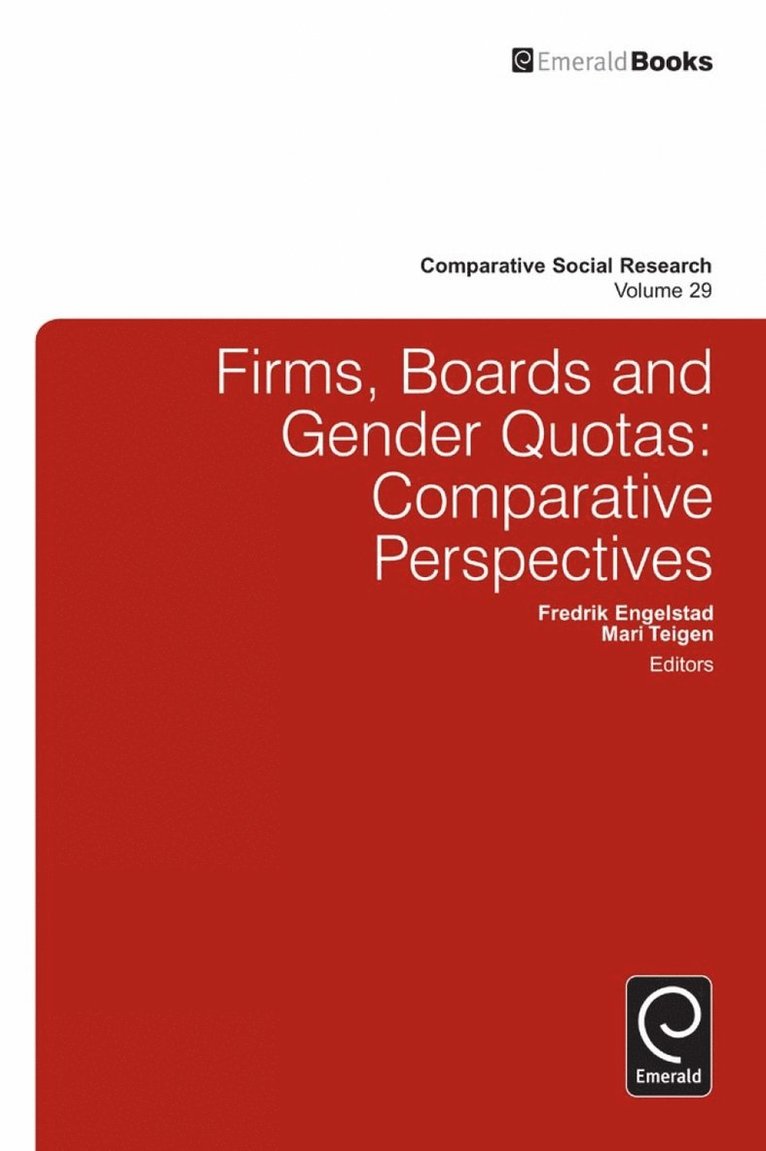
Del 29 - Comparative Social Research
Firms, Boards and Gender Quotas
Comparative Perspectives
Inbunden, Engelska, 2012
1 318 kr
Skickas inom 7-10 vardagar
During the last decade gender equality in business life has become a hot topic. One impetus is the recent reform in Norway, prescribing gender quotas to the boards of directors of public companies. Shortly after the Norwegian reform was enacted, several other European countries have adopted similar reforms. This is the only volume where this gender quota reform is thoroughly discussed from an economic, political and philosophical point of view. It looks at whether the economic performance of companies is influenced, positively or negatively. The reasons why it has been embraced in some countries and rejected in others are analyzed. Moreover, viability of the gender quota reform is assessed by comparisons to other political interventions in business life in Scandinavia, of which some have been a failure whereas others have shown themselves as successful. This specific reform also serves as a backdrop to other themes related to gender and business. This volume provides a broad comparative study of the access of women to top positions in business in Europe. It also gives detailed discussions of gender relations in family businesses both in East Asia and in Europe.
Del 34 - Comparative Social Research
Elites and People
Challenges to Democracy
Inbunden, Engelska, 2019
1 000 kr
Skickas inom 7-10 vardagar
This volume contains an Open Access chapter.Relationships between elites and democracy have always been strained. The very concept of elites - of 'chosen people' - stands in contradiction to democratic ideals of political equality. Simultaneously, they are necessary parts of democratic societies. In any large-scale society, democracy is unthinkable without large organizations, be they political bodies, bureaucracies, enterprises, or voluntary organizations. When power is concentrated at the summit of such organizations the incumbents of the top positions potentially constitute groups that often are termed elite groups. The present volume of Comparative Social Research offers a broad set of comparative studies of elites, stretching from the Arab Spring in Tunisia and Egypt to women's political leadership in Brazil and Germany, via attainment of elite positions among minorities in France and the US. The quality of democratic governance seems to be in decline in many parts of contemporary world. Nevertheless, political elections are still a main source of legitimacy, even when they are far from being free and fair. Developments in the Third Wave democracies established around 1990 both in Europe and in the rest of the world, are treated in several chapters. How do they fare two or three decades later? Another group of chapters sets the focus on elite recruitment and socialization, spelled out against class and gender. The volume concludes by highlighting various entanglements of elites with populism, concerning both underlying reasons for the recent populist expansion and the various images of elites in populist movements.