Maria A. Gil – författare
Visar alla böcker från författaren Maria A. Gil. Handla med fri frakt och snabb leverans.
6 produkter
6 produkter
625 kr
Skickas inom 5-8 vardagar
Inbunden, Engelska, 2002
1 082 kr
Skickas inom 10-15 vardagar
"Statistical Modeling, Analysis and Management of Fuzzy Data," or SMFD for short, is an important contribution to a better understanding of a basic issue -an issue which has been controversial, and still is though to a lesser degree. In substance, the issue is: are fuzziness and randomness distinct or coextensive facets of uncertainty? Are the theories of fuzziness and random ness competitive or complementary? In SMFD, these and related issues are addressed with rigor, authority and insight by prominent contributors drawn, in the main, from probability theory, fuzzy set theory and data analysis com munities. First, a historical perspective. The almost simultaneous births -close to half a century ago-of statistically-based information theory and cybernetics were two major events which marked the beginning of the steep ascent of probability theory and statistics in visibility, influence and importance. I was a student when information theory and cybernetics were born, and what is etched in my memory are the fascinating lectures by Shannon and Wiener in which they sketched their visions of the coming era of machine intelligence and automation of reasoning and decision processes. What I heard in those lectures inspired one of my first papers (1950) "An Extension of Wiener's Theory of Prediction," and led to my life-long interest in probability theory and its applications to information processing, decision analysis and control.
Del 16 - Advances in Intelligent and Soft Computing
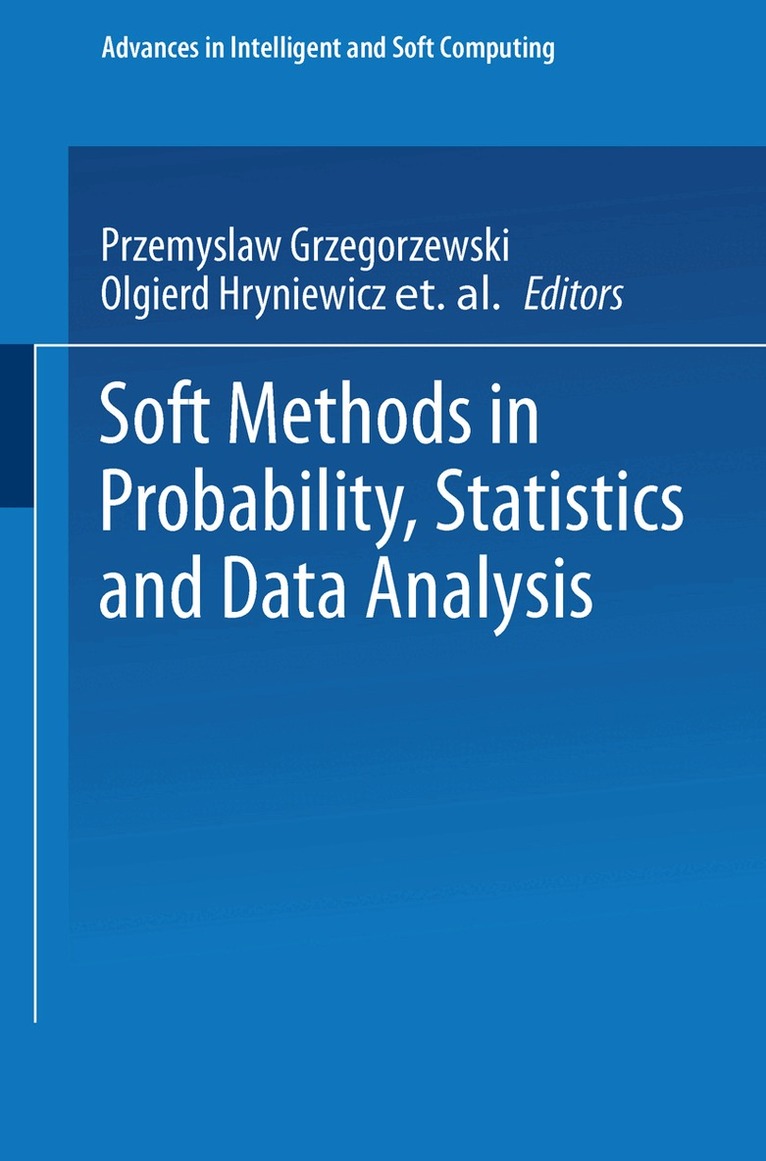
Soft Methods in Probability, Statistics and Data Analysis
Häftad, Engelska, 2002
544 kr
Skickas inom 10-15 vardagar
Classical probability theory and mathematical statistics appear sometimes too rigid for real life problems, especially while dealing with vague data or imprecise requirements. These problems have motivated many researchers to "soften" the classical theory. Some "softening" approaches utilize concepts and techniques developed in theories such as fuzzy sets theory, rough sets, possibility theory, theory of belief functions and imprecise probabilities, etc. Since interesting mathematical models and methods have been proposed in the frameworks of various theories, this text brings together experts representing different approaches used in soft probability, statistics and data analysis.
E-bok
PDF, Engelska, 2013687 kr
Läs direkt efter köp
Classical probability theory and mathematical statistics appear sometimes too rigid for real life problems, especially while dealing with vague data or imprecise requirements. These problems have motivated many researchers to "soften" the classical theory. Some "softening" approaches utilize concepts and techniques developed in theories such as fuzzy sets theory, rough sets, possibility theory, theory of belief functions and imprecise probabilities, etc. Since interesting mathematical models and methods have been proposed in the frameworks of various theories, this text brings together experts representing different approaches used in soft probability, statistics and data analysis.
E-bok
PDF, Engelska, 20121 379 kr
Läs direkt efter köp
"Statistical Modeling, Analysis and Management of Fuzzy Data," or SMFD for short, is an important contribution to a better understanding of a basic issue -an issue which has been controversial, and still is though to a lesser degree. In substance, the issue is: are fuzziness and randomness distinct or coextensive facets of uncertainty? Are the theories of fuzziness and random ness competitive or complementary? In SMFD, these and related issues are addressed with rigor, authority and insight by prominent contributors drawn, in the main, from probability theory, fuzzy set theory and data analysis com munities. First, a historical perspective. The almost simultaneous births -close to half a century ago-of statistically-based information theory and cybernetics were two major events which marked the beginning of the steep ascent of probability theory and statistics in visibility, influence and importance. I was a student when information theory and cybernetics were born, and what is etched in my memory are the fascinating lectures by Shannon and Wiener in which they sketched their visions of the coming era of machine intelligence and automation of reasoning and decision processes. What I heard in those lectures inspired one of my first papers (1950) "An Extension of Wiener''s Theory of Prediction," and led to my life-long interest in probability theory and its applications to information processing, decision analysis and control.
Del 87 - Studies in Fuzziness and Soft Computing
Statistical Modeling, Analysis and Management of Fuzzy Data
Häftad, Engelska, 2010
1 082 kr
Skickas inom 10-15 vardagar
"Statistical Modeling, Analysis and Management of Fuzzy Data," or SMFD for short, is an important contribution to a better understanding of a basic issue -an issue which has been controversial, and still is though to a lesser degree. In substance, the issue is: are fuzziness and randomness distinct or coextensive facets of uncertainty? Are the theories of fuzziness and random ness competitive or complementary? In SMFD, these and related issues are addressed with rigor, authority and insight by prominent contributors drawn, in the main, from probability theory, fuzzy set theory and data analysis com munities. First, a historical perspective. The almost simultaneous births -close to half a century ago-of statistically-based information theory and cybernetics were two major events which marked the beginning of the steep ascent of probability theory and statistics in visibility, influence and importance. I was a student when information theory and cybernetics were born, and what is etched in my memory are the fascinating lectures by Shannon and Wiener in which they sketched their visions of the coming era of machine intelligence and automation of reasoning and decision processes. What I heard in those lectures inspired one of my first papers (1950) "An Extension of Wiener's Theory of Prediction," and led to my life-long interest in probability theory and its applications to information processing, decision analysis and control.