Maria Blanton - Böcker
Visar alla böcker från författaren Maria Blanton. Handla med fri frakt och snabb leverans.
2 produkter
2 produkter
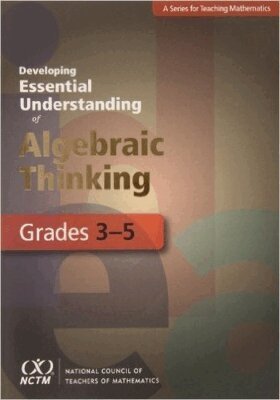
Developing Essential Understanding of Algebraic Thinking for Teaching Mathematics in Grades 3-5
Häftad, Engelska, 2011
239 kr
Skickas inom 11-20 vardagar
Like algebra at any level, early algebra is a way to explore, analyse, represent and generalise mathematical ideas and relationships. This book shows that children can and do engage in generalising about numbers and operations as their mathematical experiences expand. The authors identify and examine five big ideas and associated essential understandings for developing algebraic thinking in grades 3-5. The big ideas relate to the fundamental properties of number and operations, the use of the equals sign to represent equivalence, variables as efficient tools for representing mathematical ideas, quantitative reasoning as a way to understand mathematical relationships and functional thinking to generalise relationships between covarying quantities. The book examines challenges in teaching, learning and assessment and is interspersed with questions for teachers’ reflection.
336 kr
Skickas inom 7-10 vardagar
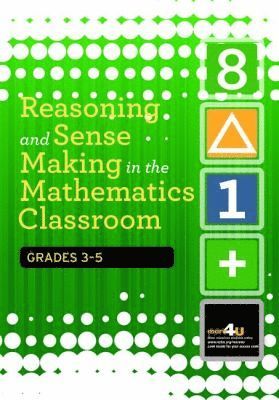
Based on extensive research conducted by the authors, Reasoning and Sense Making in the Mathematics Classroom, Grades 3–5, is designed to help classroom teachers understand, monitor, and guide the development of students’ reasoning and sense making about core ideas in elementary school mathematics. It describes and illustrates the nature of these skills using classroom vignettes and actual student work in conjunction with instructional tasks and learning progressions to show how reasoning and sense making develop and how instruction can support students in that development.Students who can make sense of mathematical ideas can apply those ideas in problem solving, even in unfamiliar situations, and can use them as a foundation for future learning. Without them, students are reduced to rote learning, often experiencing frustration and failure.But what do reasoning and sense making during learning and teaching look like?Each chapter of Reasoning and Sense Making in the Mathematics Classroom, Grades 3–5 explores a different topic that children encounter in mathematics, demonstrating with actual student work and classroom dialogue how their mathematical knowledge and reasoning ability move through “levels of sophistication” or learning progressions:After opening with a discussion of the nature of reasoning and sense making and their critical importance in developing mathematical thinking, chapter 1 examines how students attempt to make sense of the concept of length measurement.Chapter 2 focuses on student strategies that exemplify conceptually sound reasoning and sense making in the context of multiplication word problems, and discusses how instruction can support students’ growth in this reasoning. The critical topic of properties of numbers that underlie reasoning about multiplication is also examined.Chapter 3 describes how students in grades 3–5 extend their understanding of number to include fractions and how they can build reasoning and sense making for fractions through explorations of different representations such as physical materials, pictures, and story contexts.Discussions on the nature of early algebraic reasoning, including research-based descriptions of this reasoning in children, classroom practices that can support this reasoning, and how algebra can be appropriately integrated in elementary mathematical content are provided in chapter 4.Chapter 5 discusses practices and processes connected to reasoning about geometric decomposition and structuring as applied to arrays of squares and cubes and to area and volume problems. A learning progression for the development of such reasoning is examined, and instructional practices that are consistent with this learning progression are considered.Not just a theoretical discussion,the book also provides specific suggestions for related instructional activities for each topic. Reasoning and Sense Making in the Mathematics Classroom, Grades 3–5 will be a valuable and practical addition to your professional library.