Maria Isabel González Vasco – författare
Visar alla böcker från författaren Maria Isabel González Vasco. Handla med fri frakt och snabb leverans.
5 produkter
5 produkter
Häftad, Engelska, 2024
1 031 kr
Skickas inom 10-15 vardagar
Group theoretic problems have propelled scientific achievements across a wide range of fields, including mathematics, physics, chemistry, and the life sciences. Many cryptographic constructions exploit the computational hardness of group theoretical problems, and the area is viewed as a potential source of quantum-resilient cryptographic primitives for the future. Group Theoretic Cryptography supplies an ideal introduction to cryptography for those who are interested in group theory and want to learn about the possible interplays between the two fields. Assuming an undergraduate-level understanding of linear algebra and discrete mathematics, it details the specifics of using non-Abelian groups in the field of cryptography. Moreover, the book evidences how group theoretic techniques help us gain new insight into well known, seemingly unrelated, cryptographic constructions, such as DES. The book starts with brief overviews of the fundamentals of group theory, complexity theory, and cryptography. Part two is devoted to public-key encryption, including provable security guarantees, public-key encryption in the standard model, and public-key encryption using infinite groups. The third part of the book covers secret-key encryption. It examines block ciphers, like the Advanced Encryption Standard, and cryptographic hash functions and message authentication codes. The last part delves into a number of cryptographic applications which are nowadays as relevant as encryption—identification protocols, key establishment, and signature schemes are covered.The book supplies formal security analyses and highlights potential vulnerabilities for cryptographic constructions involving group theory. Summaries and references for further reading, as well as exercises, are included at the end of each chapter. Selected solutions for exercises are provided in the back of the book.
E-bok
Engelska, 20151 184 kr
Läs direkt efter köp
Group theory appears to be a promising source of hard computational problems for deploying new cryptographic constructions. This reference focuses on the specifics of using groups, including in particular non-Abelian groups, in the field of cryptography. It provides an introduction to cryptography with emphasis on the group theoretic perspective, making it one of the first books to use this approach. The authors provide the needed cryptographic and group theoretic concepts, full proofs of essential theorems, and formal security evaluations of the cryptographic schemes presented. They also provide references for further reading and exercises at the end of each chapter.
Inbunden, Engelska, 2015
1 742 kr
Skickas inom 10-15 vardagar
Group theoretic problems have propelled scientific achievements across a wide range of fields, including mathematics, physics, chemistry, and the life sciences. Many cryptographic constructions exploit the computational hardness of group theoretical problems, and the area is viewed as a potential source of quantum-resilient cryptographic primitives for the future. Group Theoretic Cryptography supplies an ideal introduction to cryptography for those who are interested in group theory and want to learn about the possible interplays between the two fields. Assuming an undergraduate-level understanding of linear algebra and discrete mathematics, it details the specifics of using non-Abelian groups in the field of cryptography. Moreover, the book evidences how group theoretic techniques help us gain new insight into well known, seemingly unrelated, cryptographic constructions, such as DES. The book starts with brief overviews of the fundamentals of group theory, complexity theory, and cryptography. Part two is devoted to public-key encryption, including provable security guarantees, public-key encryption in the standard model, and public-key encryption using infinite groups. The third part of the book covers secret-key encryption. It examines block ciphers, like the Advanced Encryption Standard, and cryptographic hash functions and message authentication codes. The last part delves into a number of cryptographic applications which are nowadays as relevant as encryption—identification protocols, key establishment, and signature schemes are covered.The book supplies formal security analyses and highlights potential vulnerabilities for cryptographic constructions involving group theory. Summaries and references for further reading, as well as exercises, are included at the end of each chapter. Selected solutions for exercises are provided in the back of the book.
E-bok
PDF, Engelska, 20151 184 kr
Läs direkt efter köp
Group theory appears to be a promising source of hard computational problems for deploying new cryptographic constructions. This reference focuses on the specifics of using groups, including in particular non-Abelian groups, in the field of cryptography. It provides an introduction to cryptography with emphasis on the group theoretic perspective, making it one of the first books to use this approach. The authors provide the needed cryptographic and group theoretic concepts, full proofs of essential theorems, and formal security evaluations of the cryptographic schemes presented. They also provide references for further reading and exercises at the end of each chapter.
E-bok
PDF, Spanska, 2022113 kr
Läs direkt efter köp
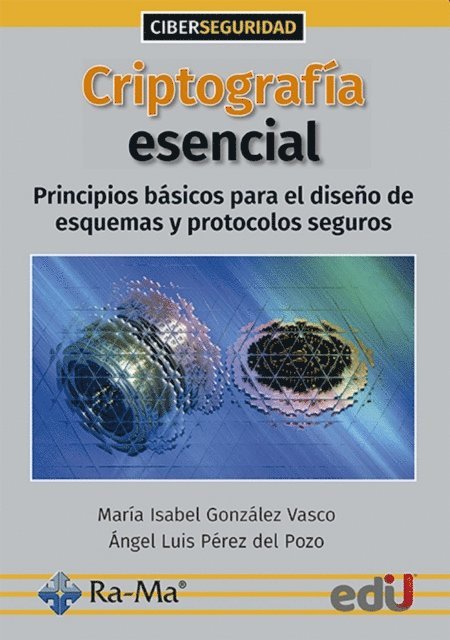
El objetivo de esta obra es explicar de manera sencilla, amena y didáctica las nociones básicas de la Criptografía moderna. Partiendo de las nociones elementales de matemáticas y teoría de complejidad imprescindibles se introduce al lector en el fascinante mundo de la Criptografía, presentándole los paradigmas de clave pública y secreta, numerosos ejemplos de construcciones clásicas y protocolos avanzados, así como técnicas de ataque y validación formal actuales.Todos los capítulos incluyen test de autoevaluación, así como una breve lista de referencias actualizadas donde pueden ampliarse los conocimientos adquiridos. Perseguimos pues con este libro distintas metas:- Familiarizar al lector con la terminología y nociones fundamentales que se utilizan en Criptografía moderna.- Presentar los paradigmas de Criptografía simétrica y asimétrica.- Exponer las nociones elementales de seguridad demostrable, de modo que el lector pueda comprender demostraciones matemáticas sencillas de seguridad y entienda las implicaciones prácticas de los teoremas.- Permitir al lector asomarse al fascinante mundo de los protocolos criptográficos, ver distintos ejemplos de diseños adaptados a aplicaciones actuales en los que la Criptografía juega un papel esencial.