
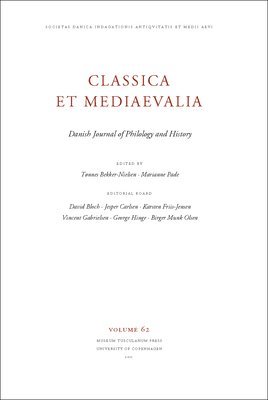
Classica et Mediaevalia encourages scholarly contributions within the fields of Greek and Latin languages and literature up to, and including, the late Middle Ages as well as Graeco-Roman history and the classical influence in general history, legal history, the history of philosophy and ecclesiastical history. Classica et Mediaevalia, which is ranked as a category A journal by the European Research Index for the Humanities (ERIH) and top-ranked in the Danish and Norwegian bibliometric systems, encourages scholarly contributions within its fields.
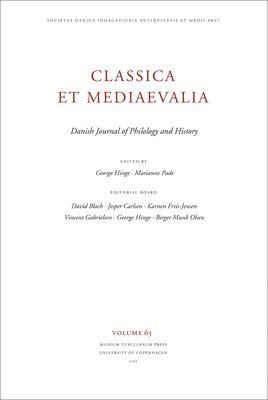
Classica et Mediaevalia is an international, peer reviewed journal covering the field of the Greek and Latin languages and literature from classical antiquity until the late Middle Ages as well as the Greco-Roman history and traditions as manifested in the general history, history of law, history of philosophy and ecclesiastic history. Articles are published mainly in English, but also in French and German. The present issue includes chapters on divination as a convention of war in Classical Greece; pornographic allusions in Catullus; Sophistic oratory and styles in Roman Asia Minor; suspense and surprise in Achilles Tatius's Leucippe and Clitophon; narrative time and mythological tale-types focusing on Beowulf and Odysseus; and Petrarch's reading of Cicero's letters, among others.
Classica et Mediaevalia encourages scholarly contributions within the fields of Greek and Latin languages and literature up to, and including, the late Middle Ages as well as Graeco-Roman history and the classical influence in general history, legal history, the history of philosophy and ecclesiastical history. Classica et Mediaevalia, which is ranked as a category A journal by the European Research Index for the Humanities (ERIH) and top-ranked in the Danish and Norwegian bibliometric systems, encourages scholarly contributions within its fields.
Classica et Mediaevalia is an international, peer reviewed journal covering the field of the Greek and Latin languages and literature from classical antiquity until the late Middle Ages as well as the Greco-Roman history and traditions as manifested in the general history, history of law, history of philosophy and ecclesiastic history. Articles are published mainly in English, but also in French and German. The present issue includes chapters on divination as a convention of war in Classical Greece; pornographic allusions in Catullus; Sophistic oratory and styles in Roman Asia Minor; suspense and surprise in Achilles Tatius's Leucippe and Clitophon; narrative time and mythological tale-types focusing on Beowulf and Odysseus; and Petrarch's reading of Cicero's letters, among others.