Marie Jahoda – författare
Visar alla böcker från författaren Marie Jahoda. Handla med fri frakt och snabb leverans.
10 produkter
De arbetslösa i Marienthal
Av Marie Jahoda, Paul F. Lazarsfeld m. fl.
Häftad, 2014
219 kr
Lägg i varukorg
När textilfabriken i den lilla orten Marienthal i Österrike slog igen i spåren av den stora depressionen blev följderna förödande: ett helt samhälle kastades ut i arbetslöshet. Hur skulle befolkningen reagera? Skulle de resa sig i protest som många av samtidens radikala intellektuella trodde och …
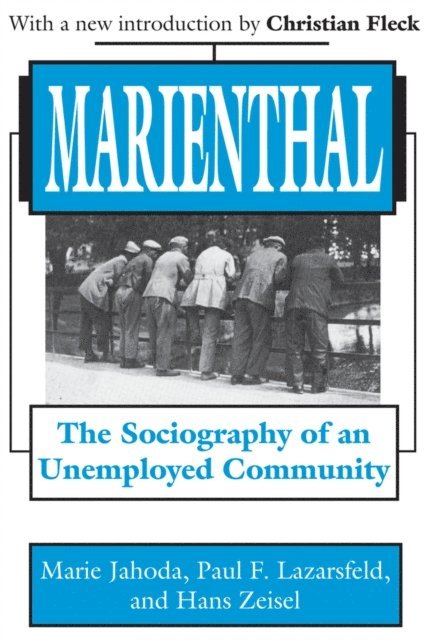
Marienthal
The Sociography of an Unemployed Community
Av Marie Jahoda, Paul F. Lazarsfeld m. fl.
Häftad, 2002
750 kr
Lägg i varukorg
"One of the main theses of the Marienthal study was that prolonged unemployment leads to a state of apathy in which the victims do not utilize any longer even the few opportunities left to them. The vicious cycle between reduced opportunities and reduced level of aspiration has remained the focus …
Employment and Unemployment
A Social-Psychological Analysis
Av Marie Jahoda
Häftad, 1982
455 kr
Lägg i varukorg
This book was first published in 1982. Unemployment is perhaps one of the most serious social problems. In economic terms the cost of unemployment, both to the individual and to the collective, is extremely high. But unemployment has other effects too. In this book Marie Jahoda looks beyond the …
Marienthal
The Sociography of an Unemployed Community
Av Marie Jahoda, Paul F. Lazarsfeld m. fl.
Inbunden, 2017
2750 kr
Lägg i varukorg
"One of the main theses of the Marienthal study was that prolonged unemployment leads to a state of apathy in which the victims do not utilize any longer even the few opportunities left to them. The vicious cycle between reduced opportunities and reduced level of aspiration has remained the focus …
Marienthal
The Sociography of an Unemployed Community
Av Hans Zeisel, Paul F. Lazarsfeld m. fl.
E-bok, 2017
883 kr
Lägg i varukorg
"One of the main theses of the Marienthal study was that prolonged unemployment leads to a state of apathy in which the victims do not utilize any longer even the few opportunities left to them. The vicious cycle between reduced opportunities and reduced level of aspiration has remained the focus …
Marienthal
The Sociography of an Unemployed Community
Av Hans Zeisel, Paul F. Lazarsfeld m. fl.
E-bok, 2017
883 kr
Lägg i varukorg
"One of the main theses of the Marienthal study was that prolonged unemployment leads to a state of apathy in which the victims do not utilize any longer even the few opportunities left to them. The vicious cycle between reduced opportunities and reduced level of aspiration has remained the focus …
Die Arbeitslosen von Marienthal
Av Marie Jahoda, Paul F. Lazarsfeld m. fl.
Häftad
173 kr
Lägg i varukorg
Lebensgeschichtliche Protokolle der arbeitenden Klassen 1850-1930
Dissertation 1932
Av Marie Jahoda, Meinrad Ziegler m. fl.
E-bok, 2017
249 kr
Lägg i varukorg
Die Publikation enthält die unveröffentlichte Dissertation der österreichischen Sozialforscherin und Sozialpsychologin Marie Jahoda (1907-2001) aus dem Jahr 1932 mit 52 Protokollen über lebensgeschichtliche Interviews mit Frauen und Männern, die um 1850 geboren sind. Damit wird erstmals eine …
Marie Jahoda: Arbeitslose bei der Arbeit & Aufsätze und Essays
Zwei Bände im Schuber
Av Marie Jahoda, Meinrad Ziegler m. fl.
E-bok, 2019
453 kr
Lägg i varukorg
MARIE JAHODA (1907–2001), in Wien geborene Sozialforscherin, wurde vor allem als Koautorin der Studie "DIE ARBEITSLOSEN VON MARIENTHAL" bekannt. Nach ihrer Ausbürgerung aus Österreich im Jahr 1937 wirkte sie in New York, London und Sussex, wo sie 1973 als Professor of Social Psychology emeritierte. …