Marino Zennaro - Böcker
Visar alla böcker från författaren Marino Zennaro. Handla med fri frakt och snabb leverans.
3 produkter
3 produkter
2 454 kr
Skickas inom 5-8 vardagar
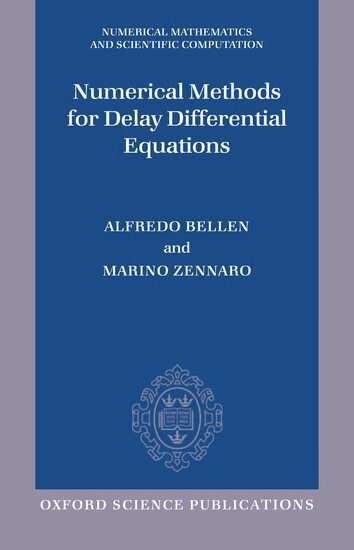
The main purpose of the book is to introduce the readers to the numerical integration of the Cauchy problem for delay differential equations (DDEs). Peculiarities and differences that DDEs exhibit with respect to ordinary differential equations are preliminarily outlined by numerous examples illustrating some unexpected, and often surprising, behaviours of the analytical and numerical solutions. The effect of various kinds of delays on the regularity of the solution is described and some essential existence and uniqueness results are reported. The book is centered on the use of Runge-Kutta methods continuously extended by polynomial interpolation, includes a brief review of the various approaches existing in the literature, and develops an exhaustive error and well-posedness analysis for the general classes of one-step and multistep methods. The book presents a comprehensive development of continuous extensions of Runge-Kutta methods which are of interest also in the numerical treatment of more general problems such as dense output, discontinuous equations, etc. Some deeper insight into convergence and superconvergence of continuous Runge-Kutta methods is carried out for DDEs with various kinds of delays. The stepsize control mechanism is also developed on a firm mathematical basis relying on the discrete and continuous local error estimates. Classical results and a unconventional analysis of "stability with respect to forcing term" is reviewed for ordinary differential equations in view of the subsequent numerical stability analysis. Moreover, an exhaustive description of stability domains for some test DDEs is carried out and the corresponding stability requirements for the numerical methods are assessed and investigated. Alternative approaches, based on suitable formulation of DEs as partial differential equations and subsequent semidiscretization are briefly described and compared with the classical approach. A list of available codes is provided, and illustrative examples, pseudo-codes and numerical experiments are included throughout the book.Series Editors: G. H. Golub (Stanford University)C. Schwab (ETH Zurich)W. A. Light (University of Leicester)E. Süli (University of Oxford)Recent developments in the field of numerical analysis have radically changed the nature of the subject. Firstly, the increasing power and availability of computer workstations has allowed the widespread feasibility of complex numerical computations, and the demands of mathematical modelling are expanding at a corresponding rate. In addition to this, the mathematical theory of numerical mathematics itself is growing in sophistication, and numerical analysis now generates research into relatively abstract mathematics.Oxford University Press has had an established series Monographs in Numerical Analysis, including Wilkinson's celebrated treatise The Algebraic Eigenvalue Problem. In the face of the developments in the field this has been relaunched as the Numerical Mathematics and Scientific Computation series. As its name suggests, the series will now aim to cover the broad subject area concerned with theoretical and computational aspects of modern numerical mathematics.
1 000 kr
Skickas inom 7-10 vardagar
The main purpose of the book is to introduce the readers to the numerical integration of the Cauchy problem for delay differential equations (DDEs). Peculiarities and differences that DDEs exhibit with respect to ordinary differential equations are preliminarily outlined by numerous examples illustrating some unexpected, and often surprising, behaviours of the analytical and numerical solutions. The effect of various kinds of delays on the regularity of the solution is described and some essential existence and uniqueness results are reported. The book is centered on the use of Runge-Kutta methods continuously extended by polynomial interpolation, includes a brief review of the various approaches existing in the literature, and develops an exhaustive error and well-posedness analysis for the general classes of one-step and multistep methods. The book presents a comprehensive development of continuous extensions of Runge-Kutta methods which are of interest also in the numerical treatment of more general problems such as dense output, discontinuous equations, etc. Some deeper insight into convergence and superconvergence of continuous Runge-Kutta methods is carried out for DDEs with various kinds of delays. The stepsize control mechanism is also developed on a firm mathematical basis relying on the discrete and continuous local error estimates. Classical results and a unconventional analysis of "stability with respect to forcing term" is reviewed for ordinary differential equations in view of the subsequent numerical stability analysis. Moreover, an exhaustive description of stability domains for some test DDEs is carried out and the corresponding stability requirements for the numerical methods are assessed and investigated. Alternative approaches, based on suitable formulation of DDEs as partial differential equations and subsequent semidiscretization are briefly described and compared with the classical approach. A list of available codes is provided, and illustrative examples, pseudo-codes and numerical experiments are included throughout the book.
Del 2082 - Lecture Notes in Mathematics
Current Challenges in Stability Issues for Numerical Differential Equations
Cetraro, Italy 2011, Editors: Luca Dieci, Nicola Guglielmi
Häftad, Engelska, 2013
483 kr
Skickas inom 10-15 vardagar
This volume addresses some of the research areas in the general field of stability studies for differential equations, with emphasis on issues of concern for numerical studies. Topics considered include: (i) the long time integration of Hamiltonian Ordinary DEs and highly oscillatory systems, (ii) connection between stochastic DEs and geometric integration using the Markov chain Monte Carlo method, (iii) computation of dynamic patterns in evolutionary partial DEs, (iv) decomposition of matrices depending on parameters and localization of singularities, and (v) uniform stability analysis for time dependent linear initial value problems of ODEs. The problems considered in this volume are of interest to people working on numerical as well as qualitative aspects of differential equations, and it will serve both as a reference and as an entry point into further research.