Mario Bunge – författare
742 kr
Skickas inom 10-15 vardagar
959 kr
Skickas inom 5-8 vardagar
742 kr
Skickas inom 10-15 vardagar
770 kr
Skickas inom 10-15 vardagar
742 kr
Skickas inom 10-15 vardagar
700 kr
Skickas inom 10-15 vardagar
2 410 kr
Skickas inom 10-15 vardagar
2 198 kr
Skickas inom 10-15 vardagar
2 664 kr
Skickas inom 10-15 vardagar
2 438 kr
Skickas inom 10-15 vardagar
874 kr
Läs direkt efter köp
This collection of essays, written on four continents by scientists, philosophers and humanists, was initially presented to Karl R. Popper on his sixtieth birthday as a token of critical admiration and in recognition of his work. But the volume also stands on its own as a remarkable series of statements utilizing Popper''s critical vision in the study of philosophy proper, logic, mathematics, science as method and theory, and finally to the study of society and history. What is remarkable is that Popper worked in all of these areas, not in a cursory or discursive way, but with the utmost clarity and rigor.
. The core position of this volume and its contributors is that the progress of knowledge is not a linear accumulation of definitive acquisitions but a zigzagging process in which counterexamples and unfavorable evidence ruin generalizations and prompt the invention of more comprehensive and sometimes deeper generalizations, to be criticized in their turn. A critical approach to problems, procedures, and results in every field of inquiry is therefore a necessary condition for the continuance of progress.
The title of this volume then is, in a sense, an homage to Popper''s critical rationalism and critical empiricism. The essays are a tribute to his unceasing and uncompromising quest, not for final certainty, but for closer truth and increased clarity. Among the contributors are outstanding figures in philosophy and the exact sciences in their own right, including Herbert Feigl, R. M. Hare, J.O. Wisdom, Nicholas Rescher, David Bohm, Paul K. Feyerabend, F. A. Hayek, and Adolf Grunbaum. Social science contributions include Hans Albert on social science and moral philosophy, W. B. Gallie, on the critical philosophy of history, Pieter Geyl on The Open Society and its Enemies, and George H. Nadel on the philosophy of History.
874 kr
Läs direkt efter köp
This collection of essays, written on four continents by scientists, philosophers and humanists, was initially presented to Karl R. Popper on his sixtieth birthday as a token of critical admiration and in recognition of his work. But the volume also stands on its own as a remarkable series of statements utilizing Popper''s critical vision in the study of philosophy proper, logic, mathematics, science as method and theory, and finally to the study of society and history. What is remarkable is that Popper worked in all of these areas, not in a cursory or discursive way, but with the utmost clarity and rigor.
. The core position of this volume and its contributors is that the progress of knowledge is not a linear accumulation of definitive acquisitions but a zigzagging process in which counterexamples and unfavorable evidence ruin generalizations and prompt the invention of more comprehensive and sometimes deeper generalizations, to be criticized in their turn. A critical approach to problems, procedures, and results in every field of inquiry is therefore a necessary condition for the continuance of progress.
The title of this volume then is, in a sense, an homage to Popper''s critical rationalism and critical empiricism. The essays are a tribute to his unceasing and uncompromising quest, not for final certainty, but for closer truth and increased clarity. Among the contributors are outstanding figures in philosophy and the exact sciences in their own right, including Herbert Feigl, R. M. Hare, J.O. Wisdom, Nicholas Rescher, David Bohm, Paul K. Feyerabend, F. A. Hayek, and Adolf Grunbaum. Social science contributions include Hans Albert on social science and moral philosophy, W. B. Gallie, on the critical philosophy of history, Pieter Geyl on The Open Society and its Enemies, and George H. Nadel on the philosophy of History.
858 kr
Läs direkt efter köp
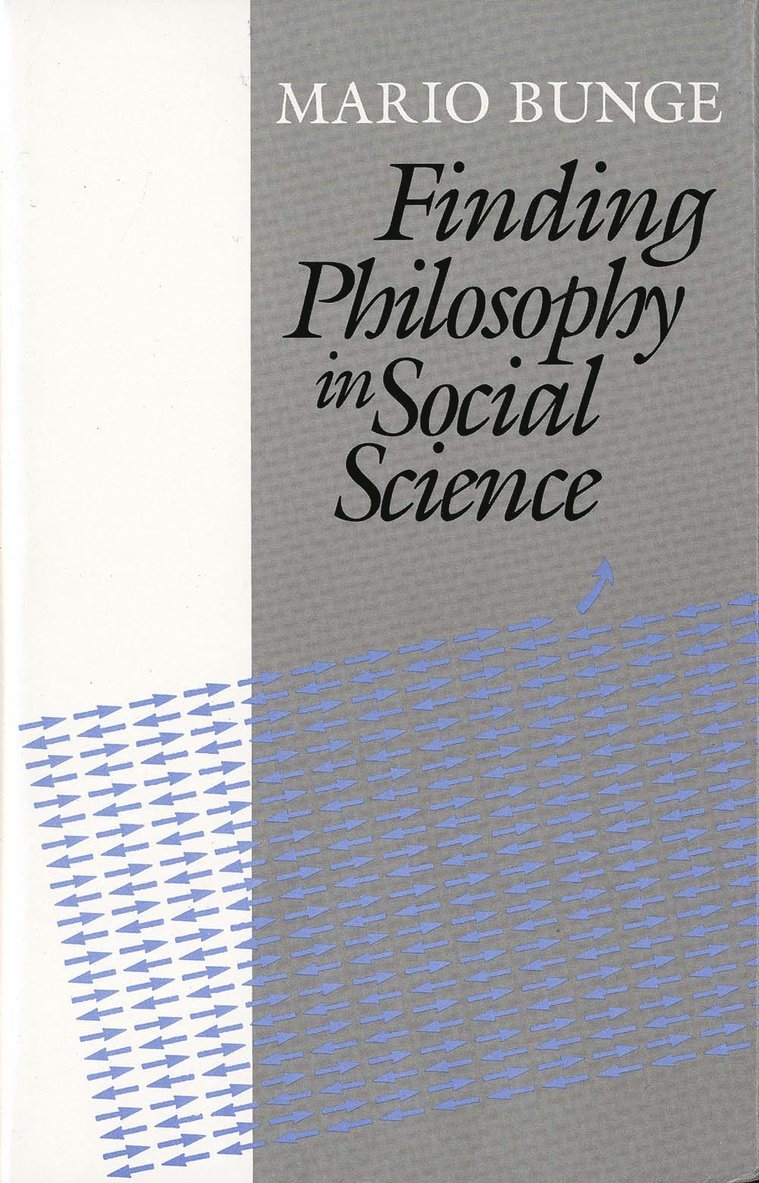
Most social scientists and philosophers claim that sociology and philosophy are disjoint fields of inquiry. Some have wondered how to trace the precise boundary between them. Mario Bunge argues that the two fields are so entangled with one another that no demarcation is possible or, indeed, desirable. In fact, sociological research has demonstrably philosophical pre-suppositions. In turn, some findings of sociology are bound to correct or enrich the philosophical theories that deal with the world, our knowledge of it, or the ways of acting upon it.
While Bunge''s thesis would hardly have shocked Mill, Marx, Durkheim, or Weber, it is alien to the current sociological mainstream and dominant philosophical schools. Bunge demonstrates that philosophical problematics arise in social science research. A fertile philosophy of social science unearths critical presuppositions, analyzes key concepts, refines effective research strategies, crafts coherent and realistic syntheses, and identifies important new problems.
Bunge examines Marx''s and Durkheim''s thesis that social facts are as objective as physical facts; the so-called Thomas theorem that refutes the behaviorist thesis that social agents react to social stimuli rather than to the way we perceive them; and Merton''s thesis on the ethos of basic science which shows that science and morality are intertwined. He considers selected philosophical problems raised by contemporary social studies and argues forcefully against tolerance of shabby work in academic social science and philosophy alike.
858 kr
Läs direkt efter köp
Most social scientists and philosophers claim that sociology and philosophy are disjoint fields of inquiry. Some have wondered how to trace the precise boundary between them. Mario Bunge argues that the two fields are so entangled with one another that no demarcation is possible or, indeed, desirable. In fact, sociological research has demonstrably philosophical pre-suppositions. In turn, some findings of sociology are bound to correct or enrich the philosophical theories that deal with the world, our knowledge of it, or the ways of acting upon it.
While Bunge''s thesis would hardly have shocked Mill, Marx, Durkheim, or Weber, it is alien to the current sociological mainstream and dominant philosophical schools. Bunge demonstrates that philosophical problematics arise in social science research. A fertile philosophy of social science unearths critical presuppositions, analyzes key concepts, refines effective research strategies, crafts coherent and realistic syntheses, and identifies important new problems.
Bunge examines Marx''s and Durkheim''s thesis that social facts are as objective as physical facts; the so-called Thomas theorem that refutes the behaviorist thesis that social agents react to social stimuli rather than to the way we perceive them; and Merton''s thesis on the ethos of basic science which shows that science and morality are intertwined. He considers selected philosophical problems raised by contemporary social studies and argues forcefully against tolerance of shabby work in academic social science and philosophy alike.
874 kr
Läs direkt efter köp
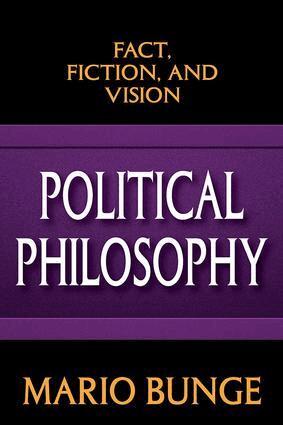
Political philosophy is not a well-defined field. It hovers between political theory and classical philosophy. Few early political thinkers could have anticipated the most pressing political issues of our time: the need to stop global warming; the reduction of nuclear armaments; the rise of inequality between individuals and nations; and the struggle against authoritarianism, particularly when it comes disguised as democracy or as socialism. Here, celebrated philosopher Mario Bunge masterfully integrates socio-political theory into a philosophical exploration of power and resource distribution in the world today.
Bunge contends that even recent political thinkers have generally failed to address the political underpinnings of topical issues. Environmental degradation, gender and race discriminations, participative democracy, nationalism, imperialism, the North-South divide, resource wars, and the industrial-military complex have all largely been bypassed in political thinking. Even connections between poverty and environmental degradation, and between inequality and bad health, have escaped the attention of those who would call themselves political thinkers.
Bunge believes that political philosophers should pay more attention to social indicators, such as the standard index of income inequality and the United Nations human development index. It is pointless to write about redistributive policies unless we have a shared understanding of current wealth distribution. This is, in short, a modern treatise on sociopolitical concerns.
874 kr
Läs direkt efter köp
Political philosophy is not a well-defined field. It hovers between political theory and classical philosophy. Few early political thinkers could have anticipated the most pressing political issues of our time: the need to stop global warming; the reduction of nuclear armaments; the rise of inequality between individuals and nations; and the struggle against authoritarianism, particularly when it comes disguised as democracy or as socialism. Here, celebrated philosopher Mario Bunge masterfully integrates socio-political theory into a philosophical exploration of power and resource distribution in the world today.
Bunge contends that even recent political thinkers have generally failed to address the political underpinnings of topical issues. Environmental degradation, gender and race discriminations, participative democracy, nationalism, imperialism, the North-South divide, resource wars, and the industrial-military complex have all largely been bypassed in political thinking. Even connections between poverty and environmental degradation, and between inequality and bad health, have escaped the attention of those who would call themselves political thinkers.
Bunge believes that political philosophers should pay more attention to social indicators, such as the standard index of income inequality and the United Nations human development index. It is pointless to write about redistributive policies unless we have a shared understanding of current wealth distribution. This is, in short, a modern treatise on sociopolitical concerns.
858 kr
Läs direkt efter köp
858 kr
Läs direkt efter köp
874 kr
Läs direkt efter köp
Originally published as Scientific Research, this pair of volumes constitutes a fundamental treatise on the strategy of science. Mario Bunge, one of the major figures of the century in the development of a scientific epistemology, describes and analyzes scientific philosophy, as well as discloses its philosophical presuppositions. This work may be used as a map to identify the various stages in the road to scientific knowledge.
Philosophy of Science is divided into two volumes, each with two parts. Part 1 offers a preview of the scheme of science and the logical and semantical took that will be used throughout the work. The account of scientific research begins with part 2, where Bunge discusses formulating the problem to be solved, hypothesis, scientific law, and theory.
The second volume opens with part 3, which deals with the application of theories to explanation, prediction, and action. This section is graced by an outstanding discussion of the philosophy of technology. Part 4 begins with measurement and experiment. It then examines risks in jumping to conclusions from data to hypotheses as well as the converse procedure.
Bunge begins this mammoth work with a section entitled "How to Use This Book." He writes that it is intended for both independent reading and reference as well as for use in courses on scientific method and the philosophy of science. It suits a variety of purposes from introductory to advanced levels. Philosophy of Science is a versatile, informative, and useful text that will benefit professors, researchers, and students in a variety of disciplines, ranging from the behavioral and biological sciences to the physical sciences.
874 kr
Läs direkt efter köp
Originally published as Scientific Research, this pair of volumes constitutes a fundamental treatise on the strategy of science. Mario Bunge, one of the major figures of the century in the development of a scientific epistemology, describes and analyzes scientific philosophy, as well as discloses its philosophical presuppositions. This work may be used as a map to identify the various stages in the road to scientific knowledge.
Philosophy of Science is divided into two volumes, each with two parts. Part 1 offers a preview of the scheme of science and the logical and semantical took that will be used throughout the work. The account of scientific research begins with part 2, where Bunge discusses formulating the problem to be solved, hypothesis, scientific law, and theory.
The second volume opens with part 3, which deals with the application of theories to explanation, prediction, and action. This section is graced by an outstanding discussion of the philosophy of technology. Part 4 begins with measurement and experiment. It then examines risks in jumping to conclusions from data to hypotheses as well as the converse procedure.
Bunge begins this mammoth work with a section entitled "How to Use This Book." He writes that it is intended for both independent reading and reference as well as for use in courses on scientific method and the philosophy of science. It suits a variety of purposes from introductory to advanced levels. Philosophy of Science is a versatile, informative, and useful text that will benefit professors, researchers, and students in a variety of disciplines, ranging from the behavioral and biological sciences to the physical sciences.
925 kr
Läs direkt efter köp
925 kr
Läs direkt efter köp
824 kr
Läs direkt efter köp
Increasingly, the religious leaders of the world are addressing problems of political economy, expressing concern about the poor. But will their efforts actually help the poor? Or harm them? Much depends, Michael Novak asserts, upon what kind of institutions are constructed, that is, upon realism and practicality.
His thesis may be simply stated: Although the Catholic Church during the nineteenth and early twentieth centuries set itself against liberalism as an ideology, it has slowly come to admire liberal institutions such as democracy and free markets. Between the Catholic vision of social justice and liberal institutions, Novak argues, there is a profound consonance (but not identity). Both celebrate realism, respect for institutions, and prudence or practical wisdom. The Catholic tradition adds to liberal individualism a strong communitarian sense.
This book was first published in 1984 as Freedom with Justice. This new edition adds both a lengthy introduction carrying forward the original argument and a long concluding chapter on Pope John Paul IPs controversial new encyclical of early 1988, Sollicitudo Rei Socialis.
795 kr
Läs direkt efter köp
Increasingly, the religious leaders of the world are addressing problems of political economy, expressing concern about the poor. But will their efforts actually help the poor? Or harm them? Much depends, Michael Novak asserts, upon what kind of institutions are constructed, that is, upon realism and practicality.
His thesis may be simply stated: Although the Catholic Church during the nineteenth and early twentieth centuries set itself against liberalism as an ideology, it has slowly come to admire liberal institutions such as democracy and free markets. Between the Catholic vision of social justice and liberal institutions, Novak argues, there is a profound consonance (but not identity). Both celebrate realism, respect for institutions, and prudence or practical wisdom. The Catholic tradition adds to liberal individualism a strong communitarian sense.
This book was first published in 1984 as Freedom with Justice. This new edition adds both a lengthy introduction carrying forward the original argument and a long concluding chapter on Pope John Paul IPs controversial new encyclical of early 1988, Sollicitudo Rei Socialis.
2 198 kr
Skickas inom 10-15 vardagar
728 kr
Skickas inom 10-15 vardagar
617 kr
Läs direkt efter köp
460 kr
Skickas inom 5-8 vardagar
834 kr
Skickas inom 3-6 vardagar
523 kr
Läs direkt efter köp