Mark A. Giembycz – författare
Visar alla böcker från författaren Mark A. Giembycz. Handla med fri frakt och snabb leverans.
19 produkter
Airways Smooth Muscle: Peptide Receptors, Ion Channels and Signal Transduction
Av Mark A. Giembycz, David Raeburn
E-bok, 2012
732 kr
Lägg i varukorg
Airways Smooth Muscle: Peptide Receptors, Ion Channels and Signal Transduction
Av David Raeburn, Mark A. Giembycz
Häftad, 2012
567 kr
Lägg i varukorg
Airways Smooth Muscle: Development, and Regulation of Contractility
Development and Regulation of Contractility
Av Mark A. Giembycz, David Raeburn
E-bok, 2013
1502 kr
Lägg i varukorg
Most studies on autonomic innervation of smooth muscle have focused on the short-term mechanisms involved in neurotransmission in physiological and pathophysiological conditions. However recent obser vations of the long-term plasticity of this system, i. e. its capacity for regeneration and for …
Airways Smooth Muscle: Development, and Regulation of Contractility
Development and Regulation of Contractility
Av David Raeburn, Mark A. Giembycz
Häftad, 2012
1127 kr
Lägg i varukorg
Most studies on autonomic innervation of smooth muscle have focused on the short-term mechanisms involved in neurotransmission in physiological and pathophysiological conditions. However recent obser vations of the long-term plasticity of this system, i. e. its capacity for regeneration and for …
Airways Smooth Muscle: Neurotransmitters, Amines, Lipid Mediators and Signal Transduction
Av Mark A. Giembycz, David Raeburn
E-bok, 2012
739 kr
Lägg i varukorg
Airways Smooth Muscle: Neurotransmitters, Amines, Lipid Mediators and Signal Transduction
Av David Raeburn, Mark A. Giembycz
Häftad, 2012
567 kr
Lägg i varukorg
Airways Smooth Muscle
Structure, Innervation and Neurotransmission
Av Mark A. Giembycz, David Raeburn
E-bok, 2013
1502 kr
Lägg i varukorg
Many factors may influence the release of neurotransmitters from airway nerves [1]. This is likely to be important in physiological control of airway functions and may be particularly relevant in airway diseases, such as asthma and chronic obstructive pulmonary disease (COPD). Neural elements in …
Airways Smooth Muscle
Structure, Innervation and Neurotransmission
Av David Raeburn, Mark A. Giembycz
Häftad, 2012
1127 kr
Lägg i varukorg
Many factors may influence the release of neurotransmitters from airway nerves [1]. This is likely to be important in physiological control of airway functions and may be particularly relevant in airway diseases, such as asthma and chronic obstructive pulmonary disease (COPD). Neural elements in …
Airways Smooth Muscle: Biochemical Control of Contraction and Relaxation
Av Mark A. Giembycz, David Raeburn
E-bok, 2013
1502 kr
Lägg i varukorg
Airways Smooth Muscle: Biochemical Control of Contraction and Relaxation
Av David Raeburn, Mark A. Giembycz
2014
672 kr
Lägg i varukorg
Airways Smooth Muscle: Biochemical Control of Contraction and Relaxation
Av David Raeburn, Mark A. Giembycz
Häftad, 2012
1127 kr
Lägg i varukorg
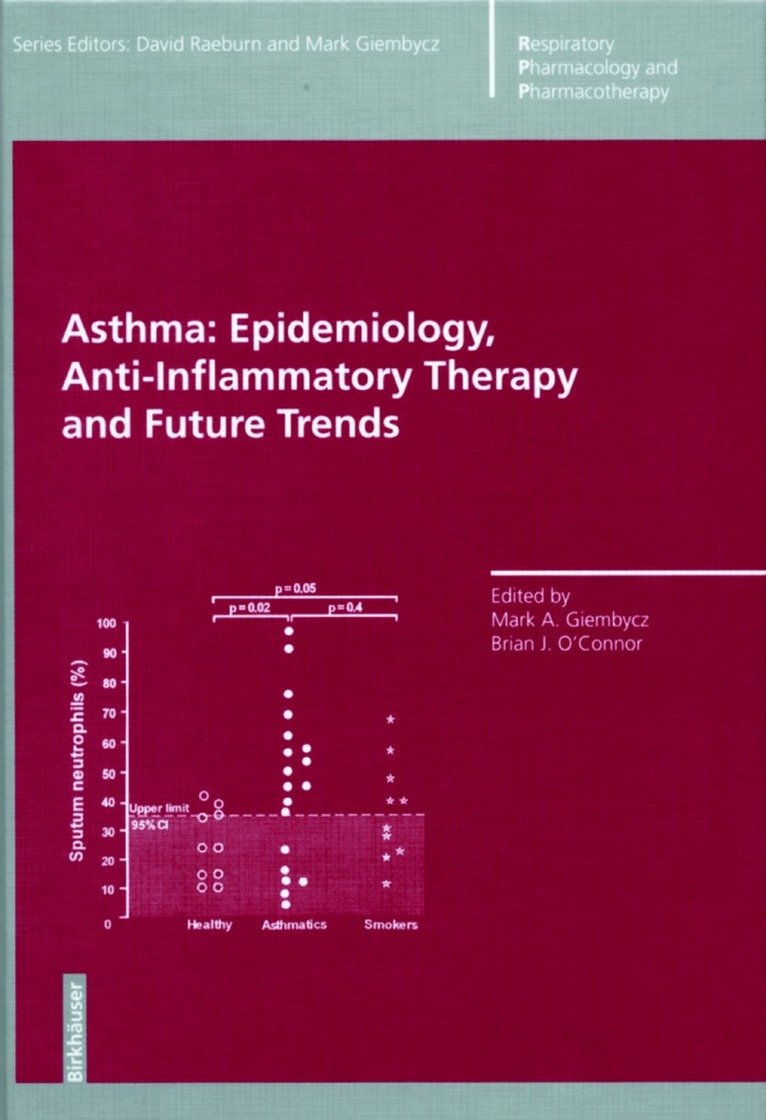
Asthma: Epidemiology, Anti-Inflammatory Therapy and Future Trends
Av Brian J. O'Connor, Mark A. Giembycz
E-bok, 2012
732 kr
Lägg i varukorg
1. 1. Invasive versus Non-Invasive Clinical Measurements in Medicine Clinical measurement has become an essential complement to traditional physical diagnosis. An ideal clinical measurement should be quantitative, have a high level of reliability and accuracy, be safe, acceptable to the patient, …
Airways Smooth Muscle: Modelling the Asthmatic Response In Vivo
Av Mark A. Giembycz, David Raeburn
E-bok, 2012
739 kr
Lägg i varukorg
Building on the existing titles in the "Airways Smooth Muscle" sub-series, the sixth volume explores physiological and pharmacological processes in the lung in vivo. The various animal models available for studying the bronchospasm and inflammation associated with human asthma are thoroughly …
Rhinitis: Immunopathology and Pharmacotherapy
Av Mark A. Giembycz, David Raeburn
E-bok, 2012
2174 kr
Lägg i varukorg
Continuing the Respiratory Pharmacology and Pharmacotherapy series, this volume explores the pathophysiology and therapy of rhinitis. The volume is introduced by a chapter describing the normal anatomy and physiology of the nose and sinuses. Against this background the contributing authors describe …
Asthma: Epidemiology, Anti-Inflammatory Therapy and Future Trends
Av Mark A. Giembycz, Brian J. O'Connor
Häftad, 2012
567 kr
Lägg i varukorg
1. 1. Invasive versus Non-Invasive Clinical Measurements in Medicine Clinical measurement has become an essential complement to traditional physical diagnosis. An ideal clinical measurement should be quantitative, have a high level of reliability and accuracy, be safe, acceptable to the patient, …
Airways Smooth Muscle: Modelling the Asthmatic Response In Vivo
Av David Raeburn, Mark A. Giembycz
Häftad, 2011
567 kr
Lägg i varukorg
Building on the existing titles in the "Airways Smooth Muscle" sub-series, the sixth volume explores physiological and pharmacological processes in the lung in vivo. The various animal models available for studying the bronchospasm and inflammation associated with human asthma are thoroughly …
Rhinitis: Immunopathology and Pharmacotherapy
Av David Raeburn, Mark A. Giembycz
Häftad, 2011
1687 kr
Lägg i varukorg
Continuing the Respiratory Pharmacology and Pharmacotherapy series, this volume explores the pathophysiology and therapy of rhinitis. The volume is introduced by a chapter describing the normal anatomy and physiology of the nose and sinuses. Against this background the contributing authors describe …
Rhinitis: Immunopathology and Pharmacotherapy
Av David Raeburn, Mark A. Giembycz
Inbunden, 1997
1693 kr
Lägg i varukorg
Continuing the Respiratory Pharmacology and Pharmacotherapy series, this volume explores the pathophysiology and therapy of rhinitis. The volume is introduced by a chapter describing the normal anatomy and physiology of the nose and sinuses. Against this background the contributing authors describe …
Asthma
Epidemiology, Anti-inflammatory Therapy and Future Trends
Av Brian O'Connor, Mark A. Giembycz m. fl.
Inbunden, 1999
906 kr
Lägg i varukorg
This text features an analysis of the epidemiology of asthma in children and adults, the role of steroids in asthma management and new and novel asthma therapies. The book addresses clinicians and basic scientists with an interest in asthma epidemiology, steroids and future therapies.