Mark C. M. van Loosdrecht – författare
Visar alla böcker från författaren Mark C. M. van Loosdrecht. Handla med fri frakt och snabb leverans.
7 produkter
7 produkter
1 822 kr
Tillfälligt slut
Over the past twenty years, the knowledge and understanding of wastewater treatment has advanced extensively and moved away from empirically based approaches to a fundamentally-based first principles approach embracing chemistry, microbiology, and physical and bioprocess engineering, often involving experimental laboratory work and techniques. Many of these experimental methods and techniques have matured to the degree that they have been accepted as reliable tools in wastewater treatment research and practice. For sector professionals, especially a new generation of young scientists and engineers entering the wastewater treatment profession, the quantity, complexity and diversity of these new developments can be overwhelming, particularly in developing countries where access to advanced level laboratory courses in wastewater treatment is not readily available. In addition, information on innovative experimental methods is scattered across scientific literature and only partially available in the form of textbooks or guidelines. This book seeks to address these deficiencies. It assembles and integrates the innovative experimental methods developed by research groups and practitioners around the world. Experimental Methods in Wastewater Treatment forms part of the internet-based curriculum in wastewater treatment at UNESCO-IHE and, as such, may also be used together with video records of experimental methods performed and narrated by the authors including guidelines on what to do and what not to do. The book is written for undergraduate and postgraduate students, researchers, laboratory staff, plant operators, consultants, and other sector professionals.
N2O and CH4 Emission from Wastewater Collection and Treatment Systems
State of the Science Report and Technical Report
Inbunden, Engelska, 2015
1 822 kr
Tillfälligt slut
In a world where there is a growing awareness of the possible effects of human activities on climate change, there is a need to identify the emission of greenhouse gases (GHG) from wastewater treatment plants (WWTPs). As a result of this growing awareness, governments started to implement regulations that require water authorities to report their GHG emissions. With these developments there exists a strong need for adequate insight into the emissions of N2O and CH4. With this insight water authorities would be able to estimate and finally reduce their emissions. The overall objectives of the different research programs performed by partners of the GWRC members WERF (United States of America), WSAA (Australia), CIRSEE-Suez (France) and STOWA (the Netherlands) were: To define the origin of N2O emission. To understand the formation processes of N2O.To identify the level of CH4 emissions from wastewater collection and treatment systems. To evaluate the use of generic emission factors to estimate the emission of N2O from individual plants
1 822 kr
Tillfälligt slut
Because of the uneven distribution of fresh water in time and space and the increasing human population, a large number of regions are experiencing water scarcity and stress. Membrane-based desalination technologies like reverse osmosis have the potential to solve the fresh water crisis in coastal areas. However, in many cases membraneperformance is restricted by biofouling.Biofouling of Membrane Systems gives a comprehensive overview on the state of the art strategies to control biofouling in spiral wound reverse osmosis membrane systems and point to possible future research directions. Despite the fact that much research and development has been done to overcome biofouling in spiral wound membrane systems used for water treatment, biofouling is still a major practical problem causing performance decline and increased energy demand. Biofouling of Membrane Systems is divided into three sections including modelling and numerical analysis, non-destructive characterization and feed spacer geometry optimization. It focuses on the development of biomass in the feed channel of the membrane module and its effect on pressure dropand hydrodynamics.This book can be used to develop an integral strategy to control biofouling in spiral wound membrane systems. An overview of several potential complementary approaches to solve biofouling is given and an integrated approach for biofouling control and feed spacer design is proposed.
2 134 kr
Tillfälligt slut
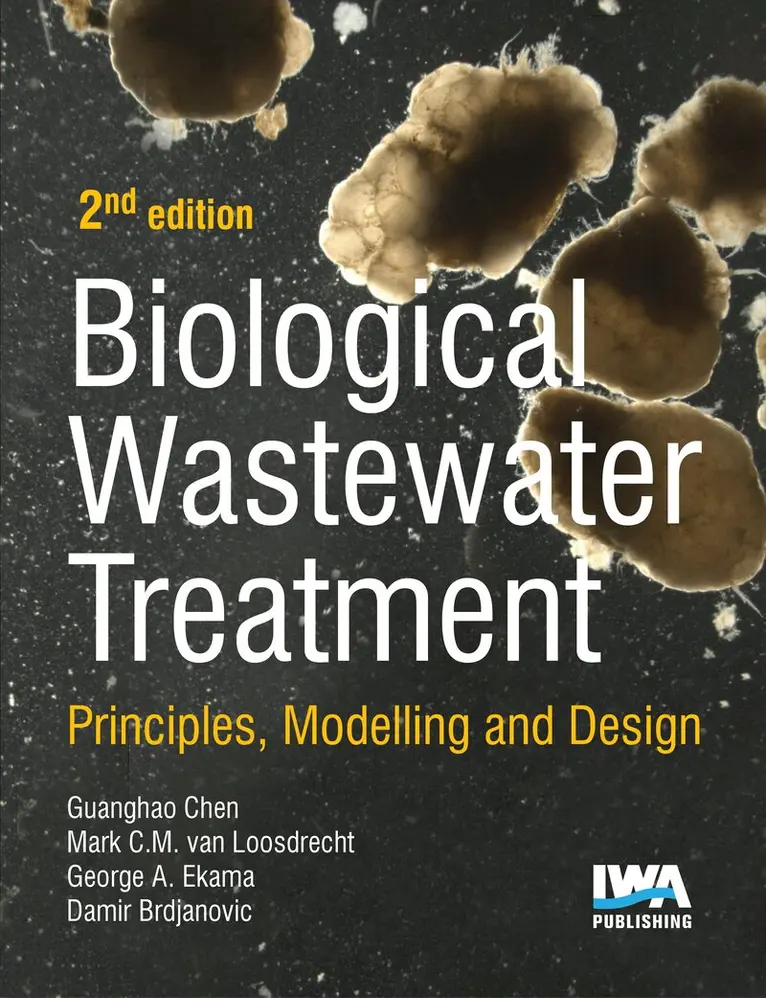
The first edition of this book was published in 2008 and it went on to become IWA Publishing’s bestseller. Clearly there was a need for it because over the twenty years prior to 2008, the knowledge and understanding of wastewater treatment had advanced extensively and moved away from empirically-based approaches to a fundamental first-principles approach based on chemistry, microbiology, physical and bioprocess engineering, mathematics and modelling. However the quantity, complexity and diversity of these new developments was overwhelming for young water professionals, particularly in developing countries without readily available access to advanced-level tertiary education courses in wastewater treatment. For a whole new generation of young scientists and engineers entering the wastewater treatment profession, this book assembled and integrated the postgraduate course material of a dozen or so professors from research groups around the world who have made significant contributions to the advances in wastewater treatment. This material had matured to the degree that it had been codified into mathematical models for simulation with computers. The first edition of the book offered, that upon completion of an in-depth study of its contents, the modern approach of modelling and simulation in wastewater treatment plant design and operation could be embraced with deeper insight, advanced knowledge and greater confidence, be it activated sludge, biological nitrogen and phosphorus removal, secondary settling tanks, or biofilm systems.However, the advances and developments in wastewater treatment have accelerated over the past 12 years since publication of the first edition. While all the chapters of the first edition have been updated to accommodate these advances and developments, some, such as granular sludge, membrane bioreactors, sulphur conversion-based bioprocesses and biofilm reactors which were new in 2008, have matured into new industry approaches and are also now included in this second edition. The target readership of this second edition remains the young water professionals, who will still be active in the field of protecting our precious water resources long after the aging professors who are leading some of these advances have retired. The authors, all still active in the field, are aware that cleaning dirty water has become more complex but that it is even more urgent now than 12 years ago, and offer this second edition to help the young water professionals engage with the scientific and bioprocess engineering principles of wastewater treatment science and technology with deeper insight, advanced knowledge and greater confidence built on stronger competence.
1 355 kr
Tillfälligt slut
The first edition of this book was published in 2008 and it went on to become IWA Publishing’s bestseller. Clearly there was a need for it because over the twenty years prior to 2008, the knowledge and understanding of wastewater treatment had advanced extensively and moved away from empirically-based approaches to a fundamental first-principles approach based on chemistry, microbiology, physical and bioprocess engineering, mathematics and modelling. However the quantity, complexity and diversity of these new developments was overwhelming for young water professionals, particularly in developing countries without readily available access to advanced-level tertiary education courses in wastewater treatment. For a whole new generation of young scientists and engineers entering the wastewater treatment profession, this book assembled and integrated the postgraduate course material of a dozen or so professors from research groups around the world who have made significant contributions to the advances in wastewater treatment. This material had matured to the degree that it had been codified into mathematical models for simulation with computers. The first edition of the book offered, that upon completion of an in-depth study of its contents, the modern approach of modelling and simulation in wastewater treatment plant design and operation could be embraced with deeper insight, advanced knowledge and greater confidence, be it activated sludge, biological nitrogen and phosphorus removal, secondary settling tanks, or biofilm systems. However, the advances and developments in wastewater treatment have accelerated over the past 12 years since publication of the first edition. While all the chapters of the first edition have been updated to accommodate these advances and developments, some, such as granular sludge, membrane bioreactors, sulphur conversion-based bioprocesses and biofilm reactors which were new in 2008, have matured into new industry approaches and are also now included in this second edition. The target readership of this second edition remains the young water professionals, who will still be active in the field of protecting our precious water resources long after the aging professors who are leading some of these advances have retired. The authors, all still active in the field, are aware that cleaning dirty water has become more complex but that it is even more urgent now than 12 years ago, and offer this second edition to help the young water professionals engage with the scientific and bioprocess engineering principles of wastewater treatment science and technology with deeper insight, advanced knowledge and greater confidence built on stronger competence.
685 kr
Skickas
Over the past twenty years, the knowledge and understanding of wastewater treatment has advanced extensively and moved away from empirically based approaches to a fundamentally-based first principles approach embracing chemistry, microbiology, and physical and bioprocess engineering, often involving experimental laboratory work and techniques. Many of these experimental methods and techniques have matured to the degree that they have been accepted as reliable tools in wastewater treatment research and practice. For sector professionals, especially a new generation of young scientists and engineers entering the wastewater treatment profession, the quantity, complexity and diversity of these new developments can be overwhelming, particularly in developing countries where access to advanced level laboratory courses in wastewater treatment is not readily available. In addition, information on innovative experimental methods is scattered across scientific literature and only partially available in the form of textbooks or guidelines. This book seeks to address these deficiencies. It assembles and integrates the innovative experimental methods developed by research groups and practitioners around the world. Experimental Methods in Wastewater Treatment forms part of the internet-based curriculum in wastewater treatment at UNESCO-IHE and, as such, may also be used together with video records of experimental methods performed and narrated by the authors including guidelines on what to do and what not to do. The book is written for undergraduate and postgraduate students, researchers, laboratory staff, plant operators, consultants, and other sector professionals.
1 822 kr
Tillfälligt slut
Wastewater and drinking water treatment are essential elements of urban infrastructure. In the course of the last century there has been enormous technical development, so successful that for the general public in industrialized countries this infrastructure is hardly noticed. Nevertheless there is ongoing activity to further improve the existing processes. The IWA Leading Edge Technology conference held in Prague helped to stimulate this development and this book helps disseminate the results. A selection of presentations from the conference are included in this volume. Wastewater and drinking-water treatment are normally considered as two separate fields due to the very different boundary conditions that apply. Nevertheless several issues such as membrane processes, removal of micropollutants and water reuse are of crucial importance to both. This potential for cross-fertilization further enhances the value of this collection of high-quality articles that delineate the leading edge of research and development in water and wastewater treatment.