Mark J. Thomas - Böcker
Visar alla böcker från författaren Mark J. Thomas. Handla med fri frakt och snabb leverans.
4 produkter
4 produkter
1 062 kr
Skickas inom 7-10 vardagar
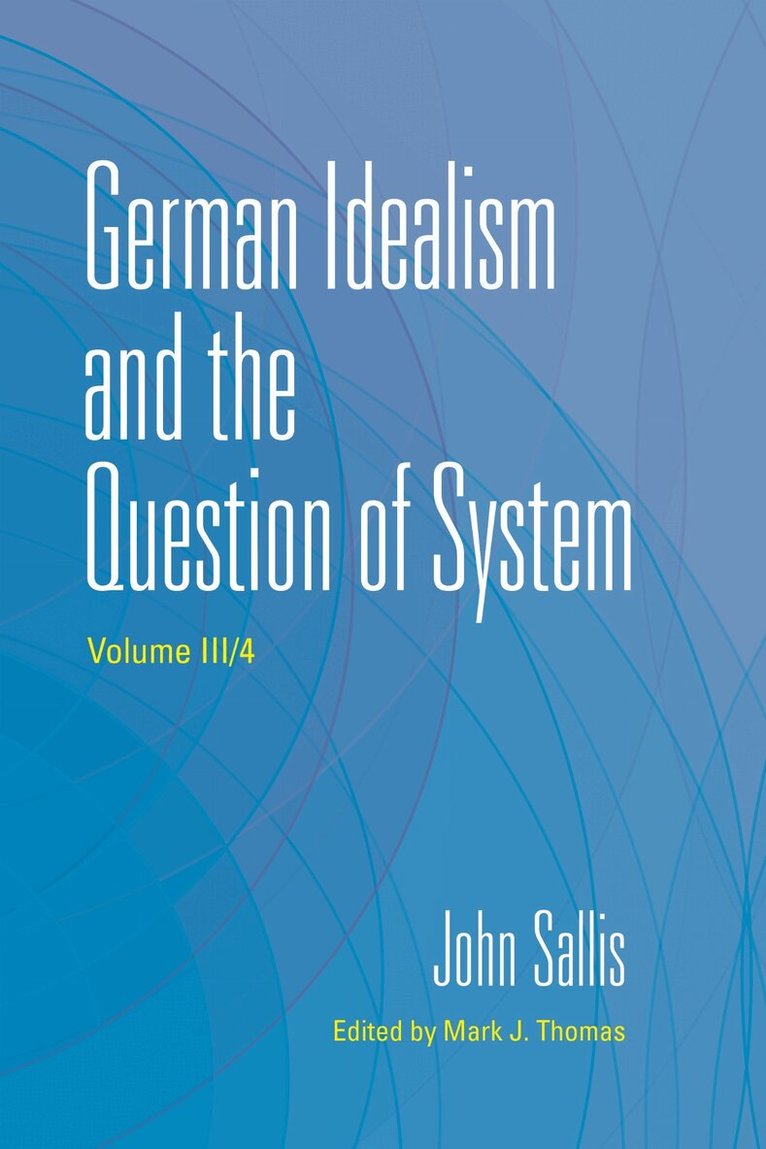
This volume in the Collected Writings of John Sallis presents his lecture course on German Idealism, tracing its development from the reception of Kant through the works of Fichte and Schelling. With insightful interpretations of key texts, John Sallis demonstrates the enduring power of post-Kantian thought—especially with respect to freedom, the relation of subject to object, and the role of the imagination. He shows that what underlies the development of German Idealism is a concern with the question of system and the nature of philosophy itself.The book begins with a treatment of Kant's philosophy and its new beginning. It then discusses the initial reception of Kant's philosophy, showing how criticisms of Kant set the stage for the subsequent development of German Idealism. The central chapters focus on Fichte, first introducing his central philosophical project (the Wissenschaftslehre) and then carefully analyzing its implementation in the 1794 Grundlage. The final chapters treat Schelling's early and middle philosophy, including the 1800 System of Transcendental Idealism and his famous 1809 treatise on freedom.Beyond its insights into the thought of German Idealism, the book is distinctive for the clarity of Sallis's exposition, his attention to the implications for philosophy today, and the sense of wonder he evokes in his readers. Because of these features, the book will be of interest to general readers as well as specialists in German philosophy.
416 kr
Skickas inom 7-10 vardagar
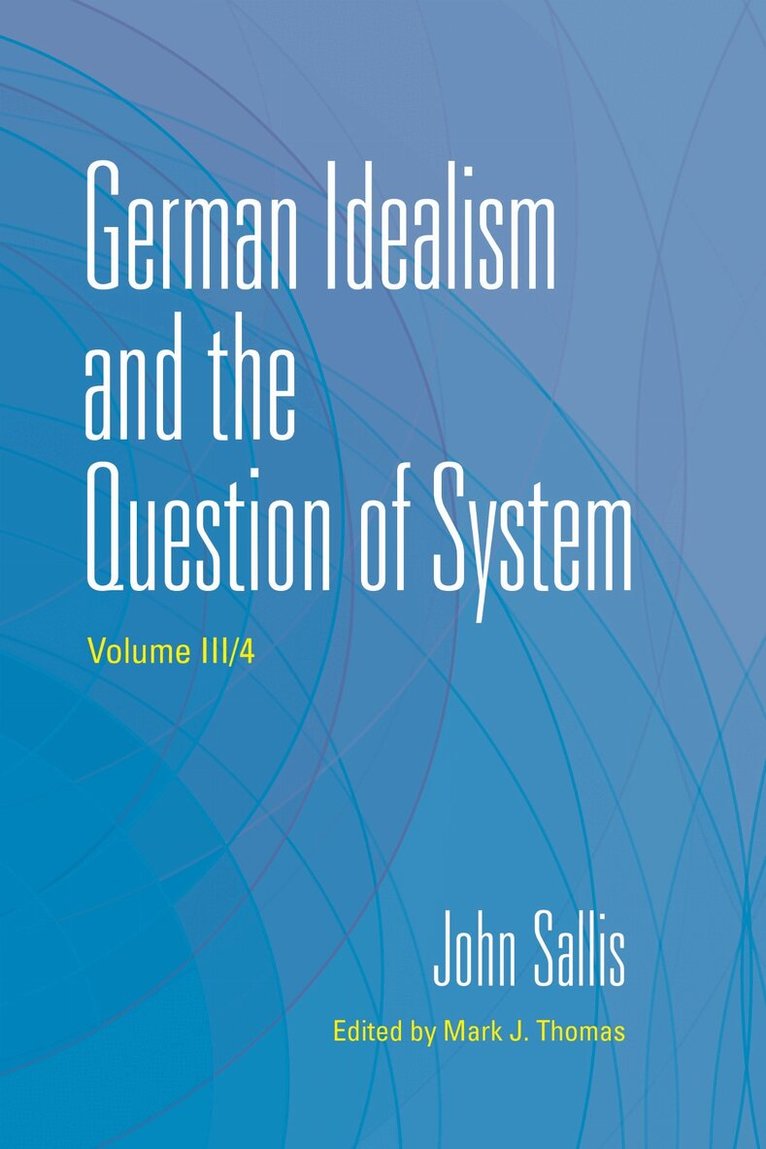
This volume in the Collected Writings of John Sallis presents his lecture course on German Idealism, tracing its development from the reception of Kant through the works of Fichte and Schelling. With insightful interpretations of key texts, John Sallis demonstrates the enduring power of post-Kantian thought—especially with respect to freedom, the relation of subject to object, and the role of the imagination. He shows that what underlies the development of German Idealism is a concern with the question of system and the nature of philosophy itself.The book begins with a treatment of Kant's philosophy and its new beginning. It then discusses the initial reception of Kant's philosophy, showing how criticisms of Kant set the stage for the subsequent development of German Idealism. The central chapters focus on Fichte, first introducing his central philosophical project (the Wissenschaftslehre) and then carefully analyzing its implementation in the 1794 Grundlage. The final chapters treat Schelling's early and middle philosophy, including the 1800 System of Transcendental Idealism and his famous 1809 treatise on freedom.Beyond its insights into the thought of German Idealism, the book is distinctive for the clarity of Sallis's exposition, his attention to the implications for philosophy today, and the sense of wonder he evokes in his readers. Because of these features, the book will be of interest to general readers as well as specialists in German philosophy.
594 kr
Skickas inom 3-6 vardagar
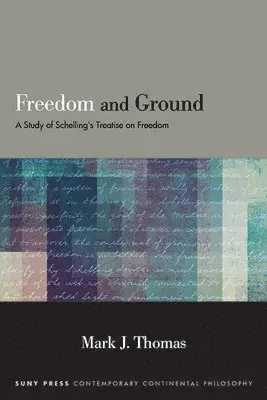
A new interpretation of Schelling's 1809 treatise on freedom, demonstrating how the work is an answer to the problem of ground.This book is a new interpretation of Schelling's path-breaking 1809 treatise on freedom, the last major work published during his lifetime. The treatise is at the heart of the current Schelling renaissance-indeed, Heidegger calls it "one of the most profound works of German, thus of Western, philosophy." It is also one of the most demanding and complex texts in German Idealism. By tracing the problem of ground through Schelling's treatise, Mark J. Thomas provides a unified reading of the text, while unlocking the meaning of its most challenging passages through clear, detailed analysis. He shows how Schelling's implicit distinction between senses of ground is the key to his project of constructing a system that can satisfy reason while accommodating objects that seem to defy rational explanation-including evil, the origins of nature, and absolute freedom. This allows Schelling to unite reason and mystery, providing a rich model for philosophizing about freedom and evil today.
1 456 kr
Skickas inom 3-6 vardagar
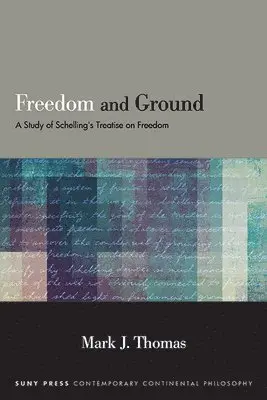
A new interpretation of Schelling's 1809 treatise on freedom, demonstrating how the work is an answer to the problem of ground.This book is a new interpretation of Schelling's path-breaking 1809 treatise on freedom, the last major work published during his lifetime. The treatise is at the heart of the current Schelling renaissance-indeed, Heidegger calls it "one of the most profound works of German, thus of Western, philosophy." It is also one of the most demanding and complex texts in German Idealism. By tracing the problem of ground through Schelling's treatise, Mark J. Thomas provides a unified reading of the text, while unlocking the meaning of its most challenging passages through clear, detailed analysis. He shows how Schelling's implicit distinction between senses of ground is the key to his project of constructing a system that can satisfy reason while accommodating objects that seem to defy rational explanation-including evil, the origins of nature, and absolute freedom. This allows Schelling to unite reason and mystery, providing a rich model for philosophizing about freedom and evil today.