Mark J. Valencia – författare
Visar alla böcker från författaren Mark J. Valencia. Handla med fri frakt och snabb leverans.
6 produkter
6 produkter
Häftad, Engelska, 2005
486 kr
Skickas inom 10-15 vardagar
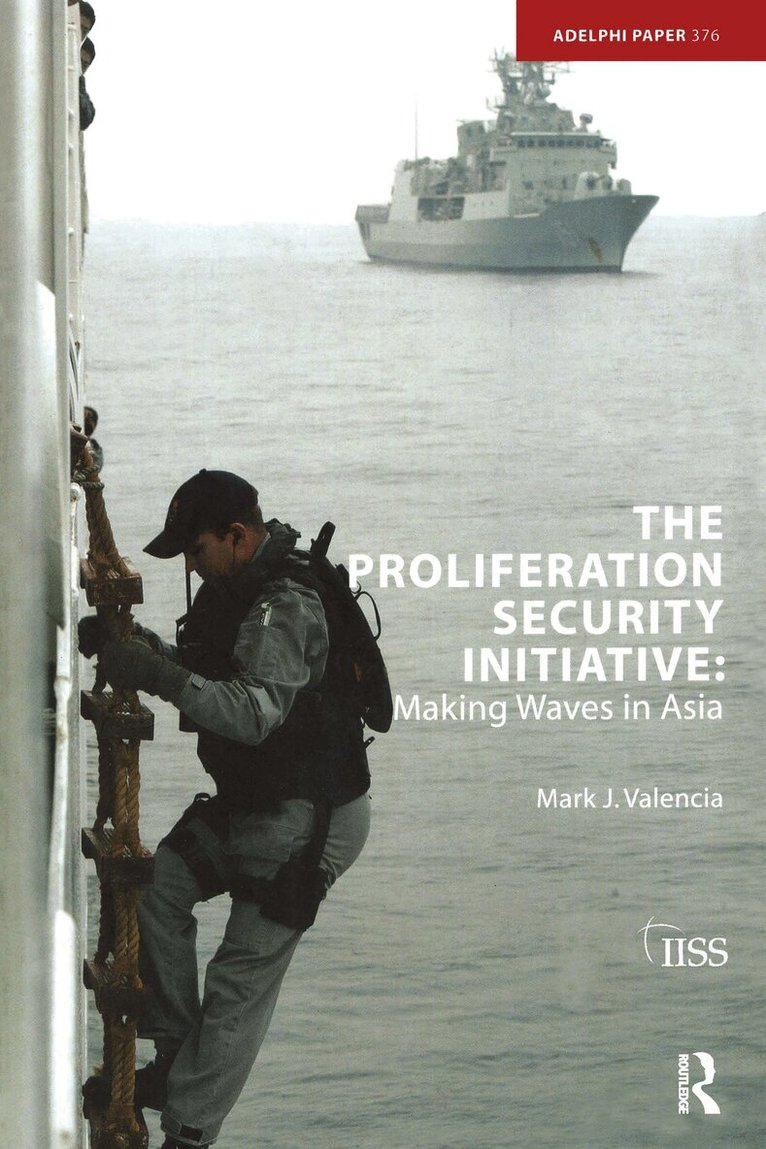
The Proliferation Security Initiative (PSI), launched initiated by US President Bush in May 2003, was designed to prevent elements of weapons of mass destruction (WMD) from reaching or leaving states or sub-state actors of proliferation concern. More than twenty countries now adhere to PSI principles. Though the principal focus of the initiative is on North Korea, Japan and Singapore are the only active East Asian participants. Most WMD traffic moves by sea, and the focus of the PSI is on maritime interdictions and seizures. Although the PSI has had some significant successes, its aggressive promotion and implementation has been controversial. It has been criticised for lacking sufficient public accountability, stretching international law to the limits, undermining the UN system, potentially limited effectiveness and for being politically divisive. Moreover, Asian countries that are key to PSI's successful implementation - notably China, India, Indonesia and South Korea - have deferred active involvement despite US pressureThe complexities of the post-Cold War security environment in East Asia make implementation of the PSI problematic. Against the background of China's rise, Japan's drive to become a 'normal' power and major-power competition for influence in Southeast Asia, maritime security issues are rising to the fore. Jurisdiction is creeping seawards while national threat perceptions as well as concepts of sovereignty are diverge, elevating maritime sensitivities.
E-bok
PDF, Engelska, 2013756 kr
Läs direkt efter köp
The South China Sea: Hydrocarbon Potential and Possibilities of Joint Development presents the proceedings of the EAPI/CCOP Workshop East-West Center held in Honolulu, Hawaii on August 5-12, 1980. The book contains papers on the geology and offshore hydrocarbon potential in the Philippines, Thailand, and Indonesia; and on the need for certain basic prerequisites for initiating and maintaining rational and orderly oil and gas exploration and development programs. The text also presents papers on the establishment of effective production-sharing type tax regimes for petroleum; on the implications of the Southeast Asian contractual framework; and on a general approach to the planning and management of environmental aspects related to offshore oil and gas prospecting, drilling, development and production. The precedents of the joint development of hydrocarbons in areas of overlapping boundary claims, with examples from the North Sea, the Persian Gulf, the Korea-Japan continental shelf and the Thai-Malaysian continental shelf, are also considered.
E-bok
PDF, Engelska, 20212 348 kr
Läs direkt efter köp
The past few decades have witnessed the emergence of a vast array of regional arrangements and institutions dealing with all aspects of ocean management. The level of cooperation ranges from minimal dispute avoidance to relatively comprehensive ocean governance at the regional level. As concrete examples, reasonably successful and comprehensive regional regimes have been created for the Baltic, the North, and the Mediterranean Seas and the South Pacific. And attempts at regional regime building are ongoing in Southeast Asia, the South China Sea and the Indian Ocean. Although there are broad similarities between the semi-enclosed seas of Western Europe and Northeast Asia, no regional maritime regime has yet been initiated in Northeast Asia.The papers in this volume are authored by leading authorities on not only the maritime affairs of their particular region of focus but on maritime policy in general. They describe and explain existing or incipient regional maritime regimes in an unusually broad comparative context, and extract lessons learned that may be applicable elsewhere including Northeast Asia. The case studies are neatly sandwiched between an introduction to concepts and principles on regional co-operation and concluding chapters on lessons learned and their applicability to Northeast Asia.Moreover, the papers raise and address several questions of relevance to policy. For example, what factors are conducive to maritime regime initiation, expansion and positive evolution, and which constrain regime formation and evolution? Why has maritime regime building been successful in Europe and largely unsuccessful in Asia? And which, if any, lessons learned in the European context are applicable in Asia? Given the growing interest in regime formation and effectiveness in general and maritime regimes in particular, this book will be of considerable interest to both analysts and policymakers.
E-bok
PDF, Engelska, 20214 068 kr
Läs direkt efter köp
E-bok
PDF, Engelska, 20223 388 kr
Läs direkt efter köp
Inbunden, Engelska, 1997
3 949 kr
Skickas inom 3-6 vardagar