Mark Nitzberg - Böcker
Visar alla böcker från författaren Mark Nitzberg. Handla med fri frakt och snabb leverans.
2 produkter
2 produkter
146 kr
Skickas
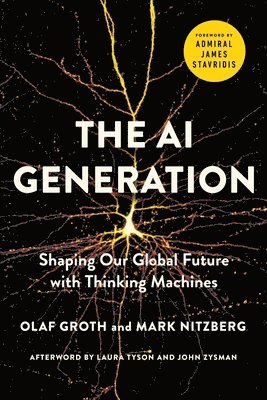
An update edition of Solomon’s Code—now The AI Generation—the thought-provoking examination of artificial intelligence and how it reshapes human values, trust, and power around the world.Whether in medicine, money, or love, technologies powered by forms of artificial intelligence are playing an increasingly prominent role in our lives. As we cede more decisions to thinking machines, we face new questions about staying safe, keeping a job and having a say over the direction of our lives. The answers to those questions might depend on your race, gender, age, behavior, or nationality. New AI technologies can drive cars, treat damaged brains and nudge workers to be more productive, but they also can threaten, manipulate, and alienate us from others. They can pit nation against nation, but they also can help the global community tackle some of its greatest challenges—from food crises to global climate change. In clear and accessible prose, global trends and strategy adviser Olaf Groth, AI scientist and social entrepreneur Mark Nitzberg, along with seasoned economics reporter Dan Zehr, provide a unique human-focused, global view of humanity in a world of thinking machines.
551 kr
Skickas inom 10-15 vardagar
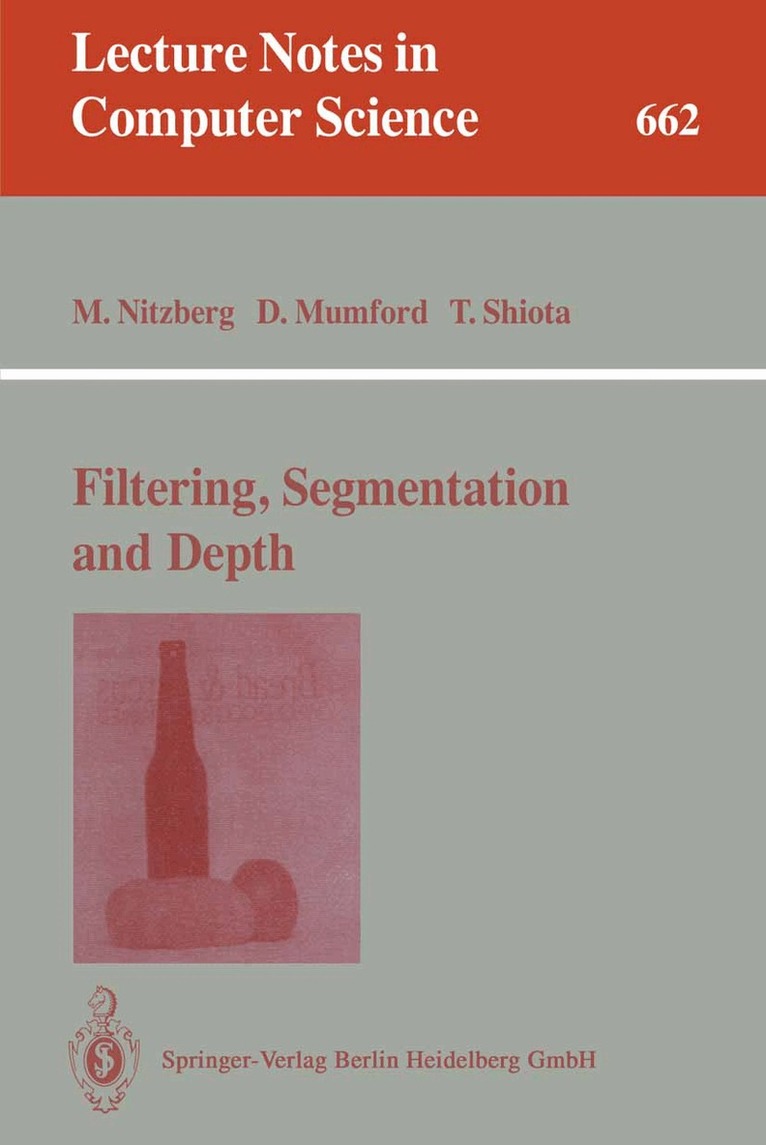
Computer vision seeks a process that starts with a noisy,ambiguous signal from a TV camera and ends with a high-leveldescription of discrete objects located in 3-dimensionalspace and identified in a human classification. This book addresses the process at several levels. First tobe treated are the low-level image-processing issues ofnoise removaland smoothing while preserving important linesand singularities in an image. At a slightly higher level, arobust contour tracing algorithm is described that producesa cartoon of the important lines in the image. Thirdis thehigh-level task of reconstructing the geometry of objects inthe scene. The book has two aims: to give the computer vision communitya new approach to early visual processing, in the form ofimage segmentation that incorporates occlusion at a lowlevel, and to introduce real computer algorithms that do abetter job than what most vision programmers use currently. The algorithms are:- a nonlinear filter that reduces noise and enhances edges,- an edge detector that also finds corners and producessmoothed contours rather than bitmaps,- an algorithm for filling gaps in contours.