Mark Owen Webb – författare
Visar alla böcker från författaren Mark Owen Webb. Handla med fri frakt och snabb leverans.
6 produkter
6 produkter
Inbunden, Engelska, 2024
742 kr
Skickas inom 7-10 vardagar
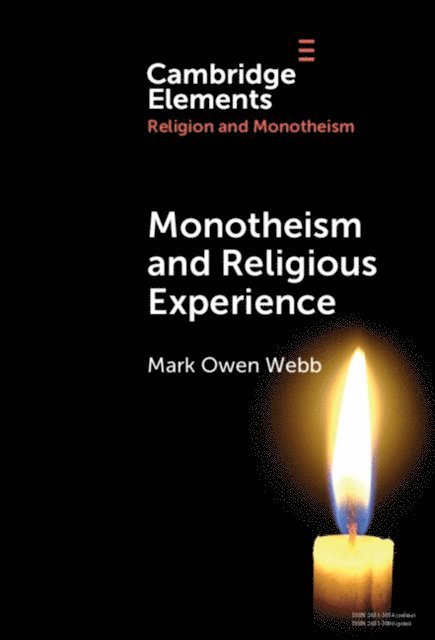
In the monotheistic traditions, there are people who report having special experiences that justify their monotheistic beliefs. They see, hear, or otherwise experience directly the one true God, ruler of the universe. In order to understand what is going on in these experiences and how we should respond to reports of these experiences, it is important to understand what religious experiences can and can't be, what the claim of monotheism entails, and therefore how what reports of such experiences mean, both for the experiencer and for the recipient of the report.
Häftad, Engelska, 2024
230 kr
Skickas inom 7-10 vardagar
In the monotheistic traditions, there are people who report having special experiences that justify their monotheistic beliefs. They see, hear, or otherwise experience directly the one true God, ruler of the universe. In order to understand what is going on in these experiences and how we should respond to reports of these experiences, it is important to understand what religious experiences can and can't be, what the claim of monotheism entails, and therefore how what reports of such experiences mean, both for the experiencer and for the recipient of the report.
E-bok
Engelska, 2024275 kr
Läs direkt efter köp
E-bok
PDF, Engelska, 2024275 kr
Läs direkt efter köp
Del 2 - SpringerBriefs in Religious Studies
Comparative Doxastic-Practice Epistemology of Religious Experience
Häftad, Engelska, 2014
550 kr
Skickas inom 10-15 vardagar
This book takes a theoretical enterprise in Christian philosophy of religion and applies it to Buddhism, thus defending Buddhism and presenting it favorably in comparison. Chapters explore how the claims of both Christianity and Theravada Buddhism rest on people’s experiences, so the question as to which claimants to religious knowledge are right rests on the evidential value of those experiences. The book examines mysticism and ways to understand what goes on in religious experiences, helping us to understand whether it is good grounds for religious belief. The author argues that religious language in both Christian and Buddhist traditions is intelligible as factual discourse, and so reports of mystical experience are true or false. The book contends that those experiences can be fruitfully thought of as perceptual in kind and that they are therefore good prima facie grounds for religious belief, in the absence of defeating conditions. The work goes on to explore Christian and Buddhist testimony and how the likelihood of self-deception, self-delusion, imaginative elaboration and the like constitutes a defeating condition. It is shown that this defeater has less scope for operation in the Buddhist case than in the Christian case, and therefore Theravada Buddhism is better grounded. This work will appeal to students and scholars of philosophy and philosophy of religion, and those interested in the study of religious experience.
E-bok
PDF, Engelska, 2014687 kr
Läs direkt efter köp
This book takes a theoretical enterprise in Christian philosophy of religion and applies it to Buddhism, thus defending Buddhism and presenting it favorably in comparison. Chapters explore how the claims of both Christianity and Theravada Buddhism rest on people’s experiences, so the question as to which claimants to religious knowledge are right rests on the evidential value of those experiences. The book examines mysticism and ways to understand what goes on in religious experiences, helping us to understand whether it is good grounds for religious belief. The author argues that religious language in both Christian and Buddhist traditions is intelligible as factual discourse, and so reports of mystical experience are true or false. The book contends that those experiences can be fruitfully thought of as perceptual in kind and that they are therefore good prima facie grounds for religious belief, in the absence of defeating conditions. The work goes on to explore Christian and Buddhist testimony and how the likelihood of self-deception, self-delusion, imaginative elaboration and the like constitutes a defeating condition. It is shown that this defeater has less scope for operation in the Buddhist case than in the Christian case, and therefore Theravada Buddhism is better grounded. This work will appeal to students and scholars of philosophy and philosophy of religion, and those interested in the study of religious experience.