Mark P. Rice - Böcker
Visar alla böcker från författaren Mark P. Rice. Handla med fri frakt och snabb leverans.
4 produkter
4 produkter
314 kr
Tillfälligt slut
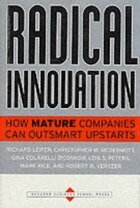
How many big businesses have pioneered the technologies and business models that now dominate e-commerce, personal computing, biotechnology, and wireless telecommunication? The answer: hardly any. The problem is not that executives fail to recognize the need to infuse their organizations with the kind of model-busting innovative capabilities of agile startups. It's a lack of understanding of what to do and how to do it. But now, this groundbreaking book reveals the patterns through which game-changing innovation occurs in large, established companies, and identifies the new managerial competencies firms need to make radical innovation happen. The authors define a radical innovation project as one that delivers a product, process, or service with either unprecedented performance features, or with familiar features that will enable market transformation through significant performance improvements or cost reductions. These projects are nurtured within the established organization, not skunkworks. They are not concerned with exploiting current lines of business, but with exploring entirely new ones.Based on evidence from a five-year, real time study of twelve radical innovation projects within ten major corporations--including General Electric, IBM, Nortel Networks, DuPont, and Texas Instruments--this book addresses seven managerial challenges large companies face in creating and sustaining radical innovation: dealing with radical ideas in the 'fuzzy front end'; developing new models for project management; learning about unfamiliar markets; working through uncertainty in the business model; bridging resource and competency gaps; managing the transition from radical project to operating status; and, engaging individual initiative. The authors, experts in a variety of areas such as entrepreneurship, R&D management, product design, marketing, organizational behavior, and operations and project management, distill a comprehensive, interdisciplinary approach to mastering each of these challenges, from the conceptualization of viable ideas to the commercialization of radical innovations.Designed to push the envelope of thinking about the most significant challenge facing large companies today, this important book offers a revolutionary new paradigm for long-term corporate success.
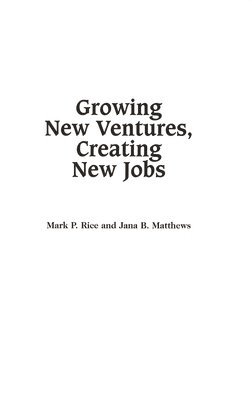
Growing New Ventures, Creating New Jobs
Principles and Practices of Successful Business Incubation
Inbunden, Engelska, 1995
901 kr
Skickas inom 10-15 vardagar
In 1980, only 10 business incubators existed in the United States. By 1995 there were nearly 500, and a new incubator is opening every week. Despite the rapid growth, the success of business incubators has been mixed at best. Growing New Ventures, Creating New Jobs provides sponsors, boards, and the management teams of business incubation programs with proven strategies for enhancing the creation and development of new ventures and ensuring the success of programs that support business growth and development.Business creation experts Jana B. Matthews and Mark P. Rice explain the three key principles of successful business incubation; the 10 best practices for starting, developing, and managing a business incubation program; ways to attract high-quality entrepreneurs; the litmus test to determine an incubator's feasibility; and many hands-on examples from the directors of some of the country's top business incubators. Incubators have helped to create more than 82,000 new jobs in communities throughout the United States, and they foster the entrepreneurial spirit that is the lifeblood of the economy. Growing New Ventures, Creating New Jobs gives business, university, and government leaders a blueprint incubator program for invigorating the regional economy.
Del 9 - The International Library of Entrepreneurship series
Entrepreneurship Education
Inbunden, Engelska, 2007
4 234 kr
Skickas inom 7-10 vardagar
Entrepreneurship education is expanding rapidly around the world with growth evident in terms of the number of courses, endowed chairs, and programs. Business schools have approached their participation in entrepreneurship education with a variety of pace, practice and policy.This authoritative collection is targeted towards business educators, educators interested in entrepreneurial approaches, and educational administrators. The volume's main aims are to provide the groundwork for any organized discussion of entrepreneurship education; and to take stock of where we are in the educational field as a means of identifying the big questions, issues, and trends that will direct the future of the discipline.The book is organized around content and pedagogy and includes chapters from leading experts. Emerging themes include the underlying assumptions built into the field, the importance of the interdisciplinary approach, concern with who is teaching entrepreneurship, and a call to make the approach more global.
1 658 kr
Skickas inom 7-10 vardagar
Entrepreneurship and innovation are increasingly viewed as key contributors to global economic and social development. University-based entrepreneurship ecosystems (U-BEEs) provide a supportive context in which entrepreneurship and innovation can thrive. In that vein, this book provides critical insight based on cutting-edge analyses of how to frame, design, launch, and sustain efforts in the area of entrepreneurship.Seven success factors were derived from an in-depth analysis of six leading, and very different, university-based entrepreneurship ecosystems in North America, Latin America, Europe, and Asia. These seven success factors are: (1) senior leadership vision, engagement and sponsorship; (2) strong programmatic and faculty leadership; (3) sustained commitment over a long period of time; (4) commitment of substantial financial resources; (5) commitment to continuing innovation in curriculum and programs; (6) an appropriate organizational infrastructure; and (7) commitment to building the extended enterprise and achieving critical mass. Based on these success factors, the authors provide a series of recommendations for the development of a comprehensive university-based entrepreneurship ecosystem.This major assessment of how best to drive university-based entrepreneurship ecosystems is essential reading for anyone involved in higher education (particularly provosts, deans, and professors), government agencies concerned with socio-economic development, and all those concerned with helping entrepreneurship ecosystems to flourish.Contributors: J.M. Aguirre Guillén, K. Allen, J.S. Butler, J. Byrne, A. Fayolle, M.L. Fetters, A.T. García, K. Giordano, P.G. Greene, Y.-P. Ho, M. Lieberman, M.P. Rice, A. Singh, P.-K. Wong