Mark S. George - Böcker
Visar alla böcker från författaren Mark S. George. Handla med fri frakt och snabb leverans.
5 produkter
5 produkter
550 kr
Skickas inom 10-15 vardagar
Recent explorations in the neurosciences have been progressing towards an understanding of the relationship between brain struc ture and brain function. Having passed through an era which may be described as one of a localisationist philosophy, in which discrete brain areas were seen to subserve only discrete functions, the perspective of brain-behaviour relationships has advanced in recent years to an appreciation that a more holistic approach is not only heuristically valid, but is also most likely to lead to future advances. The close relationship between the mind and the brain has been appreciated since the time of Hippocrates when he opined 'men ought to know that from nothing else but thence [from the brain] comes joys, delights, laughter and sports, and sorrows, griefs, despondency and lamentations ... and by this same organ we become mad and delirious and fears and terrors assail us'. In the nineteenth century, particularly in France and Germany, descrip tions of what are now recognised to be independent neurological diseases emerged following empirical clinical observations. Investi gation led to the identification in many cases of underlying struc tural abnormalities which could be linked to pathological changes.
868 kr
Tillfälligt slut
As understanding evolves about how different brain regions are involved in carrying out everyday tasks - and in causing brain diseases when they go awry - this book describes a new technology that allows physicians to focally stimulate the brain in awake adults through a non-invasive procedure. Transcranial Magnetic Stimulation in Clinical Psychiatry is an accessible and authoritative review of TMS, a procedure that is showing promise as a treatment in several disorders. Its authors explain how the procedure works, then the latest findings in a wide range of situations - notably in depression, but also in other conditions ranging from migraine to stroke recovery.This concise overview of TMS offers practical guidance for psychiatrists and other clinicians using it as a therapy, or referring their patients to have this done, as well as updating the field for neuroscientists and neurologists. It begins with background on the physics and safety of TMS, a guide for administering the procedure, and a review of basic neurophysiological studies with TMS, showing how it can be used to measure connectivity and excitability of the cerebral cortex. The heart of book is then devoted to its clinical applications, organized by disorder: Epilepsy, movement disorders, and pain - describes the use of TMS in inducing and inhibiting seizures and investigating their pathophysiology; in treating Parkinson's disease; and in relieving pain through motor cortex stimulation; Major depression - provides a critical review of research in the most-studied clinical application of TMS in psychiatry, where it is used as a therapeutic intervention and a neurophysiological probe; Mania - explores the effectiveness of TMS in light of its ECT-like properties through a trial of right TMS vs. sham TMS; Anxiety disorders - reports on investigations on the uses of TMS in treating obsessive-compulsive disorder and posttraumatic stress disorder; Schizophrenia - reviews studies utilizing single- or paired-pulse TMS to assess cortical inhibition and those that explore effects of extended trains of repetitive TMS in altering symptoms A further chapter on TMS in brain imaging shows how integrating imaging and TMS allows one to better place the TMS coil, better understand TMS effects on the brain, and improve understanding of how the brain mediates behavior. With a concluding overview of prospects for the future of repetitive TMS, this volume offers a definitive look at this cutting-edge research and provides critical guidance on how and when clinicians might use TMS in their practice.
2 492 kr
Tillfälligt slut
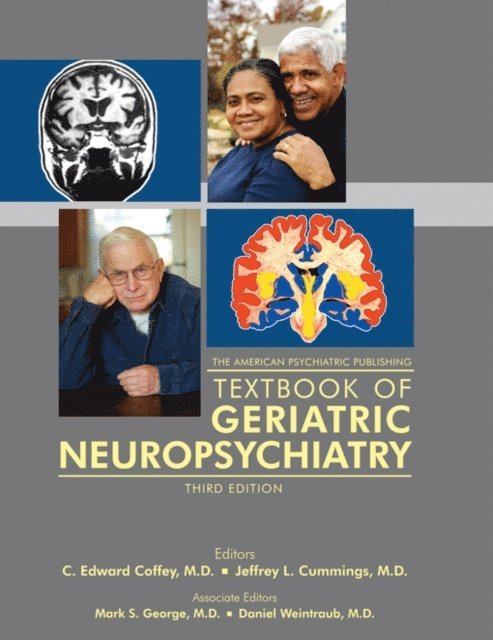
The third edition of the popular Textbook of Geriatric Neuropsychiatry thoroughly reviews this clinical subspecialty devoted to the diagnosis and treatment of psychiatric and behavior disorders in aging patients who display impaired brain function. In this text, world-renowned neuropsychiatrists and neuroscientists provide practical application of the latest research for both experienced clinicians and those new to the study of neuropsychiatry for the elderly. The book provides a comprehensive approach to treatment and contemporary neuroscience: Addresses the reality of an increasing aging population and the accompanying psychosocial changes this brings for patients and caregivers. Focuses on the health care of patients with neuropsychiatric illness. Consolidating the continued explosion of neuroscience research and the understanding of human behavior as it relates to aging. Bridges the fields of geriatric neurology and geriatric psychiatry, emphasizing relationships between neuropsychiatric illness and the aging of the nervous system. Responds to advancements in the study and science of geriatric neuropsychiatry, as well as feedback from past readers and clinicians. Concise and organized for easy reference, the textbook is divided into four parts that disclose clinically relevant information within the context of the very latest in neuroscience research and clinical application, including: Clinical definitions of the essential neuropsychiatric syndromes and disorders commonly seen in the elderly and how these disorders manifest. Emphasis on the principles and special considerations essential for the safe and effective treatment of neuropsychiatric disorders in the elderly. Study of the importance of interactions among aging; psychosocial, family, and neuropharmacological elements; and brain stimulation therapies. In-depth review of the influence of the aging nervous system on the pathophysiology, neuropsychiatric manifestations, clinical course, and prognosis of neurological and psychiatric illness in the elderly. Geriatric neuropsychiatry is an integrative specialty that draws from a diversity of fields including psychiatry, neuropsychiatry, neuroimaging, neuropsychopharmacology, gerontology, genetics, and molecular biology, to name a few. Incorporating these perspectives, this text is highly recommended for psychiatrists, neurologists, psychologists, geriatricians, psychiatric nurses, residents and fellows, and other clinicians interested in the study and treatment of the effects of aging on the brain.
772 kr
Skickas inom 5-8 vardagar
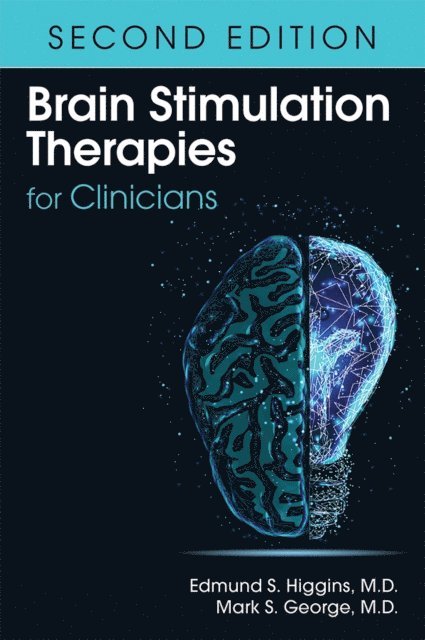
A comprehensive survey of the state of current practice, this new edition of Brain Stimulation Therapies for Clinicians provides thoroughly updated information on the growing list of electrical stimulation therapies now in use or under study, including electroconvulsive therapy (ECT), vagus nerve stimulation (VNS), transcranial magnetic stimulation (TMS), deep brain stimulation (DBS), cortical stimulation (CS), and transcranial direct current stimulation (TDCS), as well as new coverage of promising treatments such as low intensity focused ultrasound pulsation (LIFUP) and temporal interference stimulation (TI). After a brief course on the fundamentals of electricity and a refresher on neuroanatomy, the text explores how electricity works within biological systems before progressing to the chapters on individual therapies, which cover the history and evolution of the treatment, the techniques involved, clinical indications, side effects, and an up-to-date review of the evidence base supporting its use. The book is designed to help the reader cut through the initially daunting "alphabet soup" (e.g., ECT, TMS) by providing a clear and straightforward analysis of the prevailing techniques -- an indispensable resource for both clinicians and patients seeking in-depth knowledge of these acronyms and methods.The book's noteworthy features are many: Refinements in treatment protocols since the last edition are discussed in detail. For example, the sections on ECT cover advances such as focal electrically administered seizure therapy (FEAST) and magnetic seizure therapy (MST), while the TMS chapter covers theta burst and recent approval for obsessive-compulsive disorder. The underlying science is addressed in the initial review of electricity and physics, information that is foundational to these treatment modalities, but that clinicians do not encounter in the medical school curriculum. The section also addresses the parameters for brain stimulation and how to determine the right dose. A separate chapter is devoted to low intensity focused ultrasound pulsations (LIFUP) and temporally interfering (TI) electric fields, emerging treatments that have the potential to noninvasively stimulate focal locations deep in the brain without surgery or the implantation of hardware. The section on using DBS for treatment-resistant Parkinson's disease (PD) is thorough, authoritative, and a boon to clinicians assessing the viability and efficacy of treatment options for their PD patients. The new edition retains the amusing, but always informative sidebars highlighting the history of brain experimentation and applications of brain stimulation techniques Written in a down-to-earth, accessible style by authors at the forefront of progress in the field, Brain Stimulation Therapies for Clinicians is a rigorous, evidence based review of clinical data that focuses on what we know, what we don't know, and the strength of the evidence.
Neuroscience of Clinical Psychiatry
The Pathophysiology of Behavior and Mental Illness
Inbunden, Engelska, 2024
1 530 kr
Skickas inom 7-10 vardagar
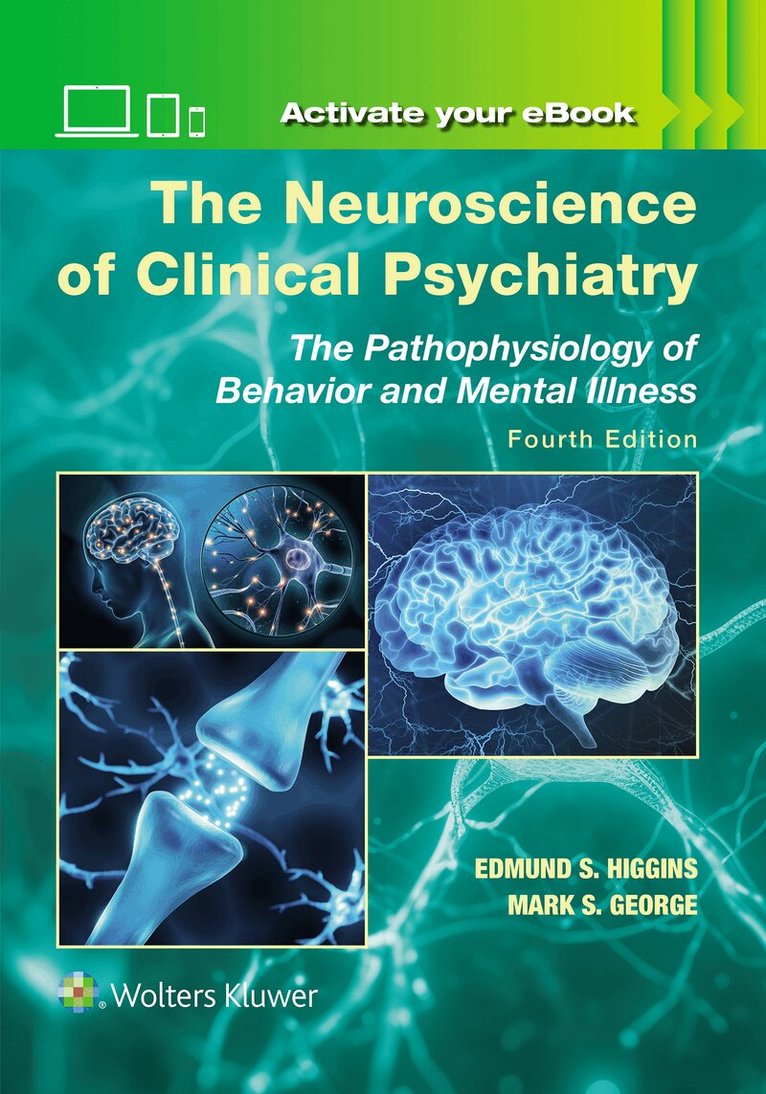
Selected as a Doody’s Core Title for 2025!With a straightforward focus on the basic neuroscientific concepts underlying normal behavior and commonly encountered psychiatric conditions, Drs. Edmund S. Higgins and Mark S. George make complex information enjoyable, relevant, and easy to understand. Ideal for residents studying for boards, practicing psychiatrists, and other mental health professionals, The Neuroscience of Clinical Psychiatry, 4th Edition, is a highly regarded, unique resource that keeps you fully up to date with current research and today’s best practices. Offers a superbly written text, packed with essential information and featuring humorous details that keep you engaged and focused Makes complex information easy to understand and retain with recommendations for clinical application throughout Provides 250 new open-ended questions on-line with explanations for board preparation Up to 52CME credit hours offered with more than 195 online-exclusive questions Features two new chapters on networks and addictions Includes hundreds of high-quality illustrations, tables, and graphs that help you learn complex concepts quickly and easily Enrich your eBook reading experienceRead directly on your preferred device(s),such as computer, tablet, or smartphone. Easily convert to audiobook,powering your content with natural language text-to-speech.