Mark Tunick – författare
Visar alla böcker från författaren Mark Tunick. Handla med fri frakt och snabb leverans.
13 produkter
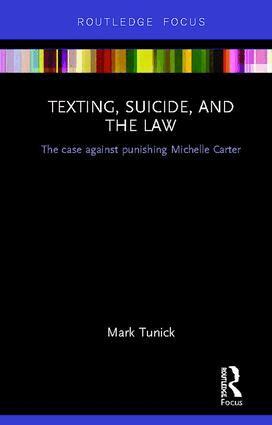
Texting, Suicide, and the Law
The case against punishing Michelle Carter
Av Mark Tunick
Inbunden, 2019
917 kr
Lägg i varukorg
In 2014, Conrad Roy committed suicide following encouragement from his long-distance girlfriend, Michelle Carter, in what has become known as the Texting Suicide case. The case has attracted much attention, largely focusing on the First Amendment free speech issue. This book takes the view that the …
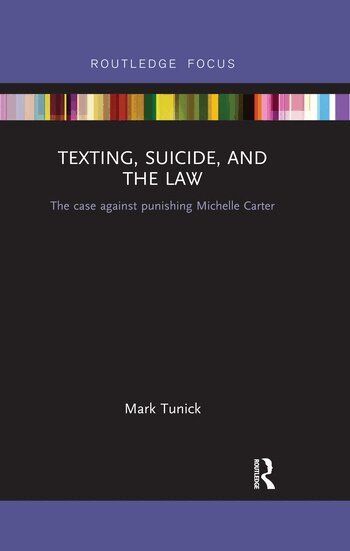
Texting, Suicide, and the Law
The case against punishing Michelle Carter
Av Mark Tunick
Häftad, 2020
634 kr
Lägg i varukorg
In 2014, Conrad Roy committed suicide following encouragement from his long-distance girlfriend, Michelle Carter, in what has become known as the Texting Suicide case. The case has attracted much attention, largely focusing on the First Amendment free speech issue. This book takes the view that the …
Texting, Suicide, and the Law
The case against punishing Michelle Carter
Av Mark Tunick
E-bok, 2019
749 kr
Lägg i varukorg
In 2014, Conrad Roy committed suicide following encouragement from his long-distance girlfriend, Michelle Carter, in what has become known as the Texting Suicide case. The case has attracted much attention, largely focusing on the First Amendment free speech issue. This book takes the view that the …
Texting, Suicide, and the Law
The case against punishing Michelle Carter
Av Mark Tunick
E-bok, 2019
749 kr
Lägg i varukorg
In 2014, Conrad Roy committed suicide following encouragement from his long-distance girlfriend, Michelle Carter, in what has become known as the Texting Suicide case. The case has attracted much attention, largely focusing on the First Amendment free speech issue. This book takes the view that the …
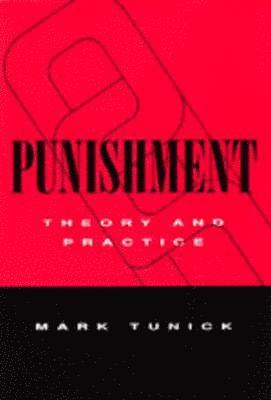
Punishment
Theory and Practice
Av Mark Tunick
Inbunden, 1992
771 kr
Lägg i varukorg
What actions should be punished? Should plea-bargaining be allowed? How should sentencing be determined? In this original, penetrating study, Mark Tunick explores not only why society punishes wrongdoing, but also how it implements punishment. Contending that the theory and practice of punishment …
Punishment
Theory and Practice
Av Mark Tunick
E-bok, 1992
918 kr
Lägg i varukorg
What actions should be punished? Should plea-bargaining be allowed? How should sentencing be determined? In this original, penetrating study, Mark Tunick explores not only why society punishes wrongdoing, but also how it implements punishment. Contending that the theory and practice of punishment …
Practices and Principles
Approaches to Ethical and Legal Judgment
Av Mark Tunick
Häftad, 2000
531 kr
Lägg i varukorg
A Japanese woman living in California attempts parent-child suicide, an ancient Japanese custom called "oyako-shinju," in order to rid herself of shame upon learning that her husband has a mistress. She survives, but her two children are drowned in the attempt. Since her attempt was made in …
Practices and Principles
Approaches to Ethical and Legal Judgment
Av Mark Tunick
E-bok, 2021
698 kr
Lägg i varukorg
A Japanese woman living in California attempts parent-child suicide, an ancient Japanese custom called "oyako-shinju," in order to rid herself of shame upon learning that her husband has a mistress. She survives, but her two children are drowned in the attempt. Since her attempt was made in …
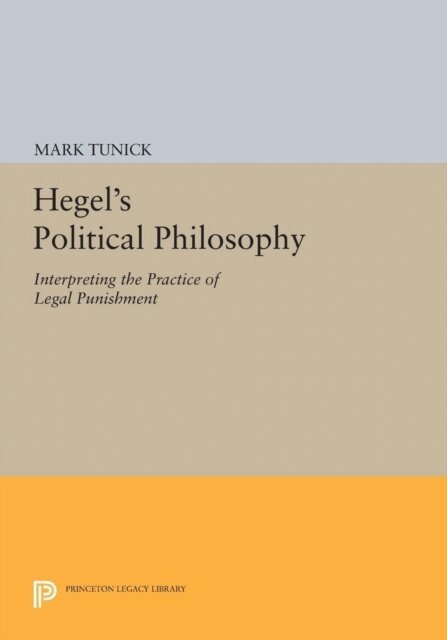
Hegel's Political Philosophy
Interpreting the Practice of Legal Punishment
Av Mark Tunick
Häftad, 2014
721 kr
Lägg i varukorg
To scholars of Western intellectual history Hegel is one of the most important of all political thinkers, but politicians and other "down-to-earth" persons see his speculative philosophy as far removed from their immediate concerns. Put off by his difficult terminology, many participants in …
Hegel's Political Philosophy
Interpreting the Practice of Legal Punishment
Av Mark Tunick
Inbunden, 2016
1465 kr
Lägg i varukorg
To scholars of Western intellectual history Hegel is one of the most important of all political thinkers, but politicians and other "down-to-earth" persons see his speculative philosophy as far removed from their immediate concerns. Put off by his difficult terminology, many participants in …
Balancing Privacy and Free Speech
Unwanted Attention in the Age of Social Media
Av Mark Tunick
Häftad, 2016
754 kr
Lägg i varukorg
In an age of smartphones, Facebook and YouTube, privacy may seem to be a norm of the past. This book addresses ethical and legal questions that arise when media technologies are used to give individuals unwanted attention. Drawing from a broad range of cases within the US, UK, Australia, Europe, …
Balancing Privacy and Free Speech
Unwanted Attention in the Age of Social Media
Av Mark Tunick
Inbunden, 2014
2517 kr
Lägg i varukorg
In an age of smartphones, Facebook and YouTube, privacy may seem to be a norm of the past. This book addresses ethical and legal questions that arise when media technologies are used to give individuals unwanted attention. Drawing from a broad range of cases within the US, UK, Australia, Europe, …
Hegel's Political Philosophy
Interpreting the Practice of Legal Punishment
Av Mark Tunick
E-bok, 2014
484 kr
Lägg i varukorg
To scholars of Western intellectual history Hegel is one of the most important of all political thinkers, but politicians and other "e;down-to-earth"e; persons see his speculative philosophy as far removed from their immediate concerns. Put off by his difficult terminology, many …