Markus Ullmann – författare
Visar alla böcker från författaren Markus Ullmann. Handla med fri frakt och snabb leverans.
6 produkter
6 produkter
Häftad, Engelska, 2004
561 kr
Skickas inom 10-15 vardagar
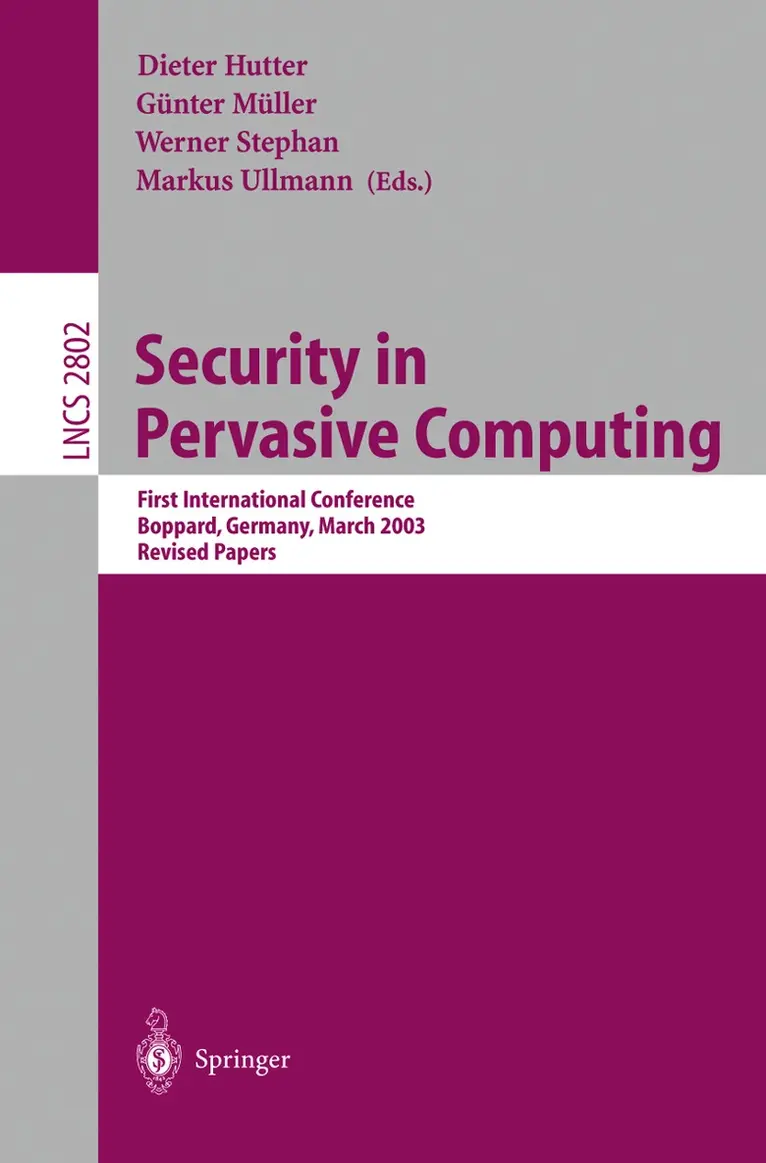
The ongoing compression of computing facilities into small and mobile devices like handhelds, portables or even wearable computers will enhance ubiquitous information processing. The basic paradigm of such pervasive computing is the combination of strongly decentralized and distributed computing with the help of diversi?ed devices allowingforspontaneousconnectivityviatheInternet.Computerswillbecomeinvisible to the user, and exchangeof informationbetween devices will effectivelybe beyondthe user's control. Assuming a broad usage of more powerful tools and more effective ways to use them the quality of everydaylife will be strongly in?uenced by the dependabilityof the new technology. Information stored, processed, and transmitted by the various devices is one of the most critical resources. Threats exploiting vulnerabilities of new kinds of user interfaces, displays, operating systems, networks, and wireless communications will cause new risks of losing con?dentiality, integrity, and availability. Can these risks be reducedbycountermeasuresto an acceptablelevelor dowe haveto rede?nepolitical and social demands.The objective of this 1st International Conference on Security in Pervasive C- puting was to develop new security concepts for complex application scenarios based on systems like handhelds, phones, smartcards, and smart labels hand in hand with the emerging technology of ubiquitous and pervasive computing. Particular subjects were methodsand technologyconcerningthe identi?cationof risks, the de?nition of security policies, and the development of security measures that are related to the speci?c - pects of ubiquitous and pervasive computing like mobility, communication, and secure hardware/software platforms.
Häftad, Engelska, 2005
561 kr
Skickas inom 10-15 vardagar
This volume contains the papers presented at the 2nd International Conference on Se- rityinPervasiveComputing(SPC2005)heldApril6-8,2005inBoppard,Germany.The objective of this second conference was to develop new security concepts for complex application scenarios based on systems like handhelds, phones, smartcards, RFID-chips andsmartlabelshandinhandwiththeemergingtechnologyofubiquitousandpervasive computing. In particular the conference focused on methods and technologies conce- ing the identi?cation of risks, the de?nition of security policies, and the development of security and privacy measures, especially cryptographic protocols that are related to speci?c aspects of ubiquitous and pervasive computing like mobility, location-based services,adhocnetworking,resourceallocation/restriction,invisibility,andsecureha- ware/software platforms. We received 48 submissions. Each submission was reviewed by three independent reviewers and an electronic Program Committee meeting was held via the Internet. We are very grateful to the Program Committee members for their ef?ciency in processing the work and also for the quality of their reviews and discussions.Finally the Program Committee decided to accept 14 long papers and 3 short papers. Apart from the Program Committee, we would like to thank also the other persons who contributed to the success of this conference: the additional referees for revi- ing the papers, the authors for submitting the papers, and the local organizers, and in particular Hans-Peter Wagner, for the local organization of the conference in Boppard. SPC 2005 was hosted by the Bundesakademie fur .. of .. fentlicheVerwaltung of the Federal Ministry of the Interior, and was sponsored by the DFKI and BSI.
E-bok
PDF, Engelska, 2005708 kr
Läs direkt efter köp
E-bok
PDF, Engelska, 2004708 kr
Läs direkt efter köp
E-bok
PDF, Engelska, 2007708 kr
Läs direkt efter köp
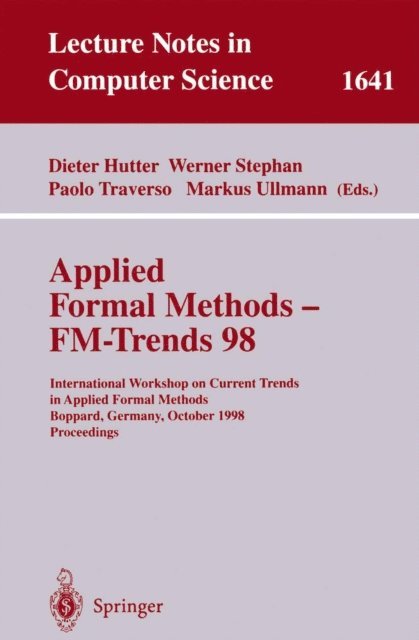
This volume contains the contributions presented at the International Workshop on Current Trends in Applied Formal Methods organized October 7-9, 1998, in Boppard, Germany. The main objective of the workshop was to draw a map of the key issues facing the practical application of formal methods in industry. This appears to be particularly timely with safety and security issues becoming a real obstacle to industrial software and hardware development. As a consequence, almost all major companies have now set up departments or groups to work with formal methods and many European countries face a severe labour shortage in this new field. Tony Hoare''s prediction of the art of software (and hardware) development becoming a proper engineering science with its own body of tools and techniques is now becoming a reality. So the focus of this application oriented workshop was not so much on spe cial academic topics but rather on the many practical aspects of this emerging new technology: verification and validation, and tool support and integration into the software life-cycle. By evaluating the state of the art with respect to industrial applications a discussion emerged among scientists, practising engi neers, and members of regulatory and funding agencies about future needs and developments. This discussion lead to roadmaps with respect to the future of this field, to tool support, and potential application areas and promising market segments. The contributions of the participants from industry as well as from the respective national security bureaus were particularly valuable and highly appreciated.
Häftad, Engelska, 1999
561 kr
Skickas inom 10-15 vardagar
This book constitutes the thoroughly refereed post-workshop proceedings of the International Workshop on Current Trends in Applied Formal Methods, FM-Trends 98, held in Boppard, Germany, in October 1998.The book presents two invited papers, 14 regular papers, three application papers, and eight tool presentations. All these papers were carefully reviewed and revised for inclusion in the book. The papers address all current issues in applying formal methods during the different design stages of software systems for use in various application fields.