Marta Dassù - Böcker
Visar alla böcker från författaren Marta Dassù. Handla med fri frakt och snabb leverans.
3 produkter
3 produkter
1 685 kr
Skickas inom 10-15 vardagar
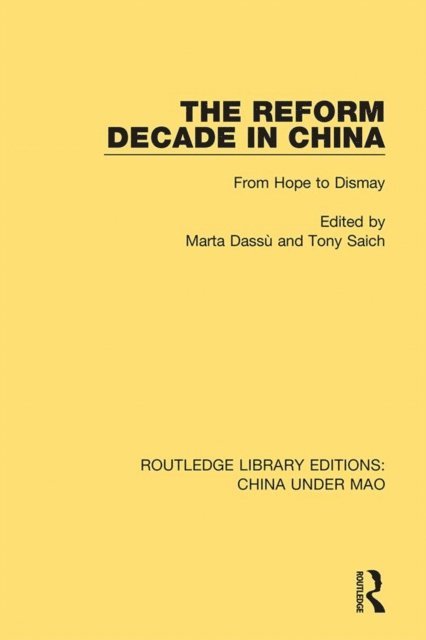
This book, first published in 1992, provides a detailed analysis of the reform programme in post-Mao China. In it, a distinguished group of specialists show how the dramatic events that came to a head in Tiananmen Square in 1989 were the result of a profound crisis in the reform programme launched in 1978. Individual chapters examine the roots of this crisis: the inability to deal sufficiently with the Maoist legacy; insufficient political reform; the clash between Deng’s revolution from above and society’s revolution from below; the imbalances created by the new economic programme; and the relationship between these domestic changes and China’s foreign policy.
495 kr
Skickas inom 10-15 vardagar
This book, first published in 1992, provides a detailed analysis of the reform programme in post-Mao China. In it, a distinguished group of specialists show how the dramatic events that came to a head in Tiananmen Square in 1989 were the result of a profound crisis in the reform programme launched in 1978. Individual chapters examine the roots of this crisis: the inability to deal sufficiently with the Maoist legacy; insufficient political reform; the clash between Deng’s revolution from above and society’s revolution from below; the imbalances created by the new economic programme; and the relationship between these domestic changes and China’s foreign policy.
396 kr
Skickas inom 7-10 vardagar
Nostalgia has become a major force in global politics. While Donald Trump hopes to ‘make America great again’, Xi Jinping calls for a ‘great rejuvenation of the Chinese people’, and a majority of Russians still mourn the Soviet Union. But it is Brexit, with its idealisation of a bygone era of full sovereignty, that epitomises nostalgic nationalism in its purest form. Despite its romantic flavour, nostalgia is a malaise—a combination of paranoia and melancholy that idealises the past, while denigrating the present. This epidemic of mythicising national history is shaping politics in risky ways, fuelled by ageing populations, shifts in the global order, and technological disruption. When deployed in the political debate, collective nostalgia is used as an emotional weapon, capable of mobilising a nation towards illusory goals.Drawing on psychology, political science, history and popular culture, Anglo Nostalgia analyses the rapid spread of this global phenomenon, before focusing on Brexit as a case study. With the detachment of informed outsiders, Campanella and Dassù expose nostalgia’s great danger: the oversimplification of reality, leading to unprecedented political miscalculations and rising geopolitical tensions.