Marta Tawil Kuri – författare
788 kr
Läs direkt efter köp
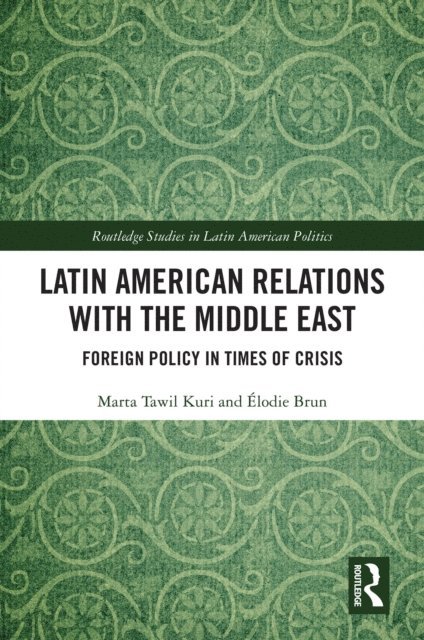
Latin American Relations with the Middle East surveys the dealings of ten Latin American and Caribbean states – Argentina, Brazil, Chile, Colombia, Costa Rica, Cuba, Peru, Mexico, Uruguay, and Venezuela – with the Middle East.
This volume examins these states'' external behavior at both an empirical and conceptual level. Empirically, authors seek to examine Latin American and Caribbean foreign policies towards the Middle East in four dimensions: diplomatic attention; trade and investment (including the energy issue); development cooperation; security matters/intelligence, and relationship with multilateralism (Iran, Palestine, and Syria). Case studies are selectively deployed to observe the influence of unfavorable circumstances that have increased since 2015, such as domestic turmoil, wars, economic crisis, ideological bias, and international constraints. Conceptually, the book enhances the theoretical framework for understanding Southern countries’ foreign policies, through fomenting dialogue with Latin American and Caribbean regional literature on foreign policy. Authors inquire about how decision-making processes occur, and uncover how influential actors help to test the main hypotheses of Foreign Policy Analysis (FPA).
Forging essential new paths of inquiry, this book is a must read for researchers of International Relations, Foreign Policy, South-South Relations, Latin American Politics, and Middle Eastern Politics.
790 kr
Läs direkt efter köp
Latin American Relations with the Middle East surveys the dealings of ten Latin American and Caribbean states – Argentina, Brazil, Chile, Colombia, Costa Rica, Cuba, Peru, Mexico, Uruguay, and Venezuela – with the Middle East.
This volume examins these states'' external behavior at both an empirical and conceptual level. Empirically, authors seek to examine Latin American and Caribbean foreign policies towards the Middle East in four dimensions: diplomatic attention; trade and investment (including the energy issue); development cooperation; security matters/intelligence, and relationship with multilateralism (Iran, Palestine, and Syria). Case studies are selectively deployed to observe the influence of unfavorable circumstances that have increased since 2015, such as domestic turmoil, wars, economic crisis, ideological bias, and international constraints. Conceptually, the book enhances the theoretical framework for understanding Southern countries’ foreign policies, through fomenting dialogue with Latin American and Caribbean regional literature on foreign policy. Authors inquire about how decision-making processes occur, and uncover how influential actors help to test the main hypotheses of Foreign Policy Analysis (FPA).
Forging essential new paths of inquiry, this book is a must read for researchers of International Relations, Foreign Policy, South-South Relations, Latin American Politics, and Middle Eastern Politics.
2 390 kr
Skickas inom 10-15 vardagar
658 kr
Skickas inom 10-15 vardagar
1 413 kr
Läs direkt efter köp
1 073 kr
Skickas inom 10-15 vardagar
1 073 kr
Skickas inom 10-15 vardagar