Martin Ceadel - Böcker
Visar alla böcker från författaren Martin Ceadel. Handla med fri frakt och snabb leverans.
3 produkter
3 produkter
The Origins of War Prevention
The British Peace Movement and International Relations 1730-1854
Inbunden, Engelska, 1996
3 587 kr
Skickas inom 3-6 vardagar
This book makes an original contribution to international relations and British politics. It identifies for the first time the dominant pre-modern theory of international relations, which fatalistically assumed that war was beyond human control. It then shows how this theory was undermined from the 1730s onwards, with the consequence that a debate began about how best to prevent war in which a vocal minority argued that war as an institution for settling disputes could be abolished. Britain led the way in this repudiation of fatalism and exploration of pacific alternatives: it produced the world's first peace movement (which appeared in the mid-1790s as a response to the French wars) and the first enduring national peace association (the Peace Society, founded in 1816 and active for nearly a century); and it was the first country to allow peace thinking (for example, as expounded by Richard Cobden) to enter its political mainstream. This book, the first to make use of the Peace Society's records, fills a major gap in the historiography of British politics.
Semi-Detached Idealists
The British Peace Movement and International Relations, 1854-1945
Inbunden, Engelska, 2000
3 873 kr
Skickas inom 5-8 vardagar
Britain's semi-detached geographical position has helped to give it the world's strongest peace movement. Secure enough from invasions to be influenced by an idealistic approach to international relations (unlike most of Europe), yet too close to the continent for isolationism to be an option (as it was in the United States), the country has provided favourable conditions for those aspiring not merely to prevent war but to abolish it. The period from the Crimean War to the Second World War marked the British peace movement's age of maturity. In 1854, it was obliged for the first time to contest a decision - and moreover a highly popular one - to enter war. It survived the resulting adversity, and gradually rebuilt its position as an accepted voice in public life, though by the end of the nineteenth century its leading associations such as the Peace Society were losing vitality as they gained respectability. Stimulated by the First World War into radicalizing and reconstructing itself through the formation of such associations as the Union of Democratic Control, the No-Conscription Fellowship, and the Fellowship of Reconciliation, the movement endured another period of unpopularity before enjoying unprecedented influence during the inter-war years, the era of the League of Nations Union, the Oxford Union's 'King and country' debate, the Peace Ballot, and the Peace Pledge Union. Finally, however, Hitler discredited much of the agenda it had been promoting the previous century or more. This book is the first comprehensive and authoritative study of this subject. It covers all significant peace associations and campaigns and is based on an extensive use of archival as well as printed sources. Its subject matter is of relevance both to historians of nineteenth and twentieth-century British politics and to specialists in international relations interested in the anti-realist tradition.
1 566 kr
Skickas inom 7-10 vardagar
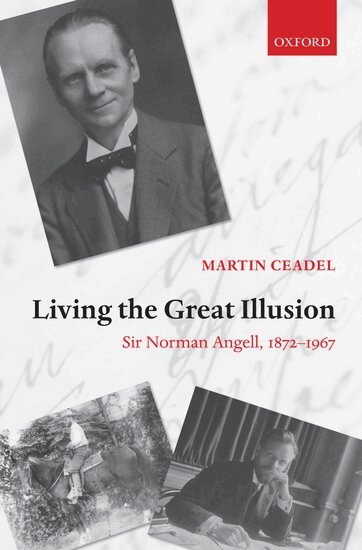
Sir Norman Angell, pioneer both of international relations as a distinct discipline and of the theory of globalization, winner of the Nobel Peace Prize, and one of the twentieth century's leading internationalist campaigners on both sides of the Atlantic, lived the great illusion in three senses. First, his 'life job', as he came to call it, was founded upon and defined by The Great Illusion, a best-seller whose original version appeared in 1909: it perceptively showed how economic interdependence would prevent great powers profiting from war; yet it made other, less felicitous, claims from whose implications he spent decades trying to extricate himself. Second, his magnum opus and all his best work derived, to an extent unusual for a public intellectual, not from abstract thinking but from an eventful and varied life as a jobbing journalist in four countries, a cowboy, land-speculator, and gold-prospector in California, production manager of the continental edition of the Daily Mail, author, lecturer, pig farmer, Labour MP, entrepreneur, and campaigner for collective security. Third, he fostered many an enduring illusion about himself by at various times giving wrongly his age, name, nationality, marital status, key career dates, and core beliefs. By dint of careful detective work, this first biography of Angell reveals the truth about a remarkable life that has hitherto been much misrepresented and misinterpreted.