Martin Dietzfelbinger - Böcker
Visar alla böcker från författaren Martin Dietzfelbinger. Handla med fri frakt och snabb leverans.
9 produkter
9 produkter
538 kr
Skickas inom 10-15 vardagar
This textbook is a concise introduction to the basic toolbox of structures that allow efficient organization and retrieval of data, key algorithms for problems on graphs, and generic techniques for modeling, understanding, and solving algorithmic problems.
554 kr
Skickas inom 10-15 vardagar
This textbook is a concise introduction to the basic toolbox of structures that allow efficient organization and retrieval of data, key algorithms for problems on graphs, and generic techniques for modeling, understanding, and solving algorithmic problems.
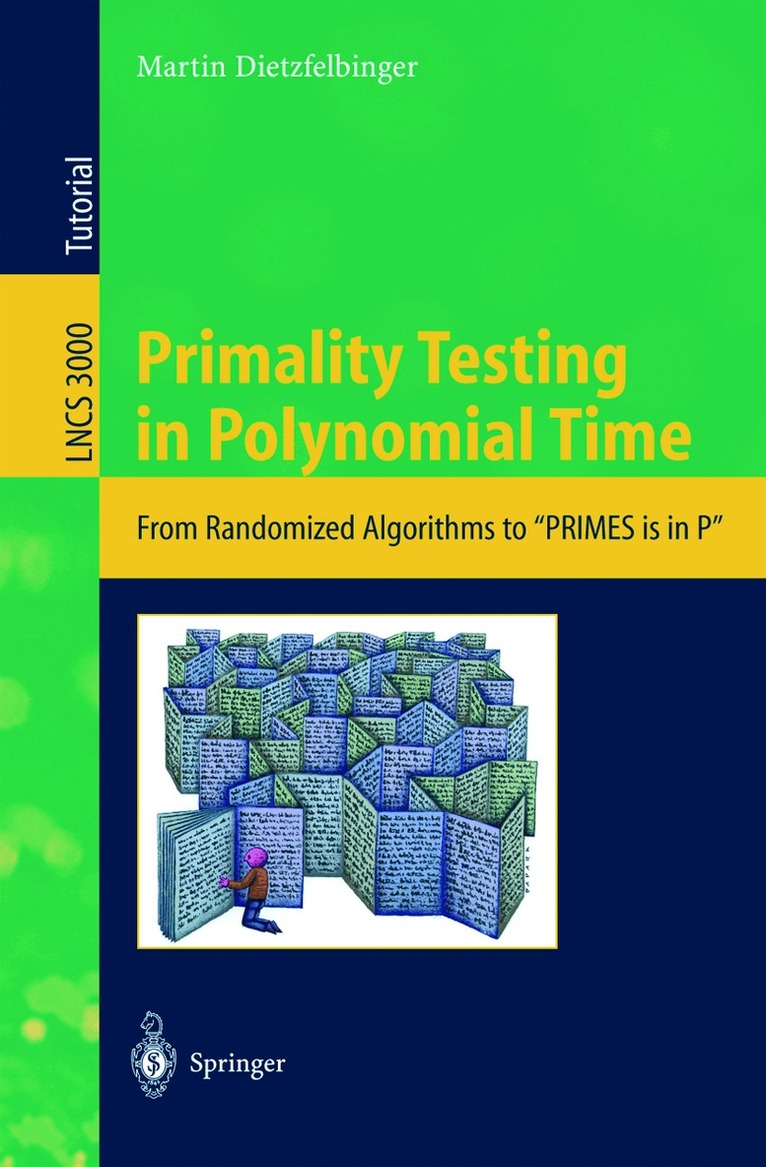
Primality Testing in Polynomial Time
From Randomized Algorithms to "PRIMES Is in P"
Häftad, Engelska, 2004
538 kr
Skickas inom 7-10 vardagar
On August 6, 2002,a paper with the title “PRIMES is in P”, by M. Agrawal, N. Kayal, and N. Saxena, appeared on the website of the Indian Institute of Technology at Kanpur, India. In this paper it was shown that the “primality problem”hasa“deterministic algorithm” that runs in “polynomial time”. Finding out whether a given number n is a prime or not is a problem that was formulated in ancient times, and has caught the interest of mathema- ciansagainandagainfor centuries. Onlyinthe 20thcentury,with theadvent of cryptographic systems that actually used large prime numbers, did it turn out to be of practical importance to be able to distinguish prime numbers and composite numbers of signi?cant size. Readily, algorithms were provided that solved the problem very e?ciently and satisfactorily for all practical purposes, and provably enjoyed a time bound polynomial in the number of digits needed to write down the input number n. The only drawback of these algorithms is that they use “randomization” — that means the computer that carries out the algorithm performs random experiments, and there is a slight chance that the outcome might be wrong, or that the running time might not be polynomial. To ?nd an algorithmthat gets by without rand- ness, solves the problem error-free, and has polynomial running time had been an eminent open problem in complexity theory for decades when the paper by Agrawal, Kayal, and Saxena hit the web.
467 kr
Skickas inom 10-15 vardagar
Hinter vielen Programmen stecken clevere Verfahren, die man als Algorithmen bezeichnet. Algorithmen lösen nicht nur mathematische Aufgaben, die sich mit Zahlen beschäftigen, sondern auch andere, ganz alltägliche Problemstellungen, bei denen logischer Spürsinn, räumliche Orientierung oder geschicktes Verhandeln gefragt sind, beispielsweise: Wie sollten Seeräuber eine Schatzkarte aufteilen, bzw. Bankangestellte den Geheimcode des Tresors? Wie ermittle ich den kürzesten Weg zwischen zwei Orten? Wie kann ich einen Kuchen gerecht aufteilen? Dieses Buch vollführt einen Streifzug durch die faszinierende Welt der Algorithmen. Es verlangt keine Vorkenntnisse, so dass Schüler ab der Mittelstufe und Informatik-interessierte Laien neue und überraschende Einblicke gewinnen können. In 43 Artikeln von Informatikern, die an Universitäten im In- und Ausland lehren, werden besonders elegante Algorithmen anschaulich und umgangssprachlich erklärt, so dass die besondere Faszination der Informatik spürbar wird.
518 kr
Skickas inom 10-15 vardagar
Algorithmen bilden das Herzstück jeder nichttrivialen Anwendung von Computern, und die Algorithmik ist ein modernes und aktives Gebiet der Informatik.
1 175 kr
Skickas inom 10-15 vardagar
Algorithms Unplugged presents some of the most beautiful algorithmic ideas in 41 articles written in colloquial, nontechnical language. Most of the articles arose out of an initiative among German-language universities to communicate the fascination of algorithms and computer science to high-school students.
Mathematical Foundations of Computer Science 2014
39th International Symposium, MFCS 2014, Budapest, Hungary, August 26-29, 2014. Proceedings, Part II
Häftad, Engelska, 2014
538 kr
Skickas inom 10-15 vardagar
This two volume set LNCS 8634 and LNCS 8635 constitutes the refereed conference proceedings of the 39th International Symposium on Mathematical Foundations of Computer Science, MFCS 2014, held in Budapest, Hungary, in August 2014. The 95 revised full papers presented together with 6 invited talks were carefully selected from 270 submissions. The focus of the conference was on following topics: Logic, Semantics, Automata, Theory of Programming, Algorithms, Complexity, Parallel and Distributed Computing, Quantum Computing, Automata, Grammars and Formal Languages, Combinatorics on Words, Trees and Games.
Mathematical Foundations of Computer Science 2014
39th International Symposium, MFCS 2014, Budapest, Hungary, August 26-29, 2014. Proceedings, Part I
Häftad, Engelska, 2014
538 kr
Skickas inom 10-15 vardagar
This two volume set LNCS 8634 and LNCS 8635 constitutes the refereed conference proceedings of the 39th International Symposium on Mathematical Foundations of Computer Science, MFCS 2014, held in Budapest, Hungary, in August 2014. The 95 revised full papers presented together with 6 invited talks were carefully selected from 270 submissions. The focus of the conference was on following topics: Logic, Semantics, Automata, Theory of Programming, Algorithms, Complexity, Parallel and Distributed Computing, Quantum Computing, Automata, Grammars and Formal Languages, Combinatorics on Words, Trees and Games.
1 175 kr
Skickas inom 10-15 vardagar
Algorithms specify the way computers process information and how they execute tasks. Many recent technological innovations and achievements rely on algorithmic ideas – they facilitate new applications in science, medicine, production, logistics, traffic, communi¬cation and entertainment. Efficient algorithms not only enable your personal computer to execute the newest generation of games with features unimaginable only a few years ago, they are also key to several recent scientific breakthroughs – for example, the sequencing of the human genome would not have been possible without the invention of new algorithmic ideas that speed up computations by several orders of magnitude. The greatest improvements in the area of algorithms rely on beautiful ideas for tackling computational tasks more efficiently. The problems solved are not restricted to arithmetic tasks in a narrow sense but often relate to exciting questions of nonmathematical flavor, such as: How can I find the exit out of amaze? How can I partition a treasure map so that the treasure can only be found if all parts of the map are recombined? How should I plan my trip to minimize cost? Solving these challenging problems requires logical reasoning, geometric and combinatorial imagination, and, last but not least, creativity – the skills needed for the design and analysis of algorithms.In this book we present some of the most beautiful algorithmic ideas in 41 articles written in colloquial, nontechnical language. Most of the articles arose out of an initiative among German-language universities to communicate the fascination of algorithms and computer science to high-school students. The book can be understood without any prior knowledge of algorithms and computing, and it will be an enlightening and fun read for students and interested adults.