Martin F. Kaplan – författare
Visar alla böcker från författaren Martin F. Kaplan. Handla med fri frakt och snabb leverans.
6 produkter
6 produkter
Häftad, Engelska, 2014
754 kr
Skickas inom 10-15 vardagar
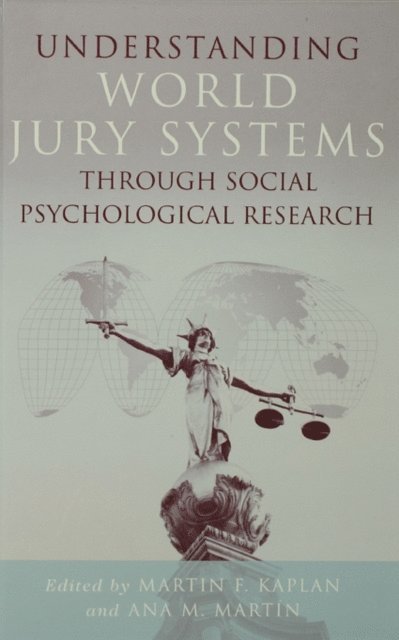
This volume examines diverse jury systems in nations around the world. These systems are marked by unique features having critical implications for jury selection, composition, functioning, processes, and ultimately, trial outcomes. These unique features are examined by applying relevant social psychological research, models and concepts to the central issues and characteristics of jury systems in those nations using a wide variety of jury procedures.Traditionally, research that has been conducted on juries has almost exclusively targeted the North-American jury. Psychologically-based research on European, Asian and Australian juries has been almost non-existent in the past decade or more. Yet, the incidence of jury trials outside of North America has been steadily increasing as more nations (e.g., Japan, Spain, Russia, and Poland) adopt, revise, or expand their use of juries in their legal system. Accordingly, research has been appearing in the scientific literature on new developments in world juries (particularly in Spain, Japan, and Australia).This volume fulfils the dual purpose of understanding the diverse practices in world juries in light of existing social psychological knowledge and applied research on juries in each nation, and outlining new research in the context of the issues raised by jury practices beyond those of North America.
E-bok
PDF, Engelska, 2013923 kr
Läs direkt efter köp
This volume examines diverse jury systems in nations around the world. These systems are marked by unique features having critical implications for jury selection, composition, functioning, processes, and ultimately, trial outcomes. These unique features are examined by applying relevant social psychological research, models and concepts to the central issues and characteristics of jury systems in those nations using a wide variety of jury procedures.Traditionally, research that has been conducted on juries has almost exclusively targeted the North-American jury. Psychologically-based research on European, Asian and Australian juries has been almost non-existent in the past decade or more. Yet, the incidence of jury trials outside of North America has been steadily increasing as more nations (e.g., Japan, Spain, Russia, and Poland) adopt, revise, or expand their use of juries in their legal system. Accordingly, research has been appearing in the scientific literature on new developments in world juries (particularly in Spain, Japan, and Australia).This volume fulfils the dual purpose of understanding the diverse practices in world juries in light of existing social psychological knowledge and applied research on juries in each nation, and outlining new research in the context of the issues raised by jury practices beyond those of North America.
E-bok
Engelska, 2013915 kr
Läs direkt efter köp
This volume examines diverse jury systems in nations around the world. These systems are marked by unique features having critical implications for jury selection, composition, functioning, processes, and ultimately, trial outcomes. These unique features are examined by applying relevant social psychological research, models and concepts to the central issues and characteristics of jury systems in those nations using a wide variety of jury procedures.Traditionally, research that has been conducted on juries has almost exclusively targeted the North-American jury. Psychologically-based research on European, Asian and Australian juries has been almost non-existent in the past decade or more. Yet, the incidence of jury trials outside of North America has been steadily increasing as more nations (e.g., Japan, Spain, Russia, and Poland) adopt, revise, or expand their use of juries in their legal system. Accordingly, research has been appearing in the scientific literature on new developments in world juries (particularly in Spain, Japan, and Australia).This volume fulfils the dual purpose of understanding the diverse practices in world juries in light of existing social psychological knowledge and applied research on juries in each nation, and outlining new research in the context of the issues raised by jury practices beyond those of North America.
E-bok
PDF, Engelska, 2013735 kr
Läs direkt efter köp
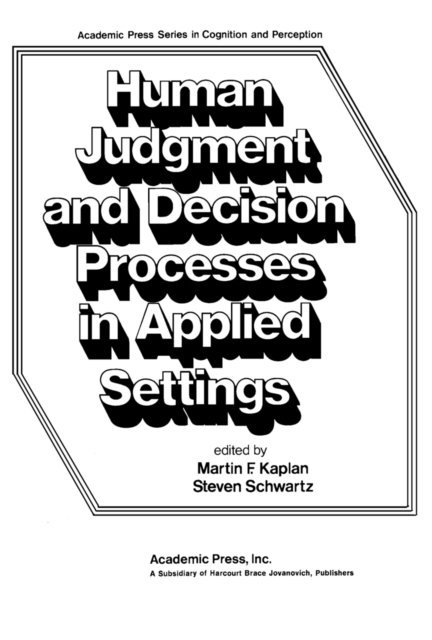
Human Judgment and Decision Processes in Applied Settings is the second to two volumes that attempt to define the areas of progress in the understanding of human decision making processes. The first volume, Human Judgment and Decision Processes (Academic Press, 1975) was concerned with formal and mathematical approaches to the problems of judgment and decision making. The major theoretical orientations (information integration theory, signal detection theory, portfolio theory, and multiattribute-utility measurement) were presented and their rationales discussed. The present volume is concerned with the application of these theories, and the various techniques derived from them, to the problems of decision making in the everyday world. The chapters reflect the many modifications and adjustments that must be made to mathematical rules in order to apply decision theory models in the real world. The tools described serve a broad variety of interests: those of the urban health or social planner, the organizational manager, the researcher, the educator, and, in fact, all of those who must weight evidence to reach decisions. Planner, manager, researcher, teacher, policymaker—all will find assistance in overcoming the commonly encountered roadblocks when one must choose between alternatives in what remains an uncertain world.
E-bok
PDF, Engelska, 2013735 kr
Läs direkt efter köp
Human Judgment and Decision Processes is a collection of papers that covers the various theoretical frameworks that relate judgment to decision making. The book is comprised of 10 chapters that cover both mathematical models involved in decision making and interpersonal aspect of judgment process. The first five chapters cover papers about decision making. The subjects of the papers include multiattribute utility measurement for social decision making; portfolio theory and the measurement of risk; and information-integration analysis of risky decision making. The other half of the text deals with the judgment process, which includes topics such as interaction of judge and informational components; judgment and decision processes in the formation and change of social attitudes; and the role of probabilistic and syllogistic reasoning in cognitive organization and social inference. The book will be of great use to psychologists involved in research on human judgment and decision process.
Inbunden, Engelska, 2006
1 876 kr
Skickas inom 10-15 vardagar
This volume examines diverse jury systems in nations around the world. These systems are marked by unique features having critical implications for jury selection, composition, functioning, processes, and ultimately, trial outcomes. These unique features are examined by applying relevant social psychological research, models and concepts to the central issues and characteristics of jury systems in those nations using a wide variety of jury procedures.Traditionally, research that has been conducted on juries has almost exclusively targeted the North-American jury. Psychologically-based research on European, Asian and Australian juries has been almost non-existent in the past decade or more. Yet, the incidence of jury trials outside of North America has been steadily increasing as more nations (e.g., Japan, Spain, Russia, and Poland) adopt, revise, or expand their use of juries in their legal system. Accordingly, research has been appearing in the scientific literature on new developments in world juries (particularly in Spain, Japan, and Australia).This volume fulfils the dual purpose of understanding the diverse practices in world juries in light of existing social psychological knowledge and applied research on juries in each nation, and outlining new research in the context of the issues raised by jury practices beyond those of North America.