Martin Gutting - Böcker
Visar alla böcker från författaren Martin Gutting. Handla med fri frakt och snabb leverans.
3 produkter
3 produkter
2 300 kr
Skickas inom 10-15 vardagar
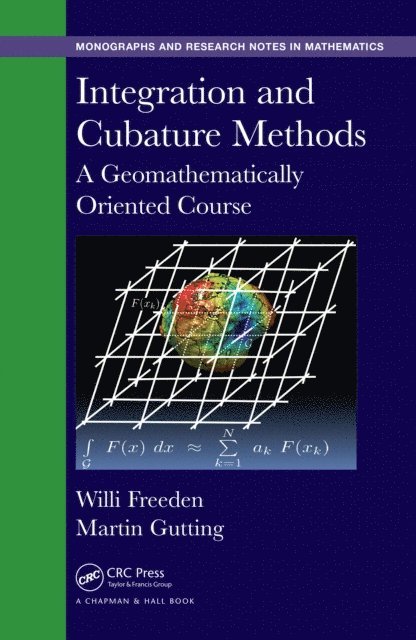
In industry and economics, the most common solutions of partial differential equations involving multivariate numerical integration over cuboids include techniques of iterated one-dimensional approximate integration. In geosciences, however, the integrals are extended over potato-like volumes (such as the ball, ellipsoid, geoid, or the Earth) and their boundary surfaces which require specific multi-variate approximate integration methods. Integration and Cubature Methods: A Geomathematically Oriented Course provides a basic foundation for students, researchers, and practitioners interested in precisely these areas, as well as breaking new ground in integration and cubature in geomathematics.
1 069 kr
Skickas inom 10-15 vardagar
The special functions to be discussed in this monograph vary greatly, depending on the measurement parameters examined (gravitation, electric and magnetic fields, deformation, climate observables, fluid flow, etc.) and on the respective field characteristic (potential field, diffusion field, wave field).
1 069 kr
Skickas inom 10-15 vardagar
Special functions enable us to formulate a scientific problem by reduction such that a new, more concrete problem can be attacked within a well-structured framework, usually in the context of differential equations. A good understanding of special functions provides the capacity to recognize the causality between the abstractness of the mathematical concept and both the impact on and cross-sectional importance to the scientific reality.The special functions to be discussed in this monograph vary greatly, depending on the measurement parameters examined (gravitation, electric and magnetic fields, deformation, climate observables, fluid flow, etc.) and on the respective field characteristic (potential field, diffusion field, wave field). The differential equation under consideration determines the type of special functions that are needed in the desired reduction process.Each chapter closes with exercises that reflect significant topics, mostly in computational applications. As a result, readers are not only directly confronted with the specific contents of each chapter, but also with additional knowledge on mathematical fields of research, where special functions are essential to application. All in all, the book is an equally valuable resource for education in geomathematics and the study of applied and harmonic analysis.Students who wish to continue with further studies should consult the literature given as supplements for each topic covered in the exercises.