Martin Land – författare
Visar alla böcker från författaren Martin Land. Handla med fri frakt och snabb leverans.
6 produkter
6 produkter
Häftad, Engelska, 2018
528 kr
Skickas inom 5-8 vardagar
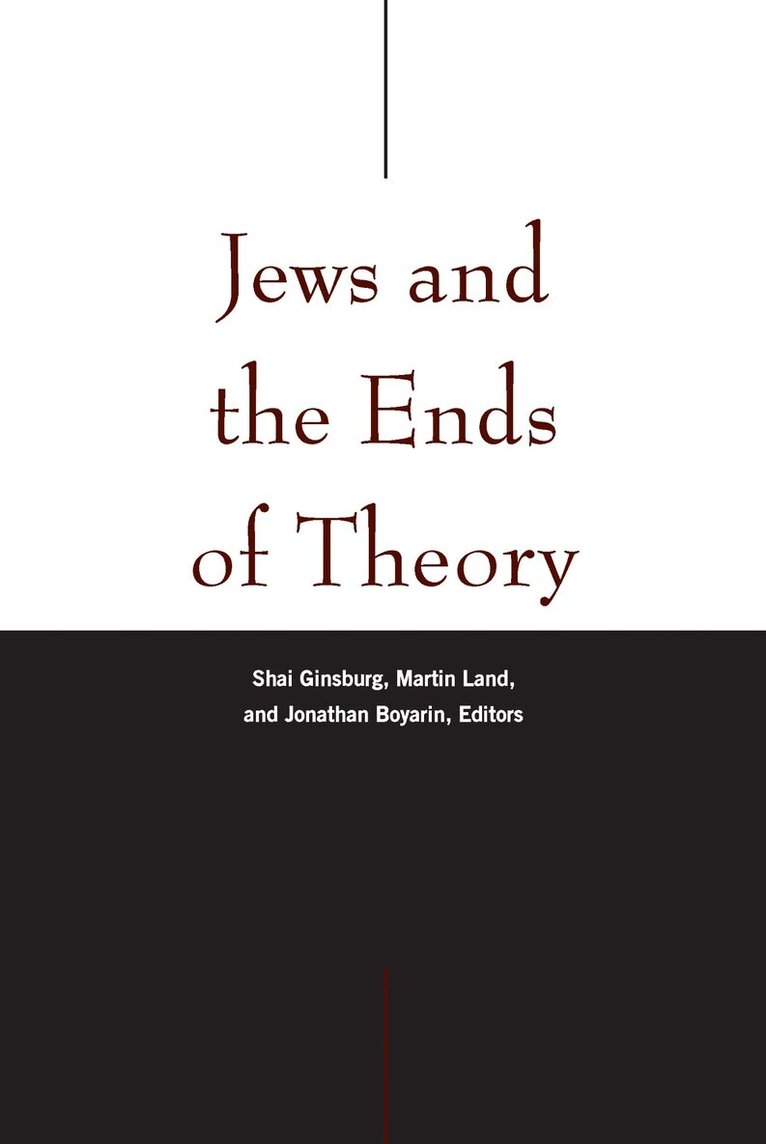
Theory, as it's happened across the humanities, has often been coded as "Jewish." This collection of essays seeks to move past explanations for this understanding that rely on the self-evident (the historical centrality of Jews to the rise of Critical Theory with the Frankfurt School) or stereotypical (psychoanalysis as the "Jewish Science") in order to show how certain problematics of modern Jewishness enrich theory.In the range of violence and agency that attend the appellation "Jew," depending on how, where, and by whom it's uttered, we can see that Jewishness is a rhetorical as much as a sociological fact, and that its rhetorical and sociological aspects, while linked, are not identical. Attention to this disjuncture helps to elucidate the questions of power, subjectivity, identity, figuration, language, and relation that modern theory has grappled with. These questions in turn implicate geopolitical issues such as the relation of a people to a state and the violence done in the name of simplistic identitarian ideologies.Clarifying a situation where "the Jew" is not readily or unproblematically legible, the editors propose what they call "spectral reading," a way to understand Jewishness as a fluid and rhetorical presence. While not divorced from sociological facts, this spectral reading works in concert with contemporary theory to mediate pessimistic and utopian impulses, experiences, and realities.Contributors: Svetlana Boym, Andrew Bush, Sergey Dolgopolski, Jay Geller, Sarah Hammerschlag, Hannan Hever, Martin Land, Martin Jay, James I. Porter, Yehouda Shenhav, Elliot R. Wolfson
Inbunden, Engelska, 2018
1 927 kr
Skickas inom 10-15 vardagar
Theory, as it's happened across the humanities, has often been coded as "Jewish." This collection of essays seeks to move past explanations for this understanding that rely on the self-evident (the historical centrality of Jews to the rise of Critical Theory with the Frankfurt School) or stereotypical (psychoanalysis as the "Jewish Science") in order to show how certain problematics of modern Jewishness enrich theory.In the range of violence and agency that attend the appellation "Jew," depending on how, where, and by whom it's uttered, we can see that Jewishness is a rhetorical as much as a sociological fact, and that its rhetorical and sociological aspects, while linked, are not identical. Attention to this disjuncture helps to elucidate the questions of power, subjectivity, identity, figuration, language, and relation that modern theory has grappled with. These questions in turn implicate geopolitical issues such as the relation of a people to a state and the violence done in the name of simplistic identitarian ideologies.Clarifying a situation where "the Jew" is not readily or unproblematically legible, the editors propose what they call "spectral reading," a way to understand Jewishness as a fluid and rhetorical presence. While not divorced from sociological facts, this spectral reading works in concert with contemporary theory to mediate pessimistic and utopian impulses, experiences, and realities.Contributors: Svetlana Boym, Andrew Bush, Sergey Dolgopolski, Jay Geller, Sarah Hammerschlag, Hannan Hever, Martin Land, Martin Jay, James I. Porter, Yehouda Shenhav, Elliot R. Wolfson
Häftad, Engelska, 2011
183 kr
Skickas inom 5-8 vardagar
Inbunden, Engelska, 2011
375 kr
Skickas inom 5-8 vardagar
Häftad, Engelska, 2019
599 kr
Skickas inom 10-15 vardagar
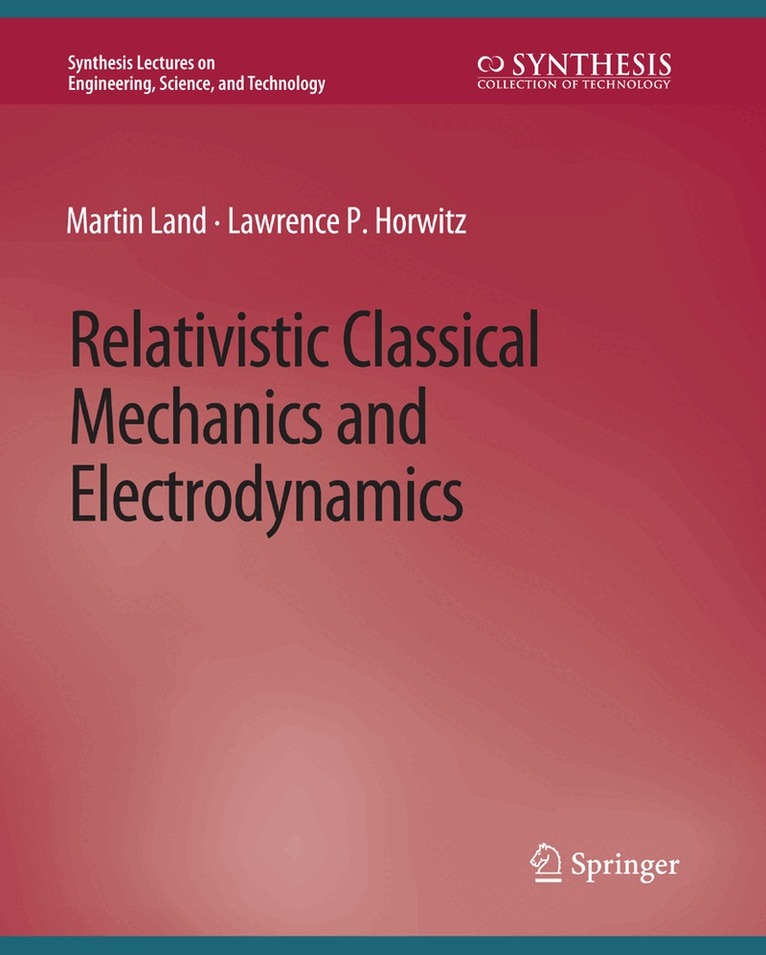
This book presents classical relativistic mechanics and electrodynamics in the Feynman-Stueckelberg event-oriented framework formalized by Horwitz and Piron. The full apparatus of classical analytical mechanics is generalized to relativistic form by replacing Galilean covariance with manifest Lorentz covariance and introducing a coordinate-independent parameter ���� to play the role of Newton's universal and monotonically advancing time. Fundamental physics is described by the ����-evolution of a system point through an unconstrained 8D phase space, with mass a dynamical quantity conserved under particular interactions. Classical gauge invariance leads to an electrodynamics derived from five ����-dependent potentials described by 5D pre-Maxwell field equations. Events trace out worldlines as ���� advances monotonically, inducing pre-Maxwell fields by their motions, and moving under the influence of these fields. The dynamics are governed canonically by a scalar Hamiltonian that generates evolution of a 4D block universe defined at ���� to an infinitesimally close 4D block universe defined at ����+��������. This electrodynamics, and its extension to curved space and non-Abelian gauge symmetry, is well-posed and integrable, providing a clear resolution to grandfather paradoxes. Examples include classical Coulomb scattering, electrostatics, plane waves, radiation from a simple antenna, classical pair production, classical CPT, and dynamical solutions in weak field gravitation. This classical framework will be of interest to workers in quantum theory and general relativity, as well as those interested in the classical foundations of gauge theory.
E-bok
PDF, Engelska, 2022791 kr
Läs direkt efter köp
This book presents classical relativistic mechanics and electrodynamics in the Feynman-Stueckelberg event-oriented framework formalized by Horwitz and Piron. The full apparatus of classical analytical mechanics is generalized to relativistic form by replacing Galilean covariance with manifest Lorentz covariance and introducing a coordinate-independent parameter ���� to play the role of Newton''s universal and monotonically advancing time. Fundamental physics is described by the ����-evolution of a system point through an unconstrained 8D phase space, with mass a dynamical quantity conserved under particular interactions. Classical gauge invariance leads to an electrodynamics derived from five ����-dependent potentials described by 5D pre-Maxwell field equations. Events trace out worldlines as ���� advances monotonically, inducing pre-Maxwell fields by their motions, and moving under the influence of these fields. The dynamics are governed canonically by a scalar Hamiltonian that generates evolution of a 4D block universe defined at ���� to an infinitesimally close 4D block universe defined at ����+��������. This electrodynamics, and its extension to curved space and non-Abelian gauge symmetry, is well-posed and integrable, providing a clear resolution to grandfather paradoxes. Examples include classical Coulomb scattering, electrostatics, plane waves, radiation from a simple antenna, classical pair production, classical CPT, and dynamical solutions in weak field gravitation. This classical framework will be of interest to workers in quantum theory and general relativity, as well as those interested in the classical foundations of gauge theory.