Martin Nerlinger – författare
Visar alla böcker från författaren Martin Nerlinger. Handla med fri frakt och snabb leverans.
2 produkter
2 produkter
Inbunden, Engelska, 2026
6 304 kr
Skickas inom 5-8 vardagar
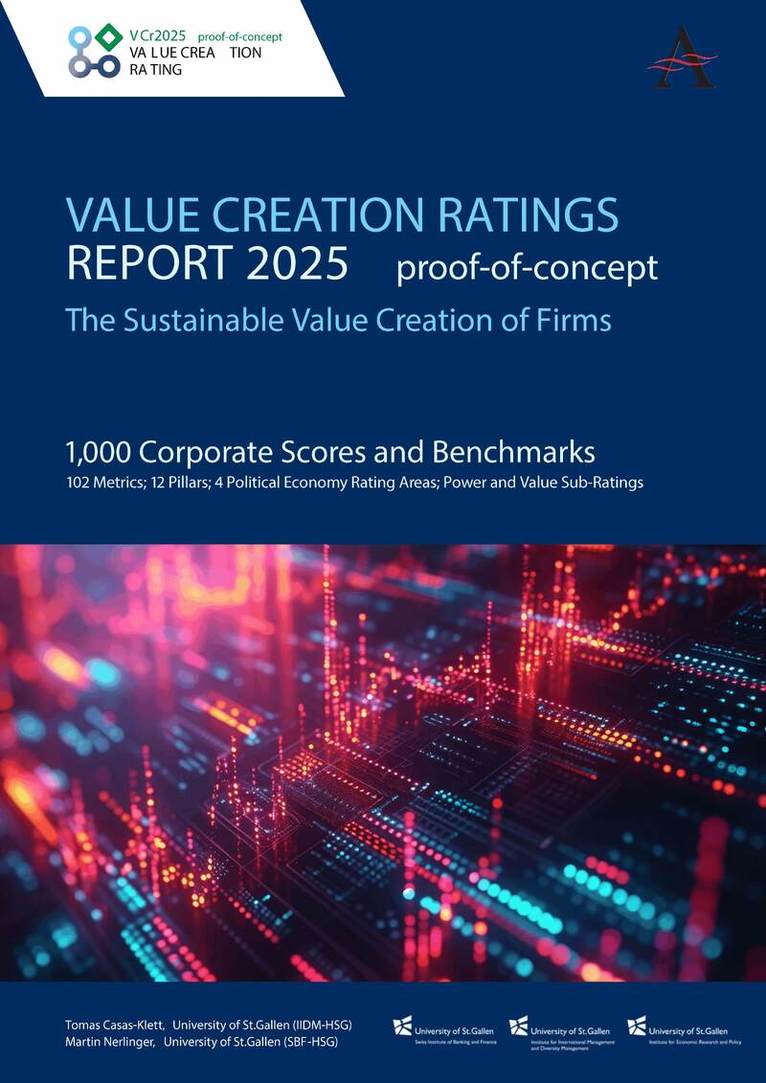
The Value Creation Ratings 2025 (VCr2025) proof-of-concept focuses on The Sustainable Value Creation of Firms and is an exploratory prototype that assesses 1,000 listed firms from the world’s leading stock markets in terms of how their business models create or transfer value.The comprehensive firm-level VCr measurement establishes the proportion of value creation in relation to revenue. A simpler second measurement, the Value Creation Position (VCp), establishes the percentage of value transfers in relation to revenue. The VCr2025 proof-of-concept report is the flagship output of a sister project to the already established Elite Quality Index (EQx2025) that assesses The Sustainable Value Creation of Nations. “Revolutionizing Risk by Weighting Value” drives VCr2025 and represents a uniquely comprehensive approach to double materiality, connecting a firm’s value creation and profit optimization with its impact on stakeholders, including customers, suppliers, capital providers, employees, regulators, nature, and academic and research institutions.In short, the VCr reports operationalize sustainability by matching the revenue of firms against their extractive value transfer-IN and inclusive transfer-OUT amounts. Value transfer-IN is “value appropriated but not created,” while value transfer-OUT is “value created but not appropriated.”A firm’s business model is assessed in the VCr2025 proof-of-concept report by 102 Sustainable Value Creation (SVC) Metrics selected because of its value transfer- IN/OUT rationale.
E-bok
PDF, Engelska, 2023329 kr
Läs direkt efter köp
How to embed the concept of sustainability is one of the key questions boards of directors and top management teams discuss in times of societal change and environmental challenges. These reflections are driven not only by self-reflection but also by capital market pressures and the consensus of public opinion. Unlike other issues on the corporate agenda, sustainability calls for a distinct approach to governance and raises questions about the foundation of corporate governance: the corporate purpose.This book presents various perspectives on corporate governance of sustainability and sustainable corporate governance, bringing together viewpoints from 16 practitioners and academics. It offers practical insights, introduces new perspectives, and invites readers to reflect on their own approaches to integrating sustainability into corporate governance.