Mary Margaret Capraro – författare
Visar alla böcker från författaren Mary Margaret Capraro. Handla med fri frakt och snabb leverans.
5 produkter
5 produkter
Häftad, Engelska, 2013
535 kr
Skickas inom 5-8 vardagar
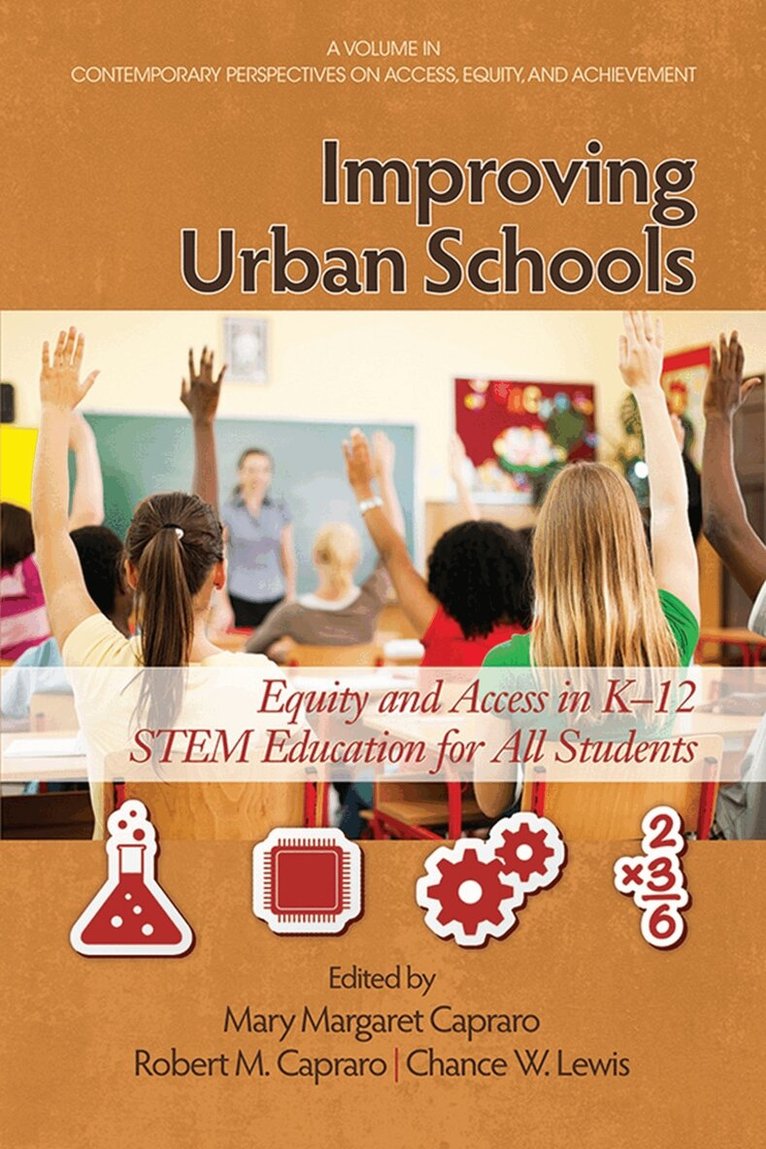
Although STEM (Science, Technology, Engineering, and Mathematics) has been diversely defined by various researchers (e.g. Buck Institute, 2003; Capraro & Slough, 2009; Scott, 2009; Wolf, 2008), during the last decade, STEM education has gained an increasing presence on the national agenda through initiatives from the National Science Foundation (NSF) and the Institute for Educational Sciences (IES). The rate of technological innovation and change has been tremendous over the past ten years, and this rapid increase will only continue. STEM literacy is the power to 'identify, apply, and integrate concepts from science, technology, engineering, and mathematics to understand complex problems and to innovate to solve them' (Washington State STEM, 2011, Internet). In order for U.S. students to be on the forefront of this revolution, ALL of our schools need to be part of the STEM vision and guide students in acquiring STEM literacy. Understanding and addressing the challenge of achieving STEM literacy for ALL students begins with an understanding of its element and the connections between them. In order to remain competitive, the Committee on Prospering in the Global Economy has recommended that the US optimize 'its knowledge-based resources, particularly in science and technology' (National Academies, 2007, p. 4). Optimizing knowledge-based resources needs to be the goal but is also a challenge for ALL educators (Scheurich & Huggins, 2009). Regardless, there is little disagreement that contemporary society is increasingly dependent on science, technology, engineering, and mathematics and thus comprehensive understandings are essential for those pursuing STEM careers. It is also generally agreed that PK-12 students do not do well in STEM areas, both in terms of national standards and in terms of international comparisons (Kuenzi, Matthews, & Mangan, 2006; Capraro, Capraro, Yetkiner, Corlu, Ozel, Ye, & Kim, 2011). The question then becomes what might PK-12 schools do to improve teachers’ and students’ STEM knowledge and skills? This book will look at equity and access issues in STEM education from PK-12, university, and administrative and policy lenses.
Inbunden, Engelska, 2013
998 kr
Skickas inom 5-8 vardagar
Although STEM (Science, Technology, Engineering, and Mathematics) has been diversely defined by various researchers (e.g. Buck Institute, 2003; Capraro & Slough, 2009; Scott, 2009; Wolf, 2008), during the last decade, STEM education has gained an increasing presence on the national agenda through initiatives from the National Science Foundation (NSF) and the Institute for Educational Sciences (IES). The rate of technological innovation and change has been tremendous over the past ten years, and this rapid increase will only continue. STEM literacy is the power to 'identify, apply, and integrate concepts from science, technology, engineering, and mathematics to understand complex problems and to innovate to solve them' (Washington State STEM, 2011, Internet). In order for U.S. students to be on the forefront of this revolution, ALL of our schools need to be part of the STEM vision and guide students in acquiring STEM literacy. Understanding and addressing the challenge of achieving STEM literacy for ALL students begins with an understanding of its element and the connections between them. In order to remain competitive, the Committee on Prospering in the Global Economy has recommended that the US optimize 'its knowledge-based resources, particularly in science and technology' (National Academies, 2007, p. 4). Optimizing knowledge-based resources needs to be the goal but is also a challenge for ALL educators (Scheurich & Huggins, 2009). Regardless, there is little disagreement that contemporary society is increasingly dependent on science, technology, engineering, and mathematics and thus comprehensive understandings are essential for those pursuing STEM careers. It is also generally agreed that PK-12 students do not do well in STEM areas, both in terms of national standards and in terms of international comparisons (Kuenzi, Matthews, & Mangan, 2006; Capraro, Capraro, Yetkiner, Corlu, Ozel, Ye, & Kim, 2011). The question then becomes what might PK-12 schools do to improve teachers’ and students’ STEM knowledge and skills? This book will look at equity and access issues in STEM education from PK-12, university, and administrative and policy lenses.
371 kr
Läs direkt efter köp
Although STEM (Science, Technology, Engineering, and Mathematics) has been diversely defined by various researchers (e.g. Buck Institute, 2003; Capraro & Slough, 2009; Scott, 2009; Wolf, 2008), during the last decade, STEM education has gained an increasing presence on the national agenda through initiatives from the National Science Foundation (NSF) and the Institute for Educational Sciences (IES). The rate of technological innovation and change has been tremendous over the past ten years, and this rapid increase will only continue. STEM literacy is the power to 'identify, apply, and integrate concepts from science, technology, engineering, and mathematics to understand complex problems and to innovate to solve them' (Washington State STEM, 2011, Internet). In order for U.S. students to be on the forefront of this revolution, ALL of our schools need to be part of the STEM vision and guide students in acquiring STEM literacy. Understanding and addressing the challenge of achieving STEM literacy for ALL students begins with an understanding of its element and the connections between them. In order to remain competitive, the Committee on Prospering in the Global Economy has recommended that the US optimize 'its knowledge-based resources, particularly in science and technology' (National Academies, 2007, p. 4). Optimizing knowledge-based resources needs to be the goal but is also a challenge for ALL educators (Scheurich & Huggins, 2009). Regardless, there is little disagreement that contemporary society is increasingly dependent on science, technology, engineering, and mathematics and thus comprehensive understandings are essential for those pursuing STEM careers. It is also generally agreed that PK-12 students do not do well in STEM areas, both in terms of national standards and in terms of international comparisons (Kuenzi, Matthews, & Mangan, 2006; Capraro, Capraro, Yetkiner, Corlu, Ozel, Ye, & Kim, 2011). The question then becomes what might PK-12 schools do to improve teachers' and students' STEM knowledge and skills? This book will look at equity and access issues in STEM education from PK-12, university, and administrative and policy lenses.
565 kr
Läs direkt efter köp
Although STEM (Science, Technology, Engineering, and Mathematics) has been diversely defined by various researchers (e.g. Buck Institute, 2003; Capraro & Slough, 2009; Scott, 2009; Wolf, 2008), during the last decade, STEM education has gained an increasing presence on the national agenda through initiatives from the National Science Foundation (NSF) and the Institute for Educational Sciences (IES). The rate of technological innovation and change has been tremendous over the past ten years, and this rapid increase will only continue. STEM literacy is the power to 'identify, apply, and integrate concepts from science, technology, engineering, and mathematics to understand complex problems and to innovate to solve them' (Washington State STEM, 2011, Internet). In order for U.S. students to be on the forefront of this revolution, ALL of our schools need to be part of the STEM vision and guide students in acquiring STEM literacy. Understanding and addressing the challenge of achieving STEM literacy for ALL students begins with an understanding of its element and the connections between them. In order to remain competitive, the Committee on Prospering in the Global Economy has recommended that the US optimize 'its knowledge-based resources, particularly in science and technology' (National Academies, 2007, p. 4). Optimizing knowledge-based resources needs to be the goal but is also a challenge for ALL educators (Scheurich & Huggins, 2009). Regardless, there is little disagreement that contemporary society is increasingly dependent on science, technology, engineering, and mathematics and thus comprehensive understandings are essential for those pursuing STEM careers. It is also generally agreed that PK-12 students do not do well in STEM areas, both in terms of national standards and in terms of international comparisons (Kuenzi, Matthews, & Mangan, 2006; Capraro, Capraro, Yetkiner, Corlu, Ozel, Ye, & Kim, 2011). The question then becomes what might PK-12 schools do to improve teachers' and students' STEM knowledge and skills? This book will look at equity and access issues in STEM education from PK-12, university, and administrative and policy lenses.
E-bok
PDF, Engelska, 2016403 kr
Läs direkt efter köp
This text contains 25 Project-Based Learning (PBL) lessons written by a combination of undergraduate preservice teachers, inservice teachers, and graduate students. Everyone who wrote a chapter strives to improve STEM education to help others implement standards-based STEM instruction that takes learning in isolation to greater accountability through integrated and meaningful tasks that answer the question every teacher dreads: When am I going to use this? The PBLs were written to implement in middle and high-school classrooms. All of them are interdisciplinary in nature. We have divided them into six themes: construction and design, water, environment, mixtures, technology, nutrition and genetics. Each lesson contains a “schedule at a glance” and the “well-defined outcome” so you can quickly see how a particular PBL fits into your curriculum. Objectives are listed along with STEM connections written as objectives. We have included all materials needed and then each day of activities including an imbedded engagement, exploration, explanation, evaluation (including rubrics), and extension. We have tried to include everything necessary for successful implementation. This practical book is the perfect companion to the handbook for learning about implementing PBLs: Project-Based Learning: An Integrated Science, Technology, Engineering, and Mathematics (STEM) Approach – second edition.