Masanori Koshiba - Böcker
Visar alla böcker från författaren Masanori Koshiba. Handla med fri frakt och snabb leverans.
2 produkter
2 produkter
850 kr
Skickas inom 10-15 vardagar
Recent advances in the field of guided-wave optics, such as fibre optics and integrated optics, have included the introduction of various optical waveguides. Computational tools for modelling and simulation are essential for a successful design, optimization, and realization of the optical waveguides. Despite its relatively brief existence, the finite element method has grown into a powerful and efficient tool for solving the most general optical waveguide problems. In this book, starting with a brief review of electromagnetic theory for optical waveguide analysis, the concepts of the finite element method and its fundamentals are discussed in detail. Current topics of the application of the finite element method to various optical waveguide problems, such as planar optical waveguides, optical channel waveguides, optical fibres, polarization-maintaining optical fibres, optical gratings, optical waveguide discontinuities, nonlinear optical waveguides, optical solitons and quantum well structures, are described, including many illustrations.
Del 5 - Advances in Opto-Electronics
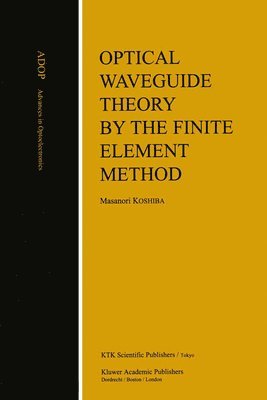
Optical Waveguide Theory by the Finite Element Method
Häftad, Engelska, 2012
534 kr
Skickas inom 10-15 vardagar
Recent advances in the field of guided-wave optics, such as fiber optics and integrated optics, have included the introduction of arbitrarily-shaped optical waveguides which, in many cases, also happened to be arbitrarily inhomogeneous, dissipative, anisotropic, and/or nonlinear. Most of such cases of waveguide arbitrariness do not lend themselves to analytical so lutions; hence, computational tools for modeling and simulation are es sential for successful design, optimization, and realization of the optical waveguides. For this purpose, various numerical techniques have been de veloped. In particular, the finite element method (FEM) is a powerful and efficient tool for the most general (i. e. , arbitrarily-shaped, inhomogeneous, dissipative, anisotropic, and nonlinear) optical waveguide problem. Its use in industry and research is extensive, and indeed it could be said that with out it many optical waveguide problems would be incapable of solution. This book is intended for students, engineers, designers, and techni cal managers interested in a detailed description of the FEM for optical waveguide analysis. Starting from a brief review of electromagnetic theory, the first chapter provides the concepts of the FEM and its fundamentals. In addition to conventional elements, i. e. , line elements, triangular elements, tetrahedral elements, ring elements, and triangular ring elements which are utilized for one-dimensional, two-dimensional, three-dimensional, axisymmetric two dimensional, and axisymmetric three-dimensional problems, respectively, special-purpose elements, such as isoparametric elements, edge elements, infinite elements, and boundary elements, are also introduced.