Masaru Tomita - Böcker
Visar alla böcker från författaren Masaru Tomita. Handla med fri frakt och snabb leverans.
9 produkter
9 produkter
Del 126 - Springer International Series in Engineering and Computer Science
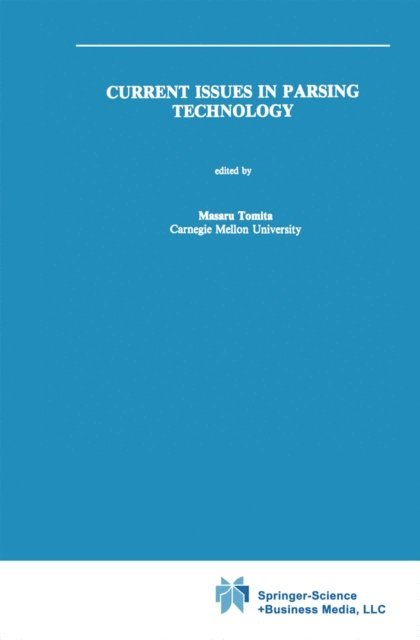
Current Issues in Parsing Technology
Inbunden, Engelska, 1990
2 164 kr
Skickas inom 10-15 vardagar
1 096 kr
Skickas inom 10-15 vardagar
The Generalized LR parsing algorithm (some call it "Tomita's algorithm") was originally developed in 1985 as a part of my Ph.D thesis at Carnegie Mellon University. When I was a graduate student at CMU, I tried to build a couple of natural language systems based on existing parsing methods. Their parsing speed, however, always bothered me. I sometimes wondered whether it was ever possible to build a natural language parser that could parse reasonably long sentences in a reasonable time without help from large mainframe machines. At the same time, I was always amazed by the speed of programming language compilers, because they can parse very long sentences (i.e., programs) very quickly even on workstations. There are two reasons. First, programming languages are considerably simpler than natural languages. And secondly, they have very efficient parsing methods, most notably LR. The LR parsing algorithm first precompiles a grammar into an LR parsing table, and at the actual parsing time, it performs shift-reduce parsing guided deterministically by the parsing table. So, the key to the LR efficiency is the grammar precompilation; something that had never been tried for natural languages in 1985. Of course, there was a good reason why LR had never been applied for natural languages; it was simply impossible. If your context-free grammar is sufficiently more complex than programming languages, its LR parsing table will have multiple actions, and deterministic parsing will be no longer possible.
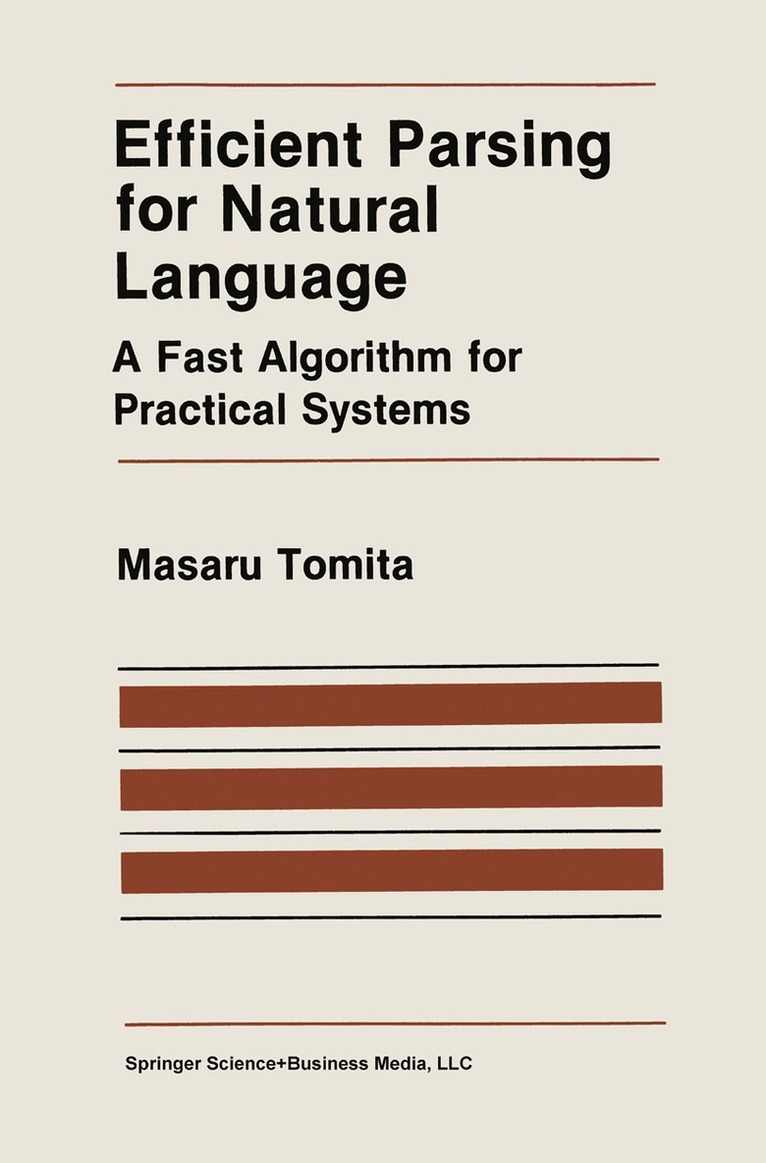
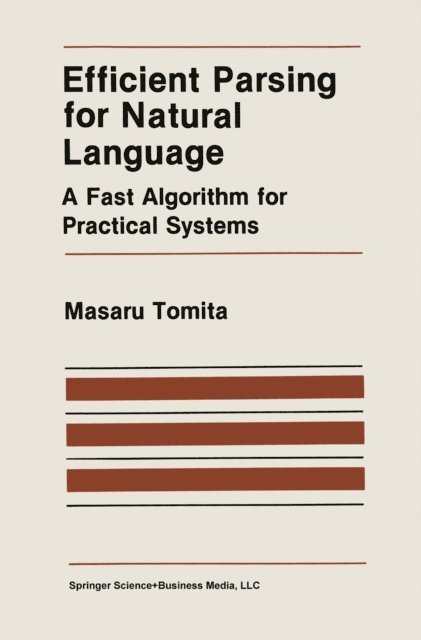
Efficient Parsing for Natural Language
A Fast Algorithm for Practical Systems
Inbunden, Engelska, 1985
1 096 kr
Skickas inom 10-15 vardagar
Parsing Efficiency is crucial when building practical natural language systems. 'Ibis is especially the case for interactive systems such as natural language database access, interfaces to expert systems and interactive machine translation. Despite its importance, parsing efficiency has received little attention in the area of natural language processing. In the areas of compiler design and theoretical computer science, on the other hand, parsing algorithms 3 have been evaluated primarily in terms of the theoretical worst case analysis (e.g. lXn», and very few practical comparisons have been made. This book introduces a context-free parsing algorithm that parses natural language more efficiently than any other existing parsing algorithms in practice. Its feasibility for use in practical systems is being proven in its application to Japanese language interface at Carnegie Group Inc., and to the continuous speech recognition project at Carnegie-Mellon University. This work was done while I was pursuing a Ph.D degree at Carnegie-Mellon University. My advisers, Herb Simon and Jaime Carbonell, deserve many thanks for their unfailing support, advice and encouragement during my graduate studies. I would like to thank Phil Hayes and Ralph Grishman for their helpful comments and criticism that in many ways improved the quality of this book. I wish also to thank Steven Brooks for insightful comments on theoretical aspects of the book (chapter 4, appendices A, B and C), and Rich Thomason for improving the linguistic part of tile book (the very beginning of section 1.1).
1 096 kr
Skickas inom 10-15 vardagar
In Marcus (1980), deterministic parsers were introduced. These are parsers which satisfy the conditions of Marcus's determinism hypothesis, i.e., they are strongly deterministic in the sense that they do not simulate non determinism in any way. In later work (Marcus et al. 1983) these parsers were modified to construct descriptions of trees rather than the trees them selves. The resulting D-theory parsers, by working with these descriptions, are capable of capturing a certain amount of ambiguity in the structures they build. In this context, it is not clear what it means for a parser to meet the conditions of the determinism hypothesis. The object of this work is to clarify this and other issues pertaining to D-theory parsers and to provide a framework within which these issues can be examined formally. Thus we have a very narrow scope. We make no ar guments about the linguistic issues D-theory parsers are meant to address, their relation to other parsing formalisms or the notion of determinism in general. Rather we focus on issues internal to D-theory parsers themselves.
1 096 kr
Skickas inom 10-15 vardagar
Parsing Efficiency is crucial when building practical natural language systems. 'Ibis is especially the case for interactive systems such as natural language database access, interfaces to expert systems and interactive machine translation. Despite its importance, parsing efficiency has received little attention in the area of natural language processing. In the areas of compiler design and theoretical computer science, on the other hand, parsing algorithms 3 have been evaluated primarily in terms of the theoretical worst case analysis (e.g. lXn», and very few practical comparisons have been made. This book introduces a context-free parsing algorithm that parses natural language more efficiently than any other existing parsing algorithms in practice. Its feasibility for use in practical systems is being proven in its application to Japanese language interface at Carnegie Group Inc., and to the continuous speech recognition project at Carnegie-Mellon University. This work was done while I was pursuing a Ph.D degree at Carnegie-Mellon University. My advisers, Herb Simon and Jaime Carbonell, deserve many thanks for their unfailing support, advice and encouragement during my graduate studies. I would like to thank Phil Hayes and Ralph Grishman for their helpful comments and criticism that in many ways improved the quality of this book. I wish also to thank Steven Brooks for insightful comments on theoretical aspects of the book (chapter 4, appendices A, B and C), and Rich Thomason for improving the linguistic part of tile book (the very beginning of section 1.1).
2 164 kr
Skickas inom 10-15 vardagar
1 096 kr
Skickas inom 10-15 vardagar
The Generalized LR parsing algorithm (some call it "Tomita's algorithm") was originally developed in 1985 as a part of my Ph.D thesis at Carnegie Mellon University. When I was a graduate student at CMU, I tried to build a couple of natural language systems based on existing parsing methods. Their parsing speed, however, always bothered me. I sometimes wondered whether it was ever possible to build a natural language parser that could parse reasonably long sentences in a reasonable time without help from large mainframe machines. At the same time, I was always amazed by the speed of programming language compilers, because they can parse very long sentences (i.e., programs) very quickly even on workstations. There are two reasons. First, programming languages are considerably simpler than natural languages. And secondly, they have very efficient parsing methods, most notably LR. The LR parsing algorithm first precompiles a grammar into an LR parsing table, and at the actual parsing time, it performs shift-reduce parsing guided deterministically by the parsing table. So, the key to the LR efficiency is the grammar precompilation; something that had never been tried for natural languages in 1985. Of course, there was a good reason why LR had never been applied for natural languages; it was simply impossible. If your context-free grammar is sufficiently more complex than programming languages, its LR parsing table will have multiple actions, and deterministic parsing will be no longer possible.
1 625 kr
Skickas inom 10-15 vardagar
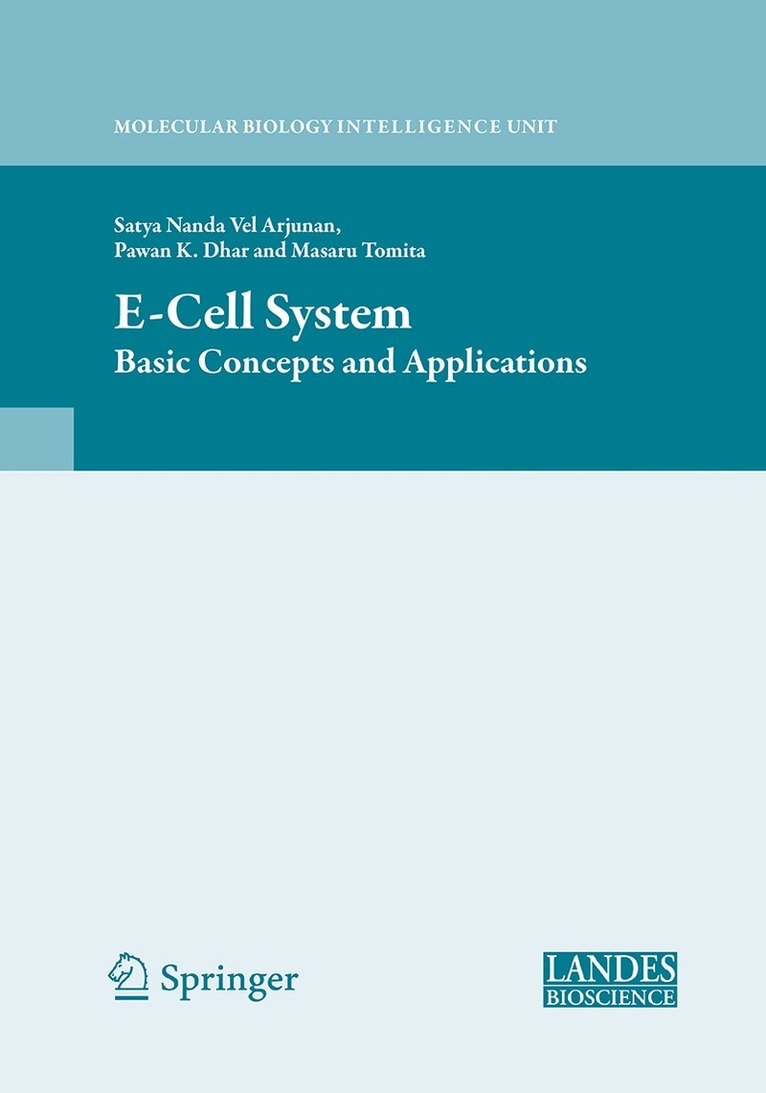
The purpose of E-Cell System: Basic Concepts and Applications is to provide a comprehensive guide for the E-Cell System version 3 in terms of the software features and its usage.
Del 118 - Molecular Biology Intelligence Unit
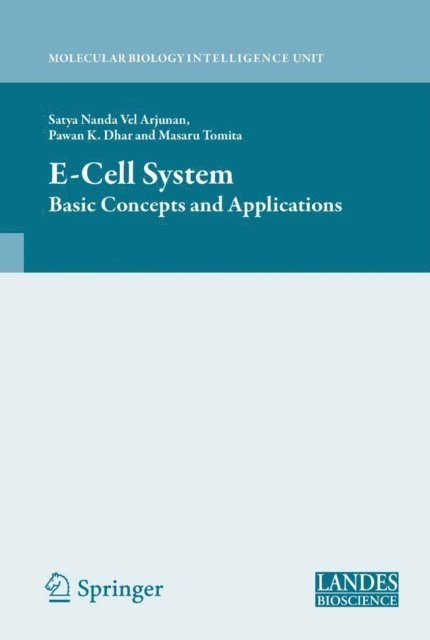
E‑Cell System
Basic Concepts and Applications
Häftad, Engelska, 2016
1 205 kr
Skickas inom 10-15 vardagar
The purpose of E-Cell System: Basic Concepts and Applications is to provide a comprehensive guide for the E-Cell System version 3 in terms of the software features and its usage.