Masataka Tanaka – författare
Visar alla böcker från författaren Masataka Tanaka. Handla med fri frakt och snabb leverans.
6 produkter
6 produkter
E-bok
PDF, Engelska, 19983 165 kr
Läs direkt efter köp
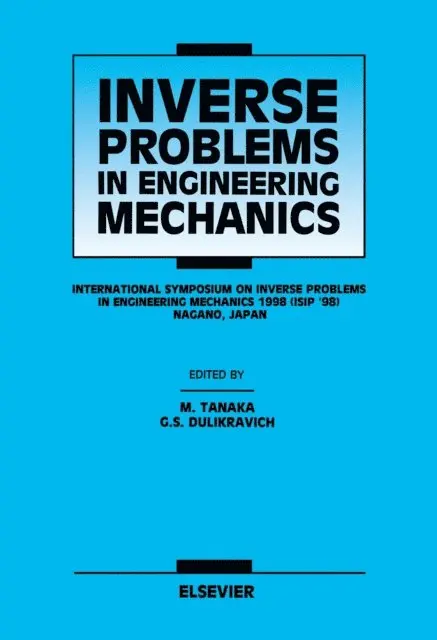
Inverse problems can be found in many topics of engineering mechanics. There are many successful applications in the fields of inverse problems (non-destructive testing and characterization of material properties by ultrasonic or X-ray techniques, thermography, etc.). Generally speaking, the inverse problems are concerned with the determination of the input and the characteristics of a mechanical system from some of the output from the system. Mathematically, such problems are ill-posed and have to be overcome through development of new computational schemes, regularization techniques, objective functionals, and experimental procedures.Seventy-two papers were presented at the International Symposium on Inverse Problems in Mechanics (ISIP ''98) held in March of 1998 in Nagano, where recent developments in the inverse problems in engineering mechanics and related topics were discussed. The main themes were: mathematical and computational aspects of the inverse problems, parameter or system identification, shape determination, sensitivity analysis, optimization, material property characterization, ultrasonic non-destructive testing, elastodynamic inverse problems, thermal inverse problems, and other engineering applications.
E-bok
PDF, Engelska, 20171 015 kr
Läs direkt efter köp
This Proceedings features a broad range of computational mechanics papers on both solid and fluid mechanics as well as electromagnetics, acoustics, heat transfer and other interdisciplinary problems. Topics covered include theoretical developments, numerical analysis, intelligent and adaptive solution strategies and practical applications.
E-bok
PDF, Engelska, 2013712 kr
Läs direkt efter köp
Inverse problems occur in a wide variey of fields. Ingeneral, the inverse problem can be defined as one where oneshould estimate the cause from the result, while the directproblem is concerned with how to obtain the result from thecause. The aim of this symposium was to gather scientistsand researchers in engineering mechanics concerned withinverse problems in order to exchange research result anddevelop computational and experimentalapproaches to solveinverse problems.The contributions in this volume cover the followingsubjects: mathematical and computational aspects of inverseproblems, parameter or system identification, shapedetermination, sensitivity analysis, optimization, materialproperty characterization, ultrasonic nondestructivetesting, elastodynamic inverse problems, thermal inverseproblems, and other miscellaneous engineering applications.
Häftad, Engelska, 2012
546 kr
Skickas inom 10-15 vardagar
Inverse problems occur in a wide variey of fields. Ingeneral, the inverse problem can be defined as one where oneshould estimate the cause from the result, while the directproblem is concerned with how to obtain the result from thecause. The aim of this symposium was to gather scientistsand researchers in engineering mechanics concerned withinverse problems in order to exchange research result anddevelop computational and experimentalapproaches to solveinverse problems.The contributions in this volume cover the followingsubjects: mathematical and computational aspects of inverseproblems, parameter or system identification, shapedetermination, sensitivity analysis, optimization, materialproperty characterization, ultrasonic nondestructivetesting, elastodynamic inverse problems, thermal inverseproblems, and other miscellaneous engineering applications.
E-bok
PDF, Engelska, 2013712 kr
Läs direkt efter köp
The International Conference on Boundary Element Methods in Engineering was started in 1978 with the following objectives: i) To act as a focus for BE research at a time when the technique wasjust emerging as a powerful tool for engineering analysis. ii) To attract new as weIl as established researchers on Boundary Elements, in order to maintain its vitality and originality. iii) To try to relate the Boundary Element Method to other engineering techniques in an effort to help unify the field of engineering analysis, rather than to contribute to its fragmentation. These objectives were achieved during the last 7 conferences and this meeting - the eighth - has continued to be as innovative and dynamic as any ofthe previous conferences. Another important aim ofthe conference is to encourage the participation of researchers from as many different countries as possible and in this regard it is a policy of the organizers to hold the conference in different locations. It is easy to forget when working on scientific projects that in science as weIl as in other subjects, human relationships are as important as mathematical equations. Science progresses not only as a resuIt oflaboratory and computer experiments or abstract thinking but also by a process of personal interaction.
Häftad, Engelska, 2013
546 kr
Skickas inom 10-15 vardagar
The International Conference on Boundary Element Methods in Engineering was started in 1978 with the following objectives: i) To act as a focus for BE research at a time when the technique wasjust emerging as a powerful tool for engineering analysis. ii) To attract new as weIl as established researchers on Boundary Elements, in order to maintain its vitality and originality. iii) To try to relate the Boundary Element Method to other engineering techniques in an effort to help unify the field of engineering analysis, rather than to contribute to its fragmentation. These objectives were achieved during the last 7 conferences and this meeting - the eighth - has continued to be as innovative and dynamic as any ofthe previous conferences. Another important aim ofthe conference is to encourage the participation of researchers from as many different countries as possible and in this regard it is a policy of the organizers to hold the conference in different locations. It is easy to forget when working on scientific projects that in science as weIl as in other subjects, human relationships are as important as mathematical equations. Science progresses not only as a resuIt oflaboratory and computer experiments or abstract thinking but also by a process of personal interaction.