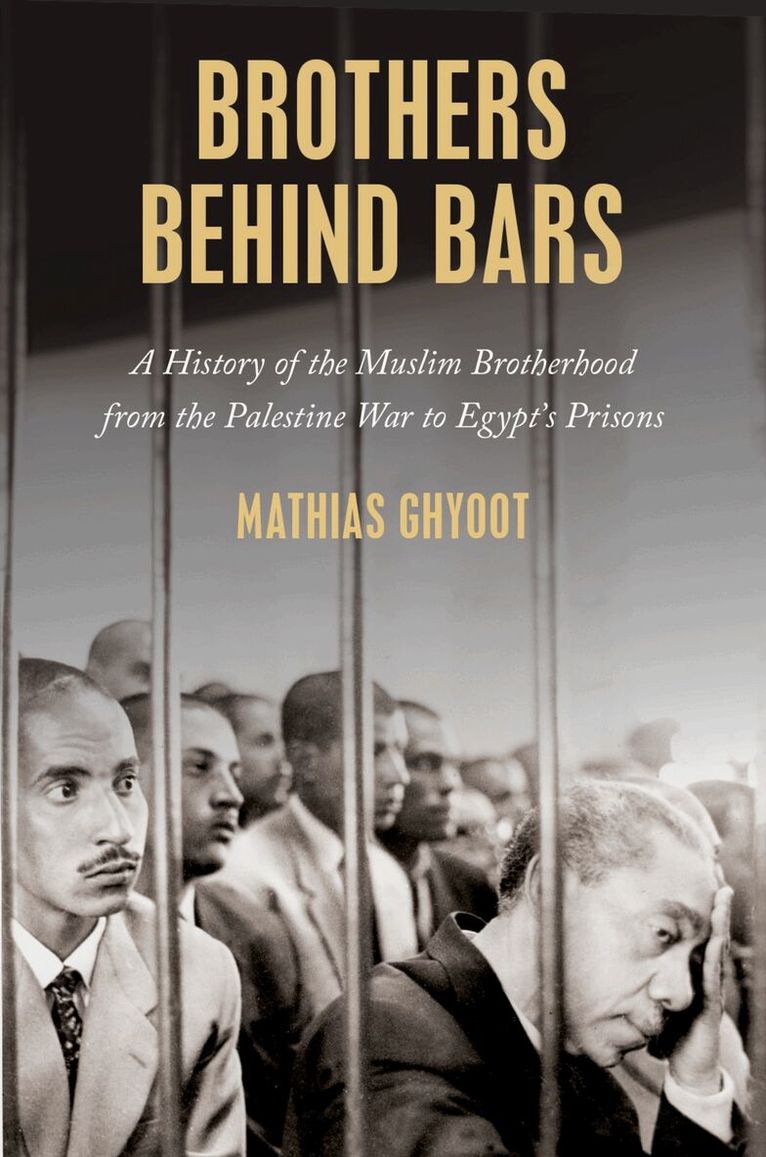
Brothers Behind Bars tells the harrowing, yet fascinating, story of the imprisonment of the Muslim Brotherhood--the largest Islamist movement in Middle Eastern history--in Egypt stretching from the Palestine war in 1948 to the consolidation of President Anwar al-Sadat's rule in 1975. Drawing on prison memoirs written by Muslim Brothers and Sisters, Mathias Ghyoot takes the reader on a rare journey behind the prison walls to show how radicals and moderates, ministers and intelligence officers, clerics and jailers were embroiled in an epic battle to define Islam in modern Egypt.Ghyoot argues that Egypt's state institutions played a crucial role in shaping ideologies within the Muslim Brotherhood, demonstrating how the institution of the prison became a critical site for the formation of political resistance in modern Egypt. Although prison severely encroached on the freedom of the Muslim Brothers, it also spurred reflection and conversations among them as well as with political prisoners of other ideological convictions, most notably communists and Zionists. By emphasizing not what state repression restricted the Muslim Brothers from doing, but rather what it allowed them to do, Ghyoot shows how the ideology of the Muslim Brothers was shaped not only by internal debates but also by encounters--good and bad--with leftist intellectuals, religious clerics, and intelligence officers inside Egypt's prisons.Ghyoot recounts how, amidst crushing state repression, the Muslim Brothers established an underground prison society that came to serve as a template for the utopia they envisioned for an Islamic Egypt. Brothers Behind Bars offers a new understanding of Islamism in twentieth-century Egypt.
In 1948, Egyptian writer and civil servant Sayyid Qutb crossed the Atlantic on a twenty-two-month study mission, traveling from New York to California to examine Western education. What he recorded instead was a searing yet nuanced account of a civilization he believed was surrendering to materialism. The America I Saw gathers thirty-three of Qutb’s essays, letters, poems, book reviews, and commentaries on America—translated into English for the first time. Written in the years before he joined the Muslim Brotherhood and became President Nasser’s most formidable opponent, these pieces reveal a lesser-known Qutb: not yet the radical executed in 1966 but a searching intellectual grappling with racism, labor, and colonialism alongside contemporary travelers in the United States like Albert Camus and Jean-Paul Sartre. Drawing on previously unstudied archival material from Egypt and the United States, the volume’s vital introduction demystifies Qutb’s American sojourn and and reframes him as a both an anticolonial theorist and conservative critic of the modern world order. An indispensable primary source, The America I Saw offers scholars and students of Islamic and Middle East studies a revelatory window into a formative mind—and into postwar America itself.
Brothers Behind Bars tells the harrowing, yet fascinating, story of the imprisonment of the Muslim Brotherhood--the largest Islamist movement in Middle Eastern history--in Egypt stretching from the Palestine war in 1948 to the consolidation of President Anwar al-Sadat's rule in 1975. Drawing on prison memoirs written by Muslim Brothers and Sisters, Mathias Ghyoot takes the reader on a rare journey behind the prison walls to show how radicals and moderates, ministers and intelligence officers, clerics and jailers were embroiled in an epic battle to define Islam in modern Egypt.Ghyoot argues that Egypt's state institutions played a crucial role in shaping ideologies within the Muslim Brotherhood, demonstrating how the institution of the prison became a critical site for the formation of political resistance in modern Egypt. Although prison severely encroached on the freedom of the Muslim Brothers, it also spurred reflection and conversations among them as well as with political prisoners of other ideological convictions, most notably communists and Zionists. By emphasizing not what state repression restricted the Muslim Brothers from doing, but rather what it allowed them to do, Ghyoot shows how the ideology of the Muslim Brothers was shaped not only by internal debates but also by encounters--good and bad--with leftist intellectuals, religious clerics, and intelligence officers inside Egypt's prisons.Ghyoot recounts how, amidst crushing state repression, the Muslim Brothers established an underground prison society that came to serve as a template for the utopia they envisioned for an Islamic Egypt. Brothers Behind Bars offers a new understanding of Islamism in twentieth-century Egypt.
In 1948, Egyptian writer and civil servant Sayyid Qutb crossed the Atlantic on a twenty-two-month study mission, traveling from New York to California to examine Western education. What he recorded instead was a searing yet nuanced account of a civilization he believed was surrendering to materialism. The America I Saw gathers thirty-three of Qutb’s essays, letters, poems, book reviews, and commentaries on America—translated into English for the first time. Written in the years before he joined the Muslim Brotherhood and became President Nasser’s most formidable opponent, these pieces reveal a lesser-known Qutb: not yet the radical executed in 1966 but a searching intellectual grappling with racism, labor, and colonialism alongside contemporary travelers in the United States like Albert Camus and Jean-Paul Sartre. Drawing on previously unstudied archival material from Egypt and the United States, the volume’s vital introduction demystifies Qutb’s American sojourn and and reframes him as a both an anticolonial theorist and conservative critic of the modern world order. An indispensable primary source, The America I Saw offers scholars and students of Islamic and Middle East studies a revelatory window into a formative mind—and into postwar America itself.