Matilda Bingham - Böcker
Visar alla böcker från författaren Matilda Bingham. Handla med fri frakt och snabb leverans.
3 produkter
3 produkter
2 845 kr
Skickas inom 5-8 vardagar
The discovery and development of effective medicines for the treatment of psychiatric disorders such as schizophrenia and depression has been heralded as one of the great medical achievements of the past century. Indeed, the profound impact of these medicines on our understanding of the pathophysiology underlying these diseases, the treatment of psychiatric patients and even our social perception of mental illnesses cannot be underestimated. However, there is still an urgent medical need for even more effective, safe and well-tolerated treatments. For example, currently available treatments for schizophrenia address mainly the positive symptoms and largely neglect the negative symptoms and cognitive disfunction which greatly impact overall morbidity. Similarly, whilst the current first line antidepressants show significantly improved side effect profiles compared to the first generation therapies, there still up to 40% of patients who are treatment resistant, and even in the patient population which responds well, the onset of action is slow at typically 2-3 weeks. The aim of this book is to provide the first point of call for those involved or just interested in this rapidly expanding and increasingly fragmented field of research and drug discovery. The editors will combine their wide ranging experience and extensive network of contacts with leading scientists and opinion leaders in this field to provide an authoritative reference text covering the evolution, major advances, challenges and future directions in drug discovery and medicinal chemistry for major psychiatric disorders.
2 174 kr
Skickas inom 10-15 vardagar
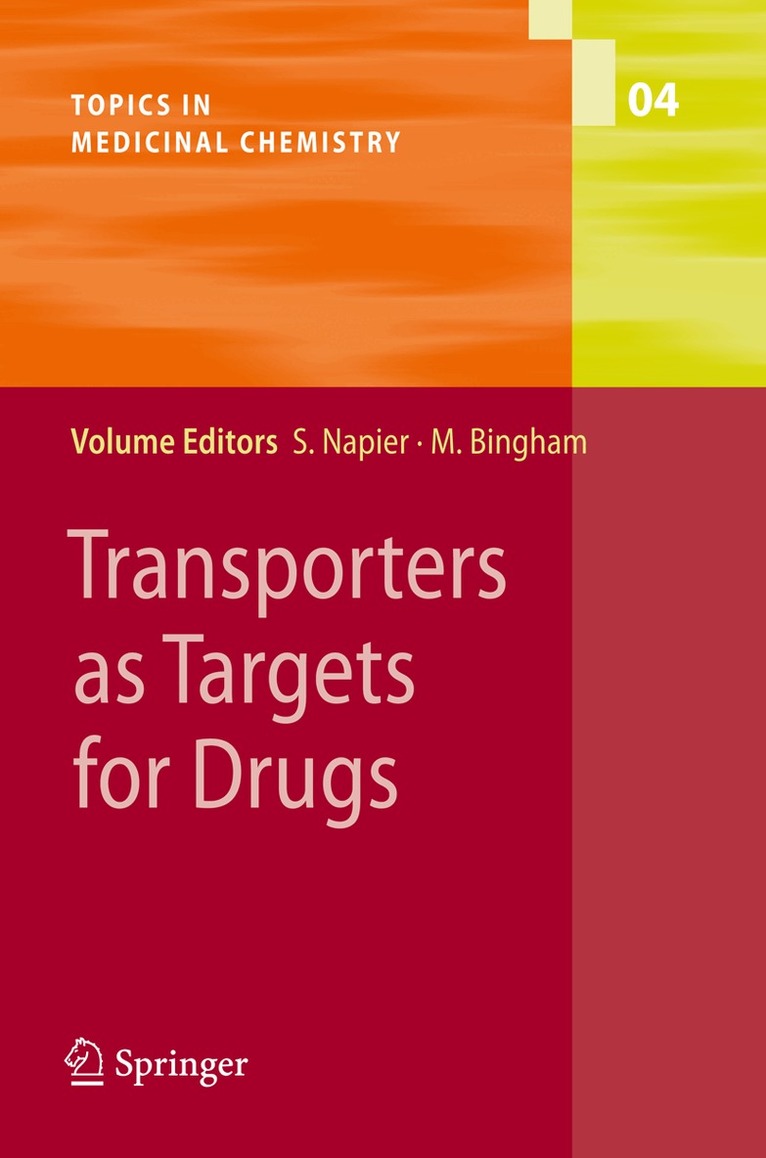
Transporters are proteins that span the plasma membrane and regulate the traf?c of small molecules in and out of the cell. They play a particularly important role in chemical signalling between neurons in the CNS, where they act to control the concentration of neurotransmitters in the synapse. In most systems the termination of chemical transmission is achieved by rapid uptake of the transmitter molecule from the synapse by transporters located on the synaptic terminal or surrounding glial cells. Another key role for transporters is in excluding undesirable xenobiotics from the cell, whilst allowing key molecules required for the cell life cycle to enter. It is incre- ingly recognised that these ef?ux or uptake transporters respectively, play an important role in the disposition of many marketed drugs, and whilst the ?eld of drug transport is yet to attain the level of maturity of drug metabolism,itiscertaintobeofincreasingimportance infuturedrugdisc- ery programmes. 2 Transporter Classification Transporters can be classed into two main families; the ATP binding c- sette (ABC) family, and the solute carrier (SLC) family.The SLC family is a very broad categorisation which encompasses, amongst others, three - portant families of transporters for organic molecules; the major facilitator superfamily (MFS) and two neurotransmitter transporter families, the neu- transmitter; sodium symporter (NSS, or SLC6) and the dicarboxylate/amino + + acid:cation (Na or H ) symporter (DAACS, or SLC1) family.
2 174 kr
Skickas inom 10-15 vardagar
Transporters are proteins that span the plasma membrane and regulate the traf?c of small molecules in and out of the cell. They play a particularly important role in chemical signalling between neurons in the CNS, where they act to control the concentration of neurotransmitters in the synapse. In most systems the termination of chemical transmission is achieved by rapid uptake of the transmitter molecule from the synapse by transporters located on the synaptic terminal or surrounding glial cells. Another key role for transporters is in excluding undesirable xenobiotics from the cell, whilst allowing key molecules required for the cell life cycle to enter. It is incre- ingly recognised that these ef?ux or uptake transporters respectively, play an important role in the disposition of many marketed drugs, and whilst the ?eld of drug transport is yet to attain the level of maturity of drug metabolism,itiscertaintobeofincreasingimportance infuturedrugdisc- ery programmes. 2 Transporter Classification Transporters can be classed into two main families; the ATP binding c- sette (ABC) family, and the solute carrier (SLC) family.The SLC family is a very broad categorisation which encompasses, amongst others, three - portant families of transporters for organic molecules; the major facilitator superfamily (MFS) and two neurotransmitter transporter families, the neu- transmitter; sodium symporter (NSS, or SLC6) and the dicarboxylate/amino + + acid:cation (Na or H ) symporter (DAACS, or SLC1) family.