Matt A. Bernstein – författare
1 966 kr
Läs direkt efter köp
2 001 kr
Skickas inom 10-15 vardagar
2 422 kr
Kommande
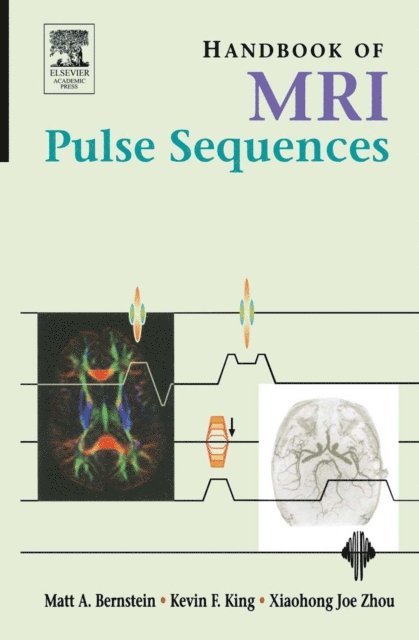
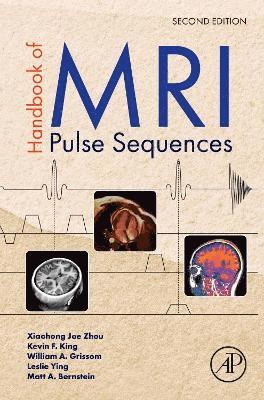
Handbook of MRI Pulse Sequences, Second Edition includes 92 self-contained sections, with each section focusing on a single subject. A new section on detailing the advanced pulse sequence techniques covers a variety of basic and advanced image reconstruction methods. The extensive topic coverage and cross-referencing makes this book ideal for beginners learning the building blocks of MRI pulse sequence design, as well as for experienced professionals who are seeking deeper knowledge of a particular technique.This book is among the most important medical imaging techniques available today. Each of these scanners is capable of running many different "pulse sequences." These sequences are governed by physics and engineering principles and implemented by software programs that control the MRI hardware.
Explains pulse sequences, their components, and the associated image reconstruction methods commonly used in MRIDescribes several system measurement tools most relevant to pulse sequence developers and usersProvides self-contained sections for individual techniquesIncludes both non-mathematical and mathematical descriptionsContains numerous figures, tables, references, and worked example problems931 kr
Skickas inom 5-8 vardagar
1 053 kr
Läs direkt efter köp
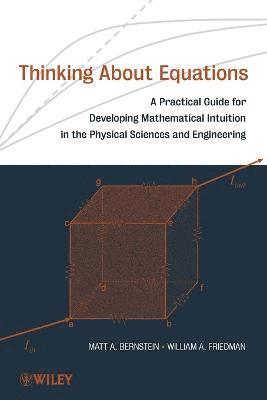
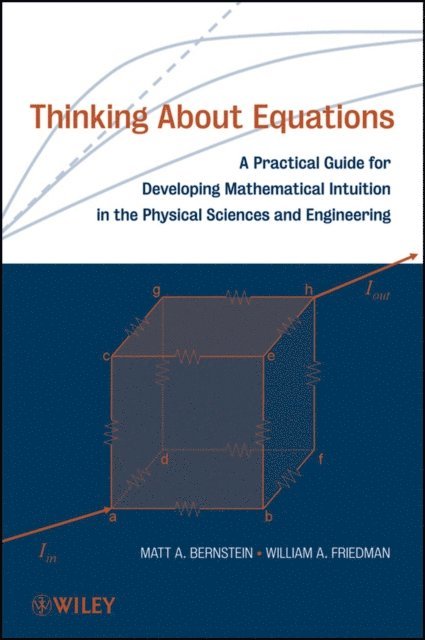
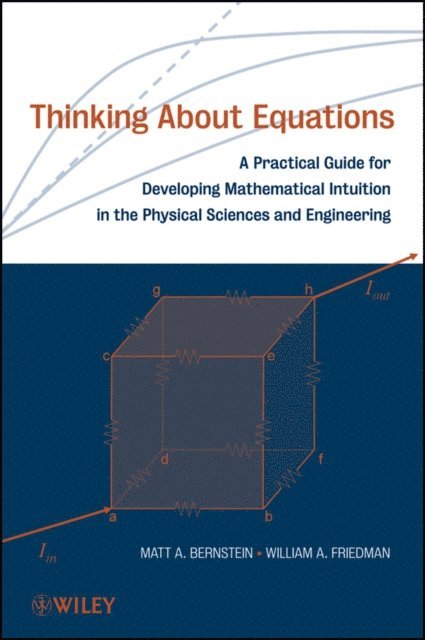
Equations play a central role in problem solving across various fields of study. Understanding what an equation means is an essential step toward forming an effective strategy to solve it, and it also lays the foundation for a more successful and fulfilling work experience. Thinking About Equations provides an accessible guide to developing an intuitive understanding of mathematical methods and, at the same time, presents a number of practical mathematical tools for successfully solving problems that arise in engineering and the physical sciences.
Equations form the basis for nearly all numerical solutions, and the authors illustrate how a firm understanding of problem solving can lead to improved strategies for computational approaches. Eight succinct chapters provide thorough topical coverage, including:
Approximation and estimation Isolating important variables Generalization and special cases Dimensional analysis and scaling Pictorial methods and graphical solutions Symmetry to simplify equationsEach chapter contains a general discussion that is integrated with worked-out problems from various fields of study, including physics, engineering, applied mathematics, and physical chemistry. These examples illustrate the mathematical concepts and techniques that are frequently encountered when solving problems. To accelerate learning, the worked example problems are grouped by the equation-related concepts that they illustrate as opposed to subfields within science and mathematics, as in conventional treatments. In addition, each problem is accompanied by a comprehensive solution, explanation, and commentary, and numerous exercises at the end of each chapter provide an opportunity to test comprehension.
Requiring only a working knowledge of basic calculus and introductory physics, Thinking About Equations is an excellent supplement for courses in engineering and the physical sciences at the upper-undergraduate and graduate levels. It is also a valuable reference for researchers, practitioners, and educators in all branches of engineering, physics, chemistry, biophysics, and other related fields who encounter mathematical problems in their day-to-day work.
1 038 kr
Läs direkt efter köp
Equations play a central role in problem solving across various fields of study. Understanding what an equation means is an essential step toward forming an effective strategy to solve it, and it also lays the foundation for a more successful and fulfilling work experience. Thinking About Equations provides an accessible guide to developing an intuitive understanding of mathematical methods and, at the same time, presents a number of practical mathematical tools for successfully solving problems that arise in engineering and the physical sciences.
Equations form the basis for nearly all numerical solutions, and the authors illustrate how a firm understanding of problem solving can lead to improved strategies for computational approaches. Eight succinct chapters provide thorough topical coverage, including:
Approximation and estimation Isolating important variables Generalization and special cases Dimensional analysis and scaling Pictorial methods and graphical solutions Symmetry to simplify equationsEach chapter contains a general discussion that is integrated with worked-out problems from various fields of study, including physics, engineering, applied mathematics, and physical chemistry. These examples illustrate the mathematical concepts and techniques that are frequently encountered when solving problems. To accelerate learning, the worked example problems are grouped by the equation-related concepts that they illustrate as opposed to subfields within science and mathematics, as in conventional treatments. In addition, each problem is accompanied by a comprehensive solution, explanation, and commentary, and numerous exercises at the end of each chapter provide an opportunity to test comprehension.
Requiring only a working knowledge of basic calculus and introductory physics, Thinking About Equations is an excellent supplement for courses in engineering and the physical sciences at the upper-undergraduate and graduate levels. It is also a valuable reference for researchers, practitioners, and educators in all branches of engineering, physics, chemistry, biophysics, and other related fields who encounter mathematical problems in their day-to-day work.