Matthew Baerman - Böcker
Visar alla böcker från författaren Matthew Baerman. Handla med fri frakt och snabb leverans.
11 produkter
11 produkter
Del 145 - Proceedings of the British Academy Volume 145
Deponency and Morphological Mismatches
Engelska, 2007
1 258 kr
Skickas inom 7-10 vardagar
Deponency is a mismatch between form and function in language that was first described for Latin, where there is a group of verbs (the deponents) which are morphologically passive but syntactically active. This is evidence of a larger problem involving the interface between syntax and morphology: inflectional morphology is supposed to specify syntactic function, but sometimes it sends out the wrong signal. Although the problem is as old as the Western linguistic tradition, no generally accepted account of it has yet been given, and it is safe to say that all current theories of language have been constructed as if deponency did not exist. In recent years, however, linguists have begun to confront its theoretical implications, albeit largely in isolation from each other. There is as yet no definitive statement of the problem, nor any generally accepted definition of its nature and scope. This volume brings together the findings of leading scholars working in the area of morphological mismatches, and represents the first book-length typological and theoretical treatment of the topic. It will establish the important role that research on deponency has to play in contemporary linguistics, and set the standard for future work.
Del 163 - Proceedings of the British Academy
Defective Paradigms
Missing Forms and What They Tell Us
Engelska, 2010
841 kr
Skickas inom 7-10 vardagar
An important design feature of language is the use of productive patterns in inflection. In English, we have pairs such as 'enjoy' ~ 'enjoyed', 'agree' ~ 'agreed', and many others. On the basis of this productive pattern, if we meet a new verb 'transduce' we know that there will be the form 'transduced'. Even if the pattern is not fully regular, there will be a form available, as in 'understand' ~ 'understood'. Surprisingly, this principle is sometimes violated, a phenomenon known as defectiveness, which means there is a gap in a word's set of forms: for example, given the verb 'forego', many if not most people are unwilling to produce a past tense. Although such gaps have been known to us since the days of Classical grammarians, they remain poorly understood. Defectiveness contradicts basic assumptions about the way inflectional rules operate, because it seems to require that speakers know that for certain words, not only should one not employ the expected rule, one should not employ any rule at all. This is a serious problem, since it is probably safe to say that all reigning models of grammar were designed as if defectiveness did not exist, and would lose a considerable amount of their elegance if it were properly factored in.This volume addressed these issues from a number of analytical approaches - historical, statistical and theoretical - and by using studies from a range of languages.
1 612 kr
Skickas inom 5-8 vardagar
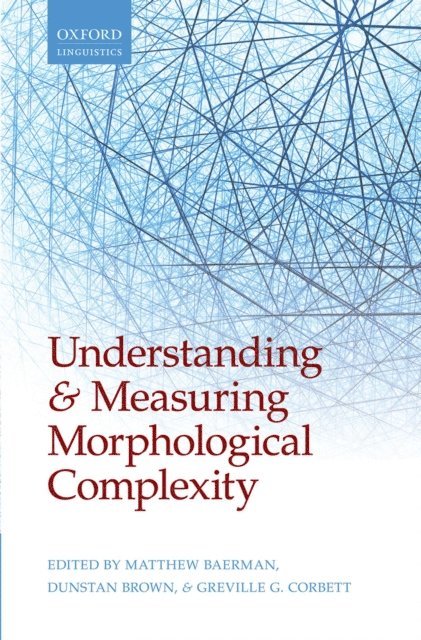
This book aims to assess the nature of morphological complexity, and the properties that distinguish it from the complexity manifested in other components of language. Of the many ways languages have of being complex, perhaps none is as daunting as what can be achieved by inflectional morphology: this volume examines languages such as Archi, which has a 1,000,000-form verb paradigm, and Chinantec, which has over 100 inflection classes. Alongside this complexity, inflection is notable for its variety across languages: one can take two unrelated languages and discover that they share similar syntax or phonology, but one would be hard pressed to find two unrelated languages with the same inflectional systems.In this volume, senior scholars and junior researchers highlight novel perspectives on conceptualizing morphological complexity, and offer concrete means for measuring, quantifying and analysing it. Examples are drawn from a wide range of languages, including those of North America, New Guinea, Australia, and Asia, alongside a number of European languages. The book will be a valuable resource for all those studying complexity phenomena in morphology, and for theoretical linguists more generally, from graduate level upwards.
643 kr
Skickas inom 5-8 vardagar
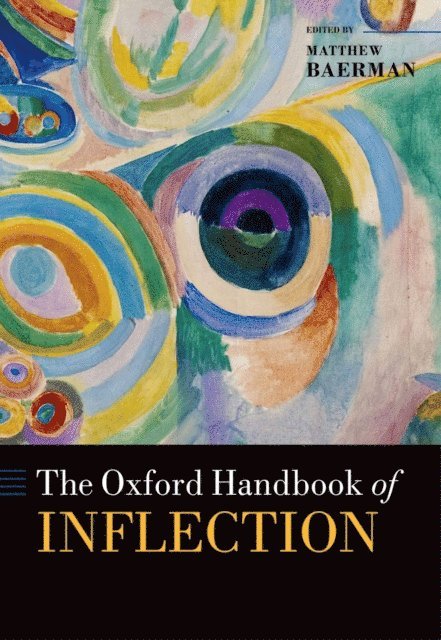
This is the latest addition to a group of handbooks covering the field of morphology, alongside The Oxford Handbook of Case (2008), The Oxford Handbook of Compounding (2009), and The Oxford Handbook of Derivational Morphology (2014). It provides a comprehensive state-of-the-art overview of work on inflection - the expression of grammatical information through changes in word forms. The volume's 24 chapters are written by experts in the field from a variety of theoretical backgrounds, with examples drawn from a wide range of languages.The first part of the handbook covers the fundamental building blocks of inflectional form and content: morphemes, features, and means of exponence. Part 2 focuses on what is arguably the most characteristic property of inflectional systems, paradigmatic structure, and the non-trivial nature of the mapping between function and form. The third part deals with change and variation over time, and the fourth part covers computational issues from a theoretical and practical standpoint. Part 5 addresses psycholinguistic questions relating to language acquisition and neurocognitive disorders. The final part is devoted to sketches of individual inflectional systems, illustrating a range of typological possibilities across a genetically diverse set of languages from Africa, Asia and the Pacific, Australia, Europe, and South America.
2 658 kr
Skickas inom 3-6 vardagar
This is the latest addition to a group of handbooks covering the field of morphology, alongside The Oxford Handbook of Case (2008), The Oxford Handbook of Compounding (2009), and The Oxford Handbook of Derivational Morphology (2014). It provides a comprehensive state-of-the-art overview of work on inflection - the expression of grammatical information through changes in word forms. The volume's 24 chapters are written by experts in the field from a variety of theoretical backgrounds, with examples drawn from a wide range of languages. The first part of the handbook covers the fundamental building blocks of inflectional form and content: morphemes, features, and means of exponence. Part 2 focuses on what is arguably the most characteristic property of inflectional systems, paradigmatic structure, and the non-trivial nature of the mapping between function and form. The third part deals with change and variation over time, and the fourth part covers computational issues from a theoretical and practical standpoint. Part 5 addresses psycholinguistic questions relating to language acquisition and neurocognitive disorders. The final part is devoted to sketches of individual inflectional systems, illustrating a range of typological possibilities across a genetically diverse set of languages from Africa, Asia and the Pacific, Australia, Europe, and South America.
Del 109 - Cambridge Studies in Linguistics
The Syntax-Morphology Interface
A Study of Syncretism
Häftad, Engelska, 2009
563 kr
Skickas inom 7-10 vardagar
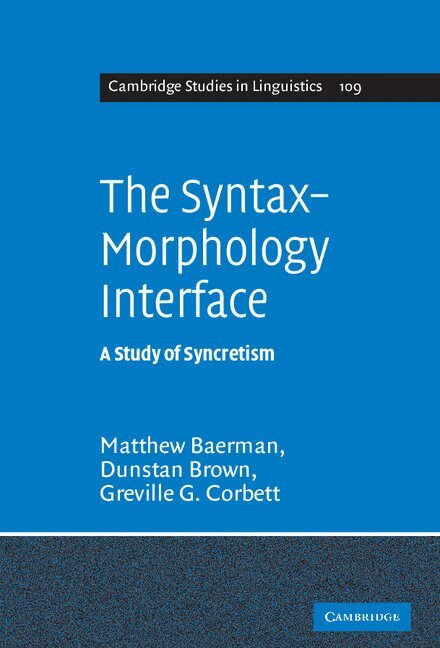
Syncretism - where a single form serves two or more morphosyntactic functions - is a persistent problem at the syntax-morphology interface. It results from a 'mismatch' whereby the syntax of a language makes a particular distinction but the morphology does not. This pioneering book provides a full-length study of inflectional syncretism, presenting a typology of its occurrence across a wide range of languages. The implications of syncretism for the syntax-morphology interface have long been recognised: it argues either for an enriched model of feature structure (thereby preserving a direct link between function and form), or for the independence of morphological structure from syntactic structure. This book presents a compelling argument for the autonomy of morphology and the resulting analysis is illustrated in a series of formal case studies within Network Morphology. It will be welcomed by all linguists interested in the relation between words and the larger units of which they are a part.
Del 109 - Cambridge Studies in Linguistics
The Syntax-Morphology Interface
A Study of Syncretism
Inbunden, Engelska, 2005
1 472 kr
Skickas inom 7-10 vardagar
Syncretism - where a single form serves two or more morphosyntactic functions - is a persistent problem at the syntax-morphology interface. It results from a 'mismatch' whereby the syntax of a language makes a particular distinction but the morphology does not. This pioneering book provides a full-length study of inflectional syncretism, presenting a typology of its occurrence across a wide range of languages. The implications of syncretism for the syntax-morphology interface have long been recognised: it argues either for an enriched model of feature structure (thereby preserving a direct link between function and form), or for the independence of morphological structure from syntactic structure. This book presents a compelling argument for the autonomy of morphology and the resulting analysis is illustrated in a series of formal case studies within Network Morphology. It will be welcomed by all linguists interested in the relation between words and the larger units of which they are a part.
1 485 kr
Skickas inom 7-10 vardagar
Inflectional morphology plays a paradoxical role in language. On the one hand it tells us useful things, for example that a noun is plural or a verb is in the past tense. On the other hand many languages get along perfectly well without it, so the baroquely ornamented forms we sometimes find come across as a gratuitous over-elaboration. This is especially apparent where the morphological structures operate at cross purposes to the general systems of meaning and function that govern a language, yielding inflection classes and arbitrarily configured paradigms. This is what we call morphological complexity. Manipulating the forms of words requires learning a whole new system of structures and relationships. This book confronts the typological challenge of characterising the wildly diverse sorts of morphological complexity we find in the languages of the world, offering both a unified descriptive framework and quantitative measures that can be applied to such heterogeneous systems.
333 kr
Skickas inom 7-10 vardagar
Inflectional morphology plays a paradoxical role in language. On the one hand it tells us useful things, for example that a noun is plural or a verb is in the past tense. On the other hand many languages get along perfectly well without it, so the baroquely ornamented forms we sometimes find come across as a gratuitous over-elaboration. This is especially apparent where the morphological structures operate at cross purposes to the general systems of meaning and function that govern a language, yielding inflection classes and arbitrarily configured paradigms. This is what we call morphological complexity. Manipulating the forms of words requires learning a whole new system of structures and relationships. This book confronts the typological challenge of characterising the wildly diverse sorts of morphological complexity we find in the languages of the world, offering both a unified descriptive framework and quantitative measures that can be applied to such heterogeneous systems.
2 443 kr
Skickas inom 3-6 vardagar
In a field still dominated by syntactic perspectives, it is easy to overlook the words that are the irreducible building blocks of language. Morphological Perspectives takes words as the starting point for any questions about linguistic structure: their form, their internal structure, their paradigmatic extensions, and their role in expressing and manipulating syntactic configurations. With a team of authors that run the typological gamut of languages, this book examines these questions from multiple perspectives, both the canonical and the non-canonical. By taking these questions seriously, and letting loose a full battery of analytical techniques, the following chapters not only celebrate the pioneering work of Greville G. Corbett but present new thinking on traditional approaches, including the paradigm, deponency and morphological features.
726 kr
Skickas inom 3-6 vardagar
In a field still dominated by syntactic perspectives, it is easy to overlook the words that are the irreducible building blocks of language. Morphological Perspectives takes words as the starting point for any questions about linguistic structure: their form, their internal structure, their paradigmatic extensions, and their role in expressing and manipulating syntactic configurations. With a team of authors that run the typological gamut of languages, this book examines these questions from multiple perspectives, both the canonical and the non-canonical. By taking these questions seriously, and letting loose a full battery of analytical techniques, the following chapters not only celebrate the pioneering work of Greville G. Corbett but present new thinking on traditional approaches, including the paradigm, deponency and morphological features.