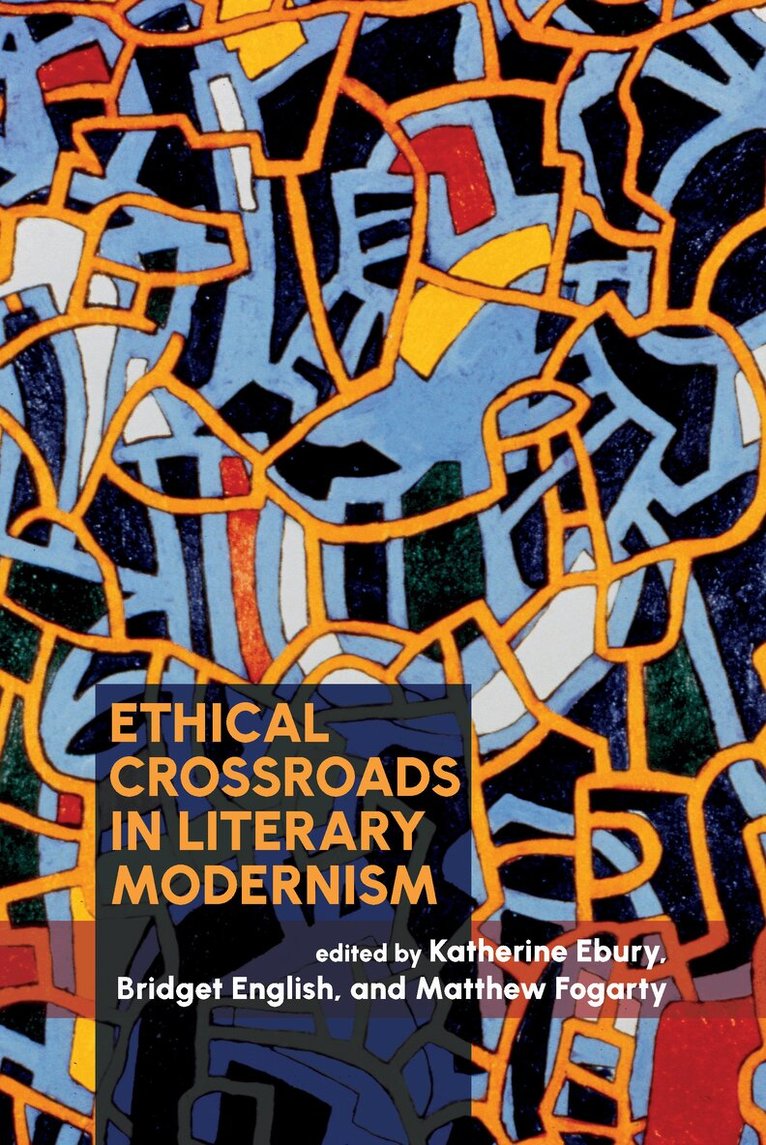
An Open Access edition of this book is available on the Liverpool University Press website and the OAPEN library.Establishing a new theoretical foothold at the crossroads of human, nonhuman, and posthuman studies in literary modernism, Ethical Crossroads in Literary Modernism broadens our current understanding of modernist ethics. Analysing a wide range of poetry, drama, prose fiction, and non-fiction writing, these essays expand the vertical and horizontal boundaries of modernist studies while addressing a number of the thematic concerns and critical approaches that are currently at the vanguard of modernist studies. These provocations, produced by both established critics and emerging scholars, include interrogations of the ethics of collaboration and influence through the lenses of queer theory, feminism, and ecocriticism, among others. The wide ranging geographical and interdisciplinary scope of this collection, which includes fields such as law and literature and animal studies, refreshes and reconfigures past debates on the positive influence and ethical failures of modernist literature for a new generation of researchers and students. This edited collection is the first book length study to use such an expansive and cutting-edge definition of modernist ethics and acts as both the definitive introduction to the topic and offers a series of original and ground-breaking essays.
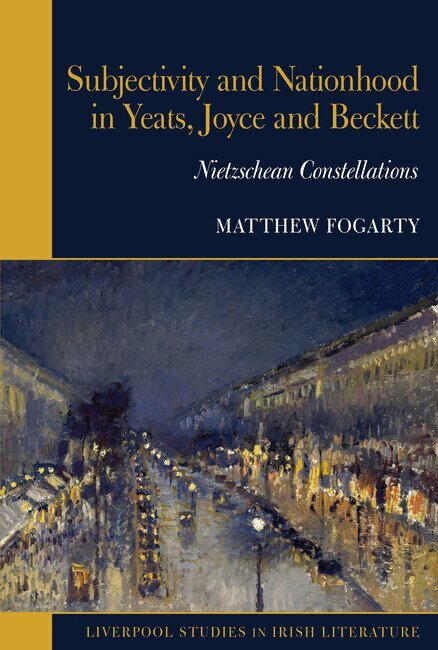
Subjectivity and Nationhood in Yeats, Joyce, and Beckett: Nietzschean Constellationsreconceptualises Friedrich Nietzsche’s position in the intellectual history of modernism and substantively refigures our received ideas regarding his relationship to these Irish modernists. Building on recent developments in new modernist studies, the book demonstrates that Nietzsche is a modernist writer and a modernist philosopher by drawing new parallels between his engagement with established philosophical theories and the aesthetic practices that Ezra Pound and T. S. Eliot identified as quintessentially modernist. With specific reference to key Nietzschean philosophemes – eternal recurrence, the Übermensch, transnationalism, cultural paralysis, and ethical perspectivism – itchallenges the longstanding assumption that Yeats, who repeatedly acknowledged his admiration for Nietzsche, is the most 'Nietzschean' of these Irish modernists. While showing how both Joyce and Beckett are in many important ways more 'Nietzschean' than Yeats, this interdisciplinary study makes a number of significant and timely contributions to the fields of Irish studies and modernist studies.