Matthew Moocarme - Böcker
Visar alla böcker från författaren Matthew Moocarme. Handla med fri frakt och snabb leverans.
3 produkter
3 produkter
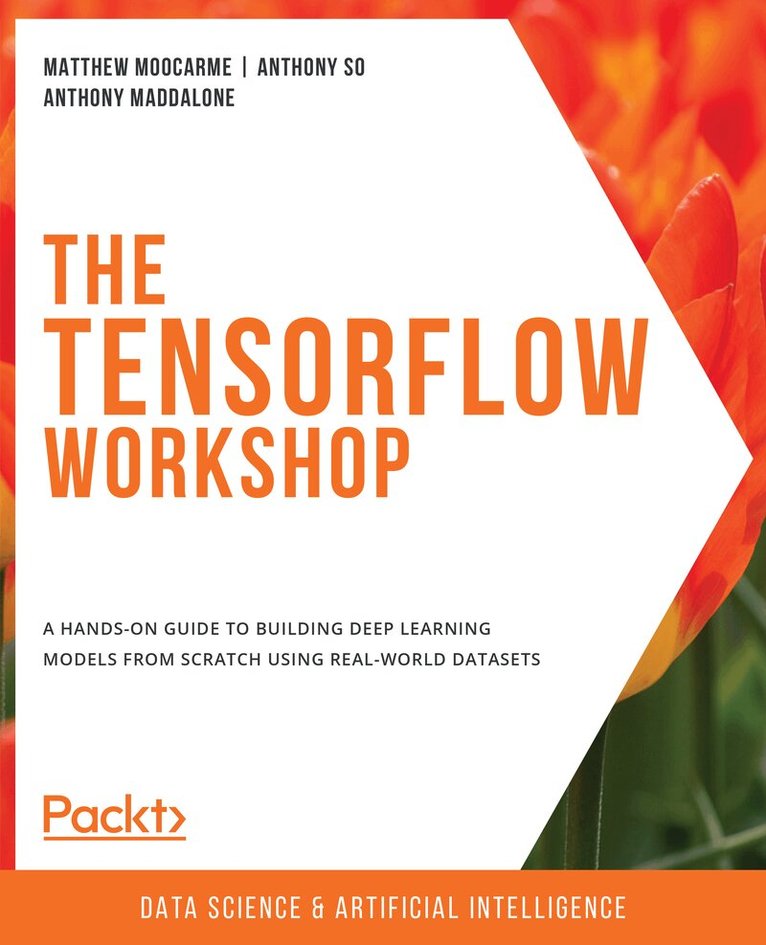
The TensorFlow Workshop
A hands-on guide to building deep learning models from scratch using real-world datasets
Häftad, Engelska, 2021
502 kr
Skickas
Get started with TensorFlow fundamentals to build and train deep learning models with real-world data, practical exercises, and challenging activitiesKey FeaturesUnderstand the fundamentals of tensors, neural networks, and deep learningDiscover how to implement and fine-tune deep learning models for real-world datasetsBuild your experience and confidence with hands-on exercises and activitiesBook DescriptionGetting to grips with tensors, deep learning, and neural networks can be intimidating and confusing for anyone, no matter their experience level. The breadth of information out there, often written at a very high level and aimed at advanced practitioners, can make getting started even more challenging.If this sounds familiar to you, The TensorFlow Workshop is here to help. Combining clear explanations, realistic examples, and plenty of hands-on practice, it’ll quickly get you up and running.You’ll start off with the basics – learning how to load data into TensorFlow, perform tensor operations, and utilize common optimizers and activation functions. As you progress, you’ll experiment with different TensorFlow development tools, including TensorBoard, TensorFlow Hub, and Google Colab, before moving on to solve regression and classification problems with sequential models.Building on this solid foundation, you’ll learn how to tune models and work with different types of neural network, getting hands-on with real-world deep learning applications such as text encoding, temperature forecasting, image augmentation, and audio processing.By the end of this deep learning book, you’ll have the skills, knowledge, and confidence to tackle your own ambitious deep learning projects with TensorFlow.What you will learnGet to grips with TensorFlow’s mathematical operationsPre-process a wide variety of tabular, sequential, and image dataUnderstand the purpose and usage of different deep learning layersPerform hyperparameter-tuning to prevent overfitting of training dataUse pre-trained models to speed up the development of learning modelsGenerate new data based on existing patterns using generative modelsWho this book is forThis TensorFlow book is for anyone who wants to develop their understanding of deep learning and get started building neural networks with TensorFlow. Basic knowledge of Python programming and its libraries, as well as a general understanding of the fundamentals of data science and machine learning, will help you grasp the topics covered in this book more easily.
Deep Learning with Keras Workshop
Learn how to define and train neural network models with just a few lines of code
Häftad, Engelska, 2020
462 kr
Skickas inom 5-8 vardagar
Discover how to leverage Keras, the powerful and easy-to-use open source Python library for developing and evaluating deep learning modelsKey FeaturesGet to grips with various model evaluation metrics, including sensitivity, specificity, and AUC scoresExplore advanced concepts such as sequential memory and sequential modelingReinforce your skills with real-world development, screencasts, and knowledge checksBook DescriptionNew experiences can be intimidating, but not this one! This beginner’s guide to deep learning is here to help you explore deep learning from scratch with Keras, and be on your way to training your first ever neural networks.What sets Keras apart from other deep learning frameworks is its simplicity. With over two hundred thousand users, Keras has a stronger adoption in industry and the research community than any other deep learning framework.The Deep Learning with Keras Workshop starts by introducing you to the fundamental concepts of machine learning using the scikit-learn package. After learning how to perform the linear transformations that are necessary for building neural networks, you'll build your first neural network with the Keras library. As you advance, you'll learn how to build multi-layer neural networks and recognize when your model is underfitting or overfitting to the training data. With the help of practical exercises, you’ll learn to use cross-validation techniques to evaluate your models and then choose the optimal hyperparameters to fine-tune their performance. Finally, you’ll explore recurrent neural networks and learn how to train them to predict values in sequential data.By the end of this book, you'll have developed the skills you need to confidently train your own neural network models.What you will learnGain insights into the fundamentals of neural networksUnderstand the limitations of machine learning and how it differs from deep learningBuild image classifiers with convolutional neural networksEvaluate, tweak, and improve your models with techniques such as cross-validationCreate prediction models to detect data patterns and make predictionsImprove model accuracy with L1, L2, and dropout regularizationWho this book is forIf you know the basics of data science and machine learning and want to get started with advanced machine learning technologies like artificial neural networks and deep learning, then this is the book for you. To grasp the concepts explained in this deep learning book more effectively, prior experience in Python programming and some familiarity with statistics and logistic regression are a must.
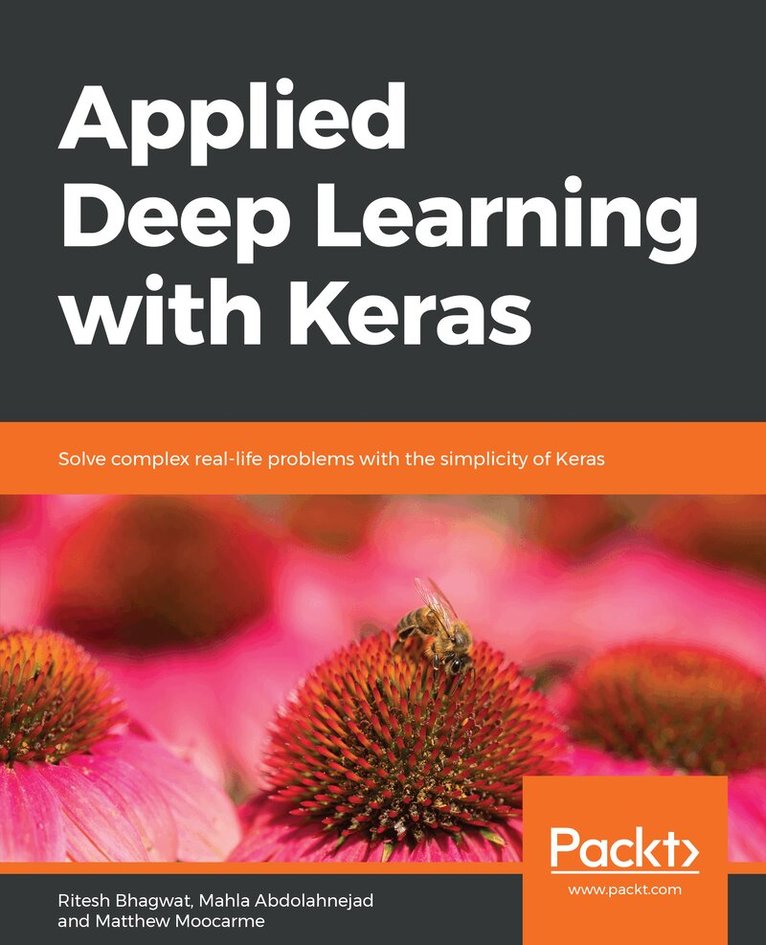
Applied Deep Learning with Keras
Solve complex real-life problems with the simplicity of Keras
Häftad, Engelska, 2019
462 kr
Skickas inom 5-8 vardagar
Take your neural networks to a whole new level with the simplicity and modularity of Keras, the most commonly used high-level neural networks API.Key FeaturesSolve complex machine learning problems with precisionEvaluate, tweak, and improve your deep learning models and solutionsUse different types of neural networks to solve real-world problemsBook DescriptionThough designing neural networks is a sought-after skill, it is not easy to master. With Keras, you can apply complex machine learning algorithms with minimum code.Applied Deep Learning with Keras starts by taking you through the basics of machine learning and Python all the way to gaining an in-depth understanding of applying Keras to develop efficient deep learning solutions. To help you grasp the difference between machine and deep learning, the book guides you on how to build a logistic regression model, first with scikit-learn and then with Keras. You will delve into Keras and its many models by creating prediction models for various real-world scenarios, such as disease prediction and customer churning. You’ll gain knowledge on how to evaluate, optimize, and improve your models to achieve maximum information. Next, you’ll learn to evaluate your model by cross-validating it using Keras Wrapper and scikit-learn. Following this, you’ll proceed to understand how to apply L1, L2, and dropout regularization techniques to improve the accuracy of your model. To help maintain accuracy, you’ll get to grips with applying techniques including null accuracy, precision, and AUC-ROC score techniques for fine tuning your model.By the end of this book, you will have the skills you need to use Keras when building high-level deep neural networks.What you will learnUnderstand the difference between single-layer and multi-layer neural network modelsUse Keras to build simple logistic regression models, deep neural networks, recurrent neural networks, and convolutional neural networksApply L1, L2, and dropout regularization to improve the accuracy of your modelImplement cross-validate using Keras wrappers with scikit-learnUnderstand the limitations of model accuracyWho this book is forIf you have basic knowledge of data science and machine learning and want to develop your skills and learn about artificial neural networks and deep learning, you will find this book useful. Prior experience of Python programming and experience with statistics and logistic regression will help you get the most out of this book. Although not necessary, some familiarity with the scikit-learn library will be an added bonus.