Mattias Kärrholm – författare
Visar alla böcker från författaren . Handla med fri frakt och snabb leverans.
11 produkter
11 produkter
Häftad, Engelska, 2020
670 kr
Skickas inom 10-15 vardagar
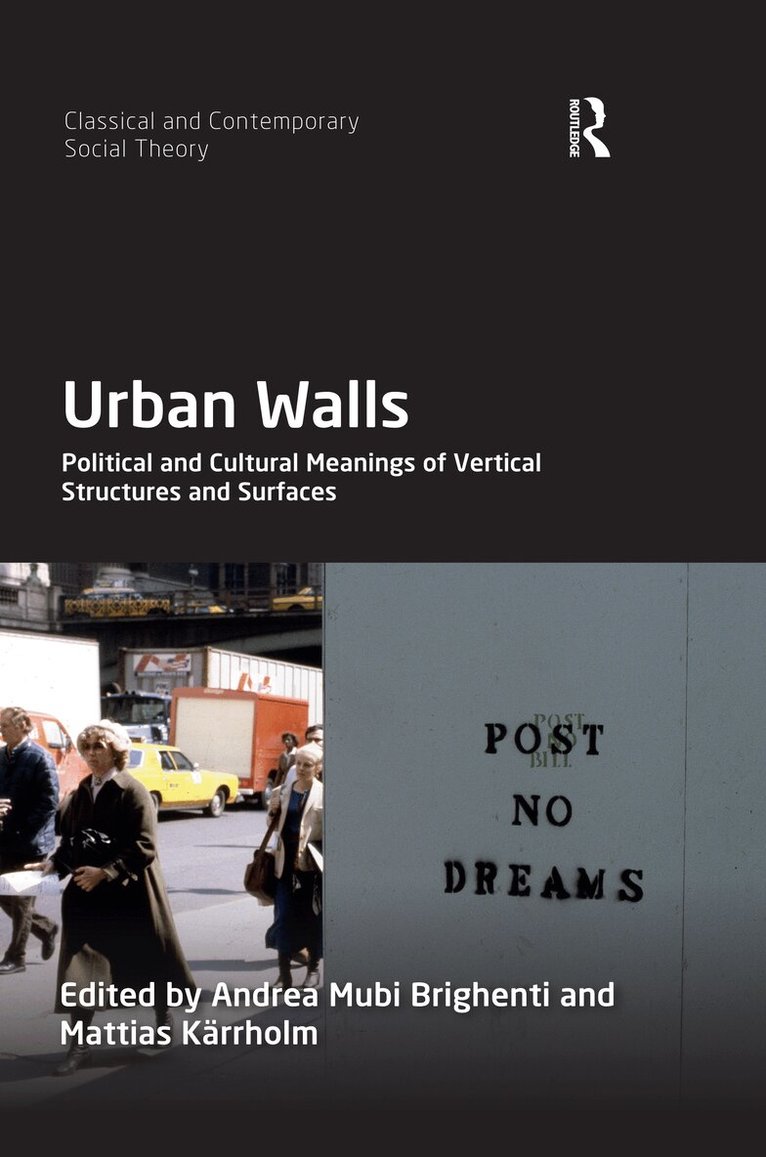
In recent years, an increasing number of separation walls have been built around the world. Walls built in urban areas are particularly striking in that they have exacted a heavy toll in terms of human suffering. As territorialising devices, walls can be protective, but the protection they grant is never straightforward. This collection invites inquiry into the complexities of the social life of walls, observing urban spaces as veritable laboratories of wall-making – places where their consequences become most visible. A study of the relationship between walls and politics, the cultural meaning of walls and their visibility, whether as barriers or as legible – sometimes spectacular – surfaces, and their importance for social processes, Urban Walls shows how walls extend into media spaces, thus drawing a multidimensional geography of separation, connection, control and resistance. As such, the collection will appeal to scholars of sociology, anthropology, geography, architecture and politics with interests in urban studies and social theory.
Inbunden, Engelska, 2022
2 433 kr
Skickas inom 10-15 vardagar
This collection seeks to illustrate the state of the art in territoriological research, both empirical and theoretical. The volume gathers together a series of original, previously unpublished essays exploring the newly emerging territorial formations in culture, politics and society. While the globalisation debate of the 1990s largely pivoted around a ‘general deterritorialisation’ hypothesis, since the 2000s it has become apparent that, rather than effacing territories, global connections are added to them, and represent a further factor in the increase of territorial complexity. Key questions follow, such as: How can we further the knowledge around territorial complexities and the ways in which different processes of territorialisation co-exist and interact, integrating scientific advances from a plurality of disciplines? Where and what forms does territorial complexity assume, and how do complex territories operate in specific instances? Which technological, political and cultural facets of territories should be tackled to make sense of the life of territories? How and by what different or combined methods can we describe territories, and do justice to their articulations and meanings? How can the territoriological vocabulary relate to contemporary social theory advancements such as ANT, the ontological turn, the mobilities paradigm, sensory urbanism, and atmospheres research? How can territorial phenomena be studied across disciplinary boundaries? Territories, Environments, Politics casts a fresh perspective onto a number of key contemporary socio-spatial phenomena. Refraining from the attempt to ossify territoriology into some disciplinary straightjacket, the collection aims to illustrate the scope of current territoriological research, its domain, its promises, its theoretical advancements, and its methodological reflection in the making. Scholars interested in social research will find in this collection a rich and imaginative theoretical-methodological toolkit. Students in human geography, anthropology and sociology, socio-legal studies, architecture and urban planning will find Territories, Environments, Politics of interest.
Häftad, Engelska, 2024
670 kr
Skickas inom 10-15 vardagar
This collection seeks to illustrate the state of the art in territoriological research, both empirical and theoretical. The volume gathers together a series of original, previously unpublished essays exploring the newly emerging territorial formations in culture, politics and society. While the globalisation debate of the 1990s largely pivoted around a ‘general deterritorialisation’ hypothesis, since the 2000s it has become apparent that, rather than effacing territories, global connections are added to them, and represent a further factor in the increase of territorial complexity. Key questions follow, such as: How can we further the knowledge around territorial complexities and the ways in which different processes of territorialisation co-exist and interact, integrating scientific advances from a plurality of disciplines? Where and what forms does territorial complexity assume, and how do complex territories operate in specific instances? Which technological, political and cultural facets of territories should be tackled to make sense of the life of territories? How and by what different or combined methods can we describe territories, and do justice to their articulations and meanings? How can the territoriological vocabulary relate to contemporary social theory advancements such as ANT, the ontological turn, the mobilities paradigm, sensory urbanism, and atmospheres research? How can territorial phenomena be studied across disciplinary boundaries? Territories, Environments, Politics casts a fresh perspective onto a number of key contemporary socio-spatial phenomena. Refraining from the attempt to ossify territoriology into some disciplinary straightjacket, the collection aims to illustrate the scope of current territoriological research, its domain, its promises, its theoretical advancements, and its methodological reflection in the making. Scholars interested in social research will find in this collection a rich and imaginative theoretical-methodological toolkit. Students in human geography, anthropology and sociology, socio-legal studies, architecture and urban planning will find Territories, Environments, Politics of interest.
Häftad, Engelska, 2016
850 kr
Skickas inom 10-15 vardagar
Over the past few years there has been a proliferation of new kinds of retail space. Retail space has cropped up just about everywhere in the urban landscape: in libraries, workplaces, churches and museums. In short, retail is becoming a more and more manifest part of the public domain. The traditional spaces of retail, such as city centres and outlying shopping malls, are either increasing in size or disappearing, producing new urban types and whole environments totally dedicated to retail. The creation of these new retail spaces has brought about a re- and de-territorialisation of urban public space, and has also led to transformations in urban design and type of materials used, and even in the logic and ways through which these design amenities meet the needs of retailers and/or consumers. This book describes how the retailisation of public domains affects our everyday life and our use of the built environment. Taking an architectural and territorial perspective on this issue, it looks specifically at how retail and consumption spaces have changed and territorialised urban life in different ways. It then develops a methodology and a set of concepts to describe and understand the role of architecture in these territorial transformations.
Inbunden, Engelska, 2018
2 193 kr
Skickas inom 10-15 vardagar
In recent years, an increasing number of separation walls have been built around the world. Walls built in urban areas are particularly striking in that they have exacted a heavy toll in terms of human suffering. As territorialising devices, walls can be protective, but the protection they grant is never straightforward. This collection invites inquiry into the complexities of the social life of walls, observing urban spaces as veritable laboratories of wall-making – places where their consequences become most visible. A study of the relationship between walls and politics, the cultural meaning of walls and their visibility, whether as barriers or as legible – sometimes spectacular – surfaces, and their importance for social processes, Urban Walls shows how walls extend into media spaces, thus drawing a multidimensional geography of separation, connection, control and resistance. As such, the collection will appeal to scholars of sociology, anthropology, geography, architecture and politics with interests in urban studies and social theory.
Inbunden, Engelska, 2012
2 506 kr
Skickas inom 10-15 vardagar
Over the past few years there has been a proliferation of new kinds of retail space. Retail space has cropped up just about everywhere in the urban landscape: in libraries, workplaces, churches and museums. In short, retail is becoming a more and more manifest part of the public domain. The traditional spaces of retail, such as city centres and outlying shopping malls, are either increasing in size or disappearing, producing new urban types and whole environments totally dedicated to retail. The creation of these new retail spaces has brought about a re- and de-territorialisation of urban public space, and has also led to transformations in urban design and type of materials used, and even in the logic and ways through which these design amenities meet the needs of retailers and/or consumers. This book describes how the retailisation of public domains affects our everyday life and our use of the built environment. Taking an architectural and territorial perspective on this issue, it looks specifically at how retail and consumption spaces have changed and territorialised urban life in different ways. It then develops a methodology and a set of concepts to describe and understand the role of architecture in these territorial transformations.
Inbunden, Engelska, 2024
2 065 kr
Skickas inom 3-6 vardagar
Inbunden, Engelska, 2024
2 453 kr
Skickas inom 3-6 vardagar
Häftad, Svenska, 2014
222 kr
Skickas
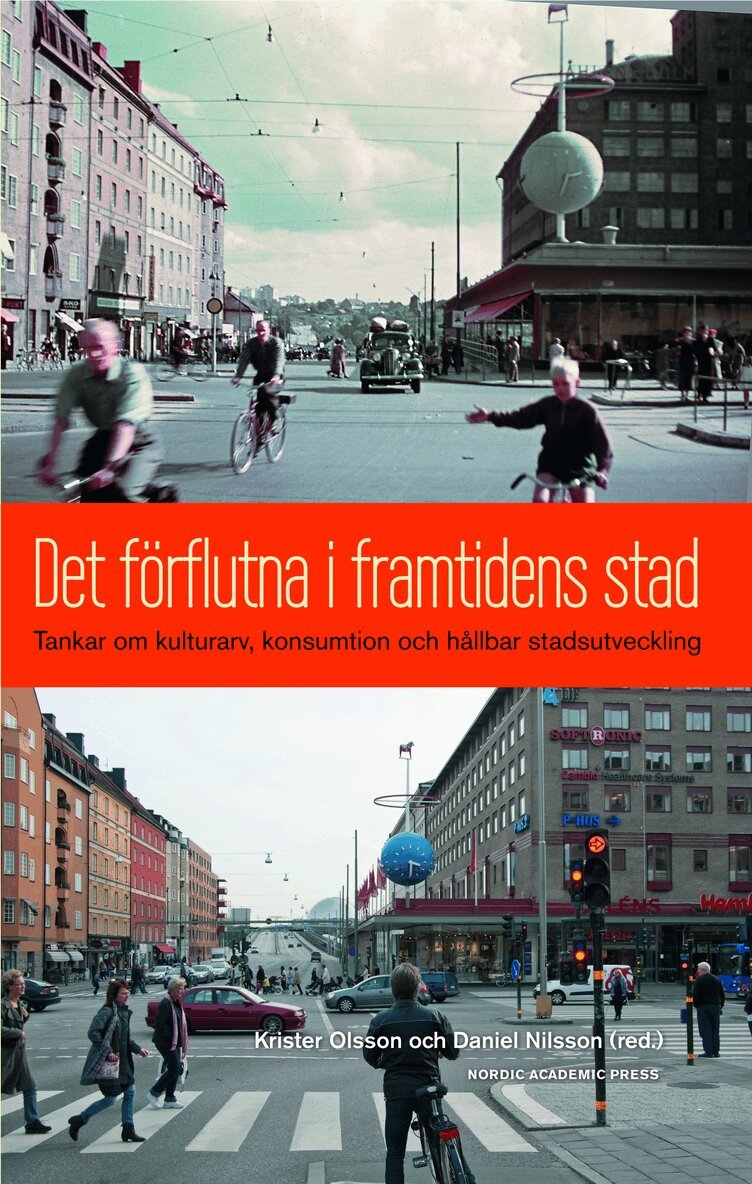
Idag lever vi i ett globaliserat konsumtionssamhälle, i ett allt intensivare tempo där konkurrensen är hård om tid, utrymme och uppmärksamhet. I vår samtid är även kultur- och stadsmiljöerna på olika sätt produkter och resurser. Men hur påverkar samhällsutvecklingen kulturarvet och vår syn på dess värden? Kanske kan vi tydligare se utvecklingstrenderna och kulturarvets roll för hållbar stadsutveckling om vi blickar bakåt i tid och även vänder perspektivet mot framtiden? I Det förflutna i framtidens stad lägger en grupp forskare olika tidsperspektiv på relationen mellan kulturarv, konsumtion och hållbar stadsutveckling. Författarna arbetar till vardags med framtidsstudier, samhällsplanering, arkeologi, arkitektur och konst och de samsas här under tematiska avsnitt som framtidsvisioner, valmöjligheter, tid och rörelse i stadslandskapet. Texterna gör nedslag i vår närmiljö bland resor, detaljhandel, bostäder och livsstilsideal. Författarna frågar sig bland annat hur vi kan bygga in hemkänsla, identitet och trygghet i stadsmiljön. Kan vi återanvända historiska bostadsmodeller? Och vem bestämmer vilka minnen som är värda att bevaras vilka föreställningar om framtiden har bäring på samtidens kulturmiljövård? Boken vänder sig till beslutsfattare, tjänstemän, studenter och en bred allmänhet alla som har ett intresse för såväl utmaningar som lösningar för en hållbar stad.
Inbunden, Engelska, 2015
189 kr
Skickas
E-bok
Engelska, 2016169 kr
Läs direkt efter köp
Urban Squares suggests a specific and fresh take on agorology – the study of urban squares. The approach is one of recording everyday life and focusing on different ways to describe and investigate the public life and space of urban squares. The book comprises four empirical case studies of squares focusing especially on the urban material culture and spatio-temporal changes of these squares. The squares are all located in the metropolitan and transnational Öresund region in between Denmark and Sweden, a region that has gone through extensive transformations during the last couple of decades. The four cases written by initiated scholars represent different images of how urban life and the space of these squares has changed. They include studies of changing day-to-day uses over time (Stortorget, Malmö), of changing rhythms of public eating and its consequences on how to address questions of urban design (Värnhemstorget, Malmö), of changing planning tools and its implementation in an urban renewal process (Slussplan, Malmö), and of new designerly ways of addressing community and spatial appropriation (at Superkilen, Copenhagen). The compilation of cases suggest different ways of addressing spatio-temporal aspects of the everyday life of urban squares, and helps us to see how the everyday life of squares plays an important part in the production of public space. The authors hope that their discussions might open up for new perspectives on urban design and public life, as well as point to the possible development of a more extensive agorology of everyday life.