Maurice Natanson - Böcker
Visar alla böcker från författaren Maurice Natanson. Handla med fri frakt och snabb leverans.
6 produkter
6 produkter
341 kr
Skickas inom 11-20 vardagar
The product of many years of reflection on phenomenology, this book is a comprehensive and creative introduction to the philosophy of Edmund Husserl. Natanson uses Husserl's later work as a clue to the meaning of his entire intellectual career, showing how his earlier methodological work evolved into the search for transcendental roots and developed into a philosophy of the life-world. Phenomenology, for Natanson, emerges as a philosophy of origin, a transcendental discipline concerned with consciousness, history, and world rather than with introspection and traditional metaphysical warfare.
540 kr
Skickas inom 10-15 vardagar
The three essays reprinted in this book were first published in 1963 as individual chapters of a psychiatric treatise entitled Psychiatrie der Gegen wart (Psychiatry of the Present Day). The editors, W. H. GRUHLE (Bonn), R. JUNG (Freiburg/Br. ), W. MAYER-GROSS (Birmingham, England), M. MUL LER (Bern, Switzerland), had not planned an encyclopedic presentation; they did not intend to present a "handbook" which would be as complete as possible in details and bibliographic reference. Their intention was to "raze the walls" separating Continental and Anglo-Saxon psychiatries and to offer a synopsis of developments in psychiatry during the last decades on an international basis. The editors requested, therefore, cooperation of scholars from many foreign countries, large and small, on both sides of the Atlantic. A section entitled "Borderlands of Psychiatry", in which MARGARET MEAD (New York) discusses the relation of "Psychiatry and Ethnology", HANS HEIMAN (Bern), the relation of "Religion und Psychiatrie", and ROBERT VOLMER (Paris), "Art et Psychiatrie", is a good illustration of the trilingual character of the whole work. Two of the editors, GRUHLE and MAYER-GROSS, died before the publi cation had been completed. In a kind of posthumous eulogy, Professor JUNG and Professor MULLER praised the initiative and accomplishments of MAYER-GROSS, "who during the last five years of his life had given a great deal of his time to this work. He had set his mind on a synthesis of German and Anglo-Saxon psychiatry.
540 kr
Skickas inom 10-15 vardagar
537 kr
Skickas inom 10-15 vardagar
Alfred Schutz was born in Vienna on April 13, 1899, and died in New York City on May 20, 1959. The year 1969, then, marks the seventieth anniversary of his birth and the tenth year of his death. The essays which follow are offered not only as a tribute to an irreplaceable friend, colleague, and teacher, but as evidence of the contributors' conviction of the eminence of his work. No special pleading is needed here to support that claim, for it is widely acknowledged that his ideas have had a significant impact on present-day philosophy and phenomenology of the social sciences. In place of either argument or evaluation, I choose to restrict myself to some bi~ graphical information and a fragmentary memoir. * The only child of Johanna and Otto Schutz (an executive in a private bank in Vienna), Alfred attended the Esterhazy Gymnasium in Vienna, an academic high school whose curriculum included eight years of Latin and Greek. He graduated at seventeen - in time to spend one year of service in the Austrian army in the First World War. For bravery at the front on the battlefield in Italy, he was decorated by his country. After the war ended, he entered the University of Vienna, completing a four year curriculum in only two and one half years and receiving his doctorate in Law.
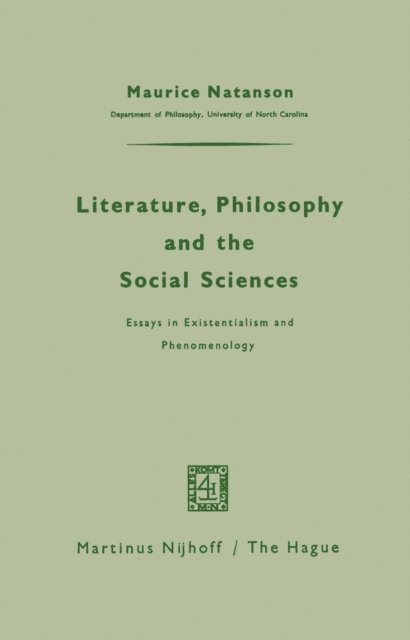
Literature, Philosophy, and the Social Sciences
Essays in Existentialism and Phenomenology
Häftad, Engelska, 1962
537 kr
Skickas inom 10-15 vardagar
A collection of one man's essays in book form tends to be viewed today with some suspicion, if not hostility, by philosophical critics. It would seem that the author is guilty of an academic sin of pride: causing or helping to cause separately conceived articles to surpass their original station and assume a new life, a grander articulation. It can hardly be denied that the essays which follow must face this sullen charge, for they were composed at different times for different sorts of audiences and, for the most part, have already been published. Their appearance in a new form will not allay commonplace criticisms: there are repetitions, certain key terms are defined and defined again in various places, a few quotations reappear, and, beyond this, the essays are unequal in range, depth, and fundamental intent. But it is what brings these essays together that constitutes, I trust, their collective merit. Underlying the special arguments that are to be found in each of the chapters is a particular sense of reality, not a thesis or a theory but rather a way of seeing the world and of appreciating its texture and design. It is that sense of reality that I should like to speak of here. Philosophy stands in a paradoxical relationship to mundane ex istence: it is at once its critique and one of its possibilities.
1 067 kr
Skickas inom 10-15 vardagar
Fifteen years ago, Dorion Cairns concluded an article on phenome nology with a cautious appraisal of its influence in America. "Thus far," he wrote, "it continues to be an exotic. " The situation today has changed: translations of the writings of Husserl, Heidegger, Marcel, Sartre, and Merleau-Ponty have appeared, and commentaries on these and related thinkers are not uncommon. Moreover, discussion of phenomenological problems is increasingly becoming part of the American (if not the British) philosophical scene. Phenomenology is in danger of domestication! Signs of its accommodation include a willingness to pay tribute to HusserI's Logical Investigations by those who find relatively little to interest them in his later work, a location of what are taken to be common themes and underlying convergences of emphasis in Continental phenomenology and Anglo-American philosophy of the more nearly Wittgensteinian and Austinian varieties, and a growing impatience (shared by some phenomenologists) with expositions, explications, and interpretations of Husserl's work at the expense of original applications of phenomenology. Most bluntly put, the attitude is: Don't talk about it; do it! It would seem that we have arrived at a point where introductions to phenomenology are of doubt ful value, if not superfluous. The present collection of essays is based on different assumptions and points to an alternative conception of the role of both methodology and originality in phenomenological work.