Maury Klein - Böcker
Visar alla böcker från författaren Maury Klein. Handla med fri frakt och snabb leverans.
8 produkter
8 produkter
398 kr
Skickas inom 5-8 vardagar
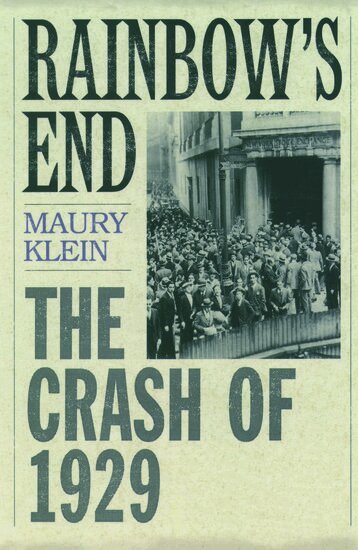
Few single events have affected business and society in the US so profoundly, and in such a short time. There have also been few books that address both these elements of the crash together, and very little published on the subject in the past decade. In this book, a gifted narrative historian with extensive background in the history of business and finance will put into perspective the many conflicting theories of what caused the crash, what role speculation did or did not play, whether or not it could have been avoided, and what role it played in bringing on the depression.The crash itself will be the climax of the narrative. Most of the book will concentrate on the decade before the crash, outlining the heavy bull market, and describing an era of unprecedented technological development, optimism, and expanding wealth. This decade saw the burgeoning of mass society and a popular culture driven by media and advertising, and a heady free market marked by unregulated banking and credit systems, and get-rich-quick schemes. Klein argues that the stock market crash marked a turning point in American history where the failure of self-regulating individualism led to an overhaul of the financial system and much more government regulation. It threw into question the beliefs in the American dream spawned by the 20s and preceded a preiod of deep depression, not only economically, but in regard to the most fundamental American values. The narrative will use a variety of people, developments, and events to illuminate these themes: Jack Morgan, Richard Whitney, Joseph Kennedy, Charles Mitchell, Herbert Hoover, John J. Raskob, and Alexander J. Noyes.
Union Pacific
The Reconfiguration: America's Greatest Railroad from 1969 to the Present
Inbunden, Engelska, 2011
616 kr
Skickas inom 5-8 vardagar
Praised by the Chicago Tribune as "thoroughly and compellingly detailed history," Volumes I and II of Maury Klein's monumental history of the Union Pacific Railroad covered the years from 1863-1969. Now the third and final volume brings the story of the Union Pacific--the oldest, largest, and most successful railroad of modern times--fully up to date. The book follows the trajectory of an icon of the industrial age trying to negotiate its way in a post-railway world, plagued by setbacks such as labor disputes, aging infrastructure, government de-regulation, ill-fated mergers, and more. By 1969 the same company that a century earlier had triumphantly driven the golden spike into Promontory Summit--to immortalize the nation's first transcontinental railway--seemed a dinosaur destined for financial ruin. But as Klein shows, the Union Pacific not only survived but is once more thriving, which proves that railways remain critical to commerce and industry in America, even as passenger train travel has all but disappeared. Drawing on interviews with Union Pacific personnel past and present, Klein takes readers inside the great railroad--into its boardrooms and along its tracks--to show how the company adapted to the rapidly changing world of modern transportation. The book also offers fascinating portraits of the men who have run the railroad. The challenges they faced, and the strategies they developed to meet them, give readers a rare glimpse into the inner workings of one of America's great companies. A capstone on a remarkable achievement, Union Pacific: The Reconfiguration will appeal to historians, business scholars, and transportation buffs alike.
305 kr
Skickas inom 7-10 vardagar
This book, first published in 2007, offers a bold new interpretation of American business history during the formative years 1870-1920, which mark the dawn of modern big business. It focuses on four major revolutions that ushered in this new era: those in power, transportation, communication, and organization. Using the metaphor of America as an economic hothouse uniquely suited to rapid economic growth during these years, it analyzes the interplay of key factors such as entrepreneurial talent, technology, land, natural resources, law, mass markets, and the rise of cities. It also delineates the process that laid the foundation for the modern era, in which virtually every human activity became a business, and, in most cases, a big business. The book also profiles numerous major entrepreneurs whose careers and activities illustrate broader trends and themes. It utilizes a wide variety of sources, including novels from the period, to produce a lively narrative.
604 kr
Skickas inom 7-10 vardagar
This book, first published in 2007, offers a bold new interpretation of American business history during the formative years 1870-1920, which mark the dawn of modern big business. It focuses on four major revolutions that ushered in this new era: those in power, transportation, communication, and organization. Using the metaphor of America as an economic hothouse uniquely suited to rapid economic growth during these years, it analyzes the interplay of key factors such as entrepreneurial talent, technology, land, natural resources, law, mass markets, and the rise of cities. It also delineates the process that laid the foundation for the modern era, in which virtually every human activity became a business, and, in most cases, a big business. The book also profiles numerous major entrepreneurs whose careers and activities illustrate broader trends and themes. It utilizes a wide variety of sources, including novels from the period, to produce a lively narrative.
639 kr
Skickas inom 10-15 vardagar
To Americans living in the early twentieth century, E. H. Harriman was as familiar a name as J. P. Morgan, John D. Rockefeller, and Andrew Carnegie. Like his fellow businessmen, Harriman (1847-1909) had become the symbol for an entire industry: Morgan stood for banking, Rockefeller for oil, Carnegie for iron and steel, and Harriman for railroads. Here, Maury Klein offers the first in-depth biography in more than seventy-five years of this influential yet surprisingly understudied figure. A Wall Street banker until age fifty, Harriman catapulted into the railroad arena in 1897, gaining control of the Union Pacific Railroad as it emerged from bankruptcy and successfully modernizing every aspect of its operation. He went on to expand his empire by acquiring large stakes in other railroads, including the Southern Pacific and the Baltimore and Ohio, in the process clashing with such foes as James J. Hill, J. P. Morgan, and Theodore Roosevelt.With its new insights into the myths and controversies that surround Harriman's career, this book reasserts his legacy as one of the great turn-of-the-century business titans.A UNC Press Enduring Edition -- UNC Press Enduring Editions use the latest in digital technology to make available again books from our distinguished backlist that were previously out of print. These editions are published unaltered from the original, and are presented in affordable paperback formats, bringing readers both historical and cultural value.
512 kr
Skickas inom 3-6 vardagar
After the Civil War, the Louisville and Nashville Railroad took the lead among southern railroads in developing rail systems and organizing transcontinental travel. Through two world wars, federal government control, internal crises, external dissension, the Depression, and the great Ohio River flood of 1937, the L&N Railroad remained one of the country's most efficient lines. It is a southern institution and a railroad buff's dream. When eminent railroad historian Maury Klein's definitive History of the Louisville and Nashville Railroad was first published in 1972, it quickly became one of the most sought after books on railroad history. This new edition both restores a hard-to-find classic to print and provides a new introduction by Klein detailing the L&N's history in the thirty years since the book was first published.
265 kr
Skickas inom 7-10 vardagar
The second volume in the history of the Union Pacific begins after the financial panic of 1893, one of the worst depressions Americans had yet experienced, which pushed the railroad into bankruptcy. Maury Klein examines the complex challenges faced by the Union Pacific in the new century—the expanding role of government and its restrictive regulations, the growth of labor unions, the devastating effects of two world wars, and the growing competition from new modes of transportation—and how, under the innovative and influential leadership of Edward H. Harriman, the Union Pacific again played the role of industrial pioneer. Union Pacific has remained one of the strongest railroads in the country, surviving the eras of government regulation and the corporate mergers of the past twenty-five years. Insightful, definitive in scope, rich in colorful anecdotes and superb characterizations, Union Pacific is a fascinating saga not only of a particular railroad but also about how that industry transformed America.Maury Klein is professor of history at the University of Rhode Island. He is the author of several books, including the Pulitzer Prize finalist The Life and Legend of Jay Gould.
Flowering of the Third America
The Making of an Organizational Society, 1850–1920
Häftad, Engelska, 1993
117 kr
Skickas inom 10-15 vardagar
In a provocative new interpretation of a transforming era in American history, Maury Klein examines the forces that turned the United States from a rural agricultural society to an urban industrial one. Integrating social, economic, and business history, he stresses the driving role of technology and the emergence of a complex society of many cultures, lacking a cohesive center. The rise of a corporate economy, described by Mr. Klein, resulted in productive miracles unequaled elsewhere—but at the cost of great social dislocation in American life. Gradually there arose a society that organized and formalized traditional American values in new and unexpected ways. This transformation produced a surprising new center for the diverse and fragmented American social order: the consumer economy. The new order flowered after the turn of the century and was advanced by the consequences of World War I, which left the United States as the world's major power. The Flowering of the Third America is a vivid and authoritative portrait of the making of modern America.