Max C. Keilbach - Böcker
Visar alla böcker från författaren Max C. Keilbach. Handla med fri frakt och snabb leverans.
2 produkter
2 produkter
1 989 kr
Skickas inom 5-8 vardagar
Public policy spanning a broad range of contexts, ranging from the European Union, to states, cities and local communities around the globe, has turned to entrepreneurship to provide the engine for economic growth, competitiveness in globally linked markets, and jobs. This book explains why entrepreneurship has emerged as a bona fide instrument of growth policy. The knowledge spillover theory of entrepreneurship suggests that entrepreneurship provides a crucial mechanism in the process of economic growth by serving as a conduit for knowledge spillovers. Investments in new knowledge and ideas may not automatically spill over and result in commercialization, as has typically been assumed in models of economic growth. Rather, the existence of what is introduced as the knowledge filter impedes the spillover and commercialization of investments in new ideas and knowledge. By penetrating the knowledge filter and facilitating the spillover of knowledge that might otherwise not be commercialized, entrepreneurship provides the missing link to economic growth. This new focus of entrepreneurship as a conduit transmitting the spillover of knowledge generates a series of theoretical propositions, involving not just the impact of entrepreneurship on economic performance and growth, but also the very nature of entrepreneurship. The theoretical propositions range from positing that entrepreneurial opportunities are not exogenously given but rather endogenously and systematically created by investments in new knowledge and ideas, to the importance of geographic proximity between entrepreneurial activity and knowledge sources, the impact of location on entrepreneurial performance, and the new roles for board, managers and modes of finance in entrepreneurial firms accessing and absorbing knowledge spillovers. These propositions are subjected to systematic econometric scrutiny and verification using both aggregate data to analyze the links between entrepreneurship and growth, as well as firm-level data to analyze the impact of knowledge spillover on entrepreneurial location, performance, boards, managers and mode of finance. The resulting empirical evidence supports the knowledge spillover of entrepreneurship not only by linking entrepreneurship to economic growth and performance, but also by identifying how the organization and strategy of entrepreneurial firms are influenced by the need to access, absorb and commercialize external knowledge spillovers. The book concludes that the new millennium may not be so much about the process of Joseph Schumpeter's creative destruction, where entrepreneurial startups displace and ultimately drive incumbent company's out of business, but rather characterized by creative construction. Globalization and its concomitant outsourcing and offshoring is the source of the "destruction", especially in terms of lower skilled jobs. By contrast, in the 21st century global economy, entrepreneurship is constructive by commercializing investments in knowledge and ideas that might never have been commercialized but ultimately result in growth, global competitiveness and employment. Thus, the emergence of entrepreneurship policy can be interpreted as the attempt to generate entrepreneurial based economic growth by creating an entrepreneurial economy.
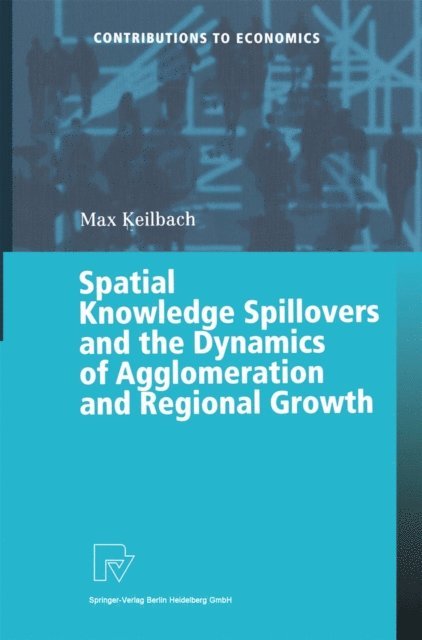
Spatial Knowledge Spillovers and the Dynamics of Agglomeration and Regional Growth
Häftad, Engelska, 2000
540 kr
Skickas inom 10-15 vardagar
When considering the dynamics of regional growth rates, one usually observes growth convergence on spatial aggregates but non-convergence or even divergence within smaller regions of different type. This book suggests various approaches to investigate this puzzle. A formal model, merging approaches from growth theory and new economic geography, shows that spatial knowledge spillovers might be the driving force behind this behavior. To analyze an arbitrary number of regions, the model is implemented on a locally recursive simulation tool - cellular automata. Convergence regressions from different runs of the automaton confirm previous findings. Finally, the existence of spatial knowledge spillovers is tested. Regressions give strong evidence for spatial knowledge spillovers. All the relevant literature and spatial econometric methods are surveyed. Data is reproduced in the appendix.