M.E. Waithe – författare
Visar alla böcker från författaren M.E. Waithe. Handla med fri frakt och snabb leverans.
13 produkter
13 produkter
Inbunden, Engelska, 1990
2 156 kr
Skickas inom 10-15 vardagar
edited by Mary Ellen Waithe Series: HISTORY OF WOMEN PHILOSOPHERS volume: 3 From the 17th century onwards, increasing numbers of mostly self-educated women became philosophers. The philosophical writings of Anna Maria van Schurman, Margaret Cavendish, Anne Conway, Mary Astell, Catharine Trotter Cockburn, Damaris Cudworth Masham, Harriet Taylor Mill, Harriet Martineau, Margaret Fuller, Charlotte Perkins Gilman, Lou Andreas Salome, Germaine de Staehl, Sophie Germain, and Mary Sommerville were influential. Other philosophers, including Queen Kristina of Sweden, Sor Juana Inez de la Cruz, Julie Favre, Clarisse Coignet, Anna Tumarkin, Hortense Allart de Meritens, Sophie Bryant, and Hedwig Bender were less well known. But all demonstrate expertise in many areas of philosophy: epistemology, logic, aesthetics, metaphysics, ethics, political philosophy, philosophy of science, of psychology, of religion, and, of mathematics. They write on such diverse topics as the mystical and the paranormal, the nature of thought, of faith, of morality, of liberty, of logic, and, the rights of women. Together they manifest philosophy's own transition from mysticism to logical positivism.Kluwer Academic Publishers, Dordrecht March 1991 344 pp. Hardbound Dfl.196.00 BrP.78.50 March 1991 344 pp. Paperback Dfl.71.00 BrP.28.50
Häftad, Engelska, 1991
2 371 kr
Skickas inom 10-15 vardagar
Del 4 - History of Women Philosophers
History of Women Philosophers
Contemporary Women Philosophers, 1900-Today
Inbunden, Engelska, 1994
2 156 kr
Skickas inom 10-15 vardagar
Like their predecessors, and like their male counterparts, most women philosophers of the 20th century have significant expertise in several specialities. Moreover, their work represents the gamut of 20th century philosophy's interests in moral pragmatism, logical positivism, philosophy of mathematics, of psychology, and of mind. Their writings include feminist philosophy, classical moral theory reevaluated in light of Kant, Mill, and the 19th century feminist and abolitionist movements, and issues in logic and perception. Included in the fourth volume of the series are discussions of L. Susan Stebbing, Edith Stein, Hedwig Conrad Martius, Simone de Beauvoir, Simone Weil, Mary Whiton Calkins, Gerda Walther, and others. While pre-20th century women philosophers were usually self-educated, those of the 20th century had greater access to academic preparation in philosophy. Yet, for all the advances made by women philosophers over two and a half millennia, the philosophers discussed in this volume were sometimes excluded from full participation in academic life, and sometimes denied full professional academic status.
Häftad, Engelska, 1994
2 156 kr
Skickas inom 10-15 vardagar
Like their predecessors, and like their male counterparts, most women philosophers of the 20th century have significant expertise in several specialities. Moreover, their work represents the gamut of 20th century philosophy's interests in moral pragmatism, logical positivism, philosophy of mathematics, of psychology, and of mind. Their writings include feminist philosophy, classical moral theory reevaluated in light of Kant, Mill, and the 19th century feminist and abolitionist movements, and issues in logic and perception. Included in the fourth volume of the series are discussions of L. Susan Stebbing, Edith Stein, Hedwig Conrad Martius, Simone de Beauvoir, Simone Weil, Mary Whiton Calkins, Gerda Walther, and others. While pre-20th century women philosophers were usually self-educated, those of the 20th century had greater access to academic preparation in philosophy. Yet, for all the advances made by women philosophers over two and a half millennia, the philosophers discussed in this volume were sometimes excluded from full participation in academic life, and sometimes denied full professional academic status.
9 017 kr
Skickas inom 10-15 vardagar
Like their predecessors, and like their male counterparts, most women philosophers of the 20th century have significant expertise in several specialities. Moreover, their work represents the gamut of 20th century philosophy's interests in moral pragmatism, logical positivism, philosophy of mathematics, of psychology, and of mind. Their writings include feminist philosophy, classical moral theory reevaluated in light of Kant, Mill, and the 19th century feminist and abolitionist movements, and issues in logic and perception. Included in the fourth volume of the series are discussions of L. Susan Stebbing, Edith Stein, Hedwig Conrad Martius, Simone de Beauvoir, Simone Weil, Mary Whiton Calkins, Gerda Walther, and others. While pre-20th century women philosophers were usually self-educated, those of the 20th century had greater access to academic preparation in philosophy. Yet, for all the advances made by women philosophers over two and a half millennia, the philosophers discussed in this volume were sometimes excluded from full participation in academic life, and sometimes denied full professional academic status.
Inbunden, Engelska, 1987
2 371 kr
Skickas inom 10-15 vardagar
edited by Mary Ellen Waithe Series: HISTORY OF WOMEN PHILOSOPHERS volume: 1 This first volume in a set of four chronicles the contributions women have made to that most abstract of intellectual disciplines, philosophy. Translations of the aphorisms of Theano, the feminist ethical writings of Theano II, Phintys and Perictione, the socio-political theory of Aesara of Lucania and the Sophias of Perictione II demonstrate that women have been philosophers since circa 600 B.C. A chapter on Aspasia, author of the Epitaphia reported by Socrates in Plato's Menexenus, describes her role as a rhetorician. This volume challenges the view that Diotima was not a philosopher but was Plato's only fictitious character. The discussion of Hypatia's Commentaries on Diophantus and on Ptolemy belies the Suda's claim that all of her writings have perished. Chapters on Makrina's Christian philosophy and on Julia Domna's philosophic circle testify to ancient women's philosophical enterprises.A chapter describing the philosophic schools headed by Arete of Cyrene and by Asclepigenia, as well as the philosophic activities of Cleobuline of Rhodes, Hipparchia, Axiothea and Lasthenia completes the survey of ancient women's philosophical legacy. Martinus Nijhoff Publishers, Dordrecht April 1987 256 pp. Hardbound Dfl.169.00 BrP.67.50 April 1987 256 pp. Paperback Dfl.56.00 BrP.22.50
Häftad, Engelska, 1987
2 156 kr
Skickas inom 10-15 vardagar
This first volume in a set of four chronicles the contributions women have made to that most abstract of intellectual disciplines, philosophy.
Inbunden, Engelska, 1989
3 231 kr
Skickas inom 10-15 vardagar
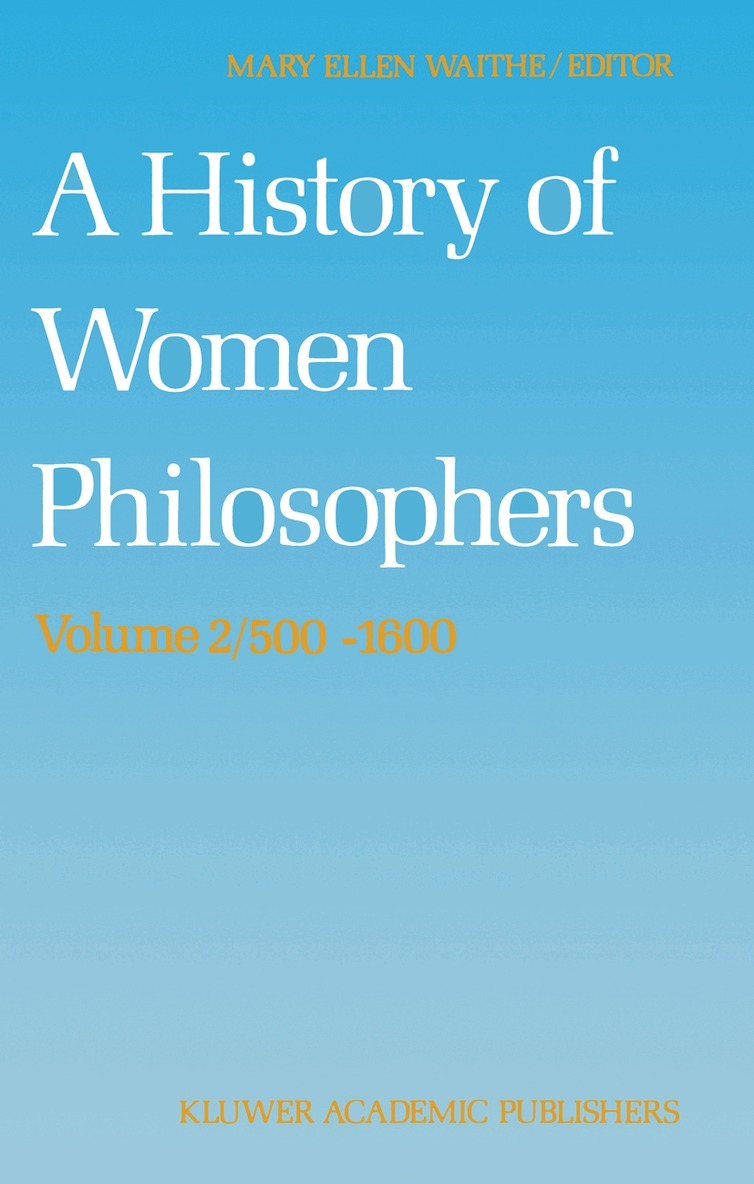
aspirations, the rise of western monasticism was the most note worthy event of the early centuries. The importance of monasteries cannot be overstressed as sources of spirituality, learning and auto nomy in the intensely masculinized, militarized feudal period. Drawing their members from the highest levels of society, women's monasteries provided an outlet for the energy and ambition of strong-willed women, as well as positions of considerable authority. Even from periods relatively inhospitable to learning of all kinds, the memory has been preserved of a good number of women of education. Their often considerable achievements and influence, however, generally lie outside even an expanded definition of philo sophy. Among the most notable foremothers of this early period were several whose efforts signal the possibility of later philosophical work. Radegund, in the sixth century, established one of the first Frankish convents, thereby laying the foundations for women's spiritual andintellectual development. From these beginnings, women's monasteries increased rapidly in both number and in fluence both on the continent and in Anglo-Saxon England. Hilda (d. 680) is well known as the powerful abbsess of the double monastery of Whitby. She was eager for knowledge, and five Eng lish bishops were educated under her tutelage. She is also accounted the patron of Caedmon, the first Anglo-Saxon poet of religious verse. The Anglo-Saxon nun Lioba was versed in the liberal arts as well as Scripture and canon law.
Häftad, Engelska, 1989
3 768 kr
Skickas inom 10-15 vardagar
aspirations, the rise of western monasticism was the most note worthy event of the early centuries. The importance of monasteries cannot be overstressed as sources of spirituality, learning and auto nomy in the intensely masculinized, militarized feudal period. Drawing their members from the highest levels of society, women's monasteries provided an outlet for the energy and ambition of strong-willed women, as well as positions of considerable authority. Even from periods relatively inhospitable to learning of all kinds, the memory has been preserved of a good number of women of education. Their often considerable achievements and influence, however, generally lie outside even an expanded definition of philo sophy. Among the most notable foremothers of this early period were several whose efforts signal the possibility of later philosophical work. Radegund, in the sixth century, established one of the first Frankish convents, thereby laying the foundations for women's spiritual andintellectual development. From these beginnings, women's monasteries increased rapidly in both number and in fluence both on the continent and in Anglo-Saxon England. Hilda (d. 680) is well known as the powerful abbsess of the double monastery of Whitby. She was eager for knowledge, and five Eng lish bishops were educated under her tutelage. She is also accounted the patron of Caedmon, the first Anglo-Saxon poet of religious verse. The Anglo-Saxon nun Lioba was versed in the liberal arts as well as Scripture and canon law.
E-bok
PDF, Engelska, 20124 161 kr
Läs direkt efter köp
aspirations, the rise of western monasticism was the most note worthy event of the early centuries. The importance of monasteries cannot be overstressed as sources of spirituality, learning and auto nomy in the intensely masculinized, militarized feudal period. Drawing their members from the highest levels of society, women''s monasteries provided an outlet for the energy and ambition of strong-willed women, as well as positions of considerable authority. Even from periods relatively inhospitable to learning of all kinds, the memory has been preserved of a good number of women of education. Their often considerable achievements and influence, however, generally lie outside even an expanded definition of philo sophy. Among the most notable foremothers of this early period were several whose efforts signal the possibility of later philosophical work. Radegund, in the sixth century, established one of the first Frankish convents, thereby laying the foundations for women''s spiritual andintellectual development. From these beginnings, women''s monasteries increased rapidly in both number and in fluence both on the continent and in Anglo-Saxon England. Hilda (d. 680) is well known as the powerful abbsess of the double monastery of Whitby. She was eager for knowledge, and five Eng lish bishops were educated under her tutelage. She is also accounted the patron of Caedmon, the first Anglo-Saxon poet of religious verse. The Anglo-Saxon nun Lioba was versed in the liberal arts as well as Scripture and canon law.
E-bok
PDF, Engelska, 20122 777 kr
Läs direkt efter köp
E-bok
PDF, Engelska, 20132 765 kr
Läs direkt efter köp
Like their predecessors, and like their male counterparts, most women philosophers of the 20th century have significant expertise in several specialities. Moreover, their work represents the gamut of 20th century philosophy''s interests in moral pragmatism, logical positivism, philosophy of mathematics, of psychology, and of mind. Their writings include feminist philosophy, classical moral theory reevaluated in light of Kant, Mill, and the 19th century feminist and abolitionist movements, and issues in logic and perception. Included in the fourth volume of the series are discussions of L. Susan Stebbing, Edith Stein, Hedwig Conrad Martius, Simone de Beauvoir, Simone Weil, Mary Whiton Calkins, Gerda Walther, and others. While pre-20th century women philosophers were usually self-educated, those of the 20th century had greater access to academic preparation in philosophy. Yet, for all the advances made by women philosophers over two and a half millennia, the philosophers discussed in this volume were sometimes excluded from full participation in academic life, and sometimes denied full professional academic status.
E-bok
PDF, Engelska, 20122 840 kr
Läs direkt efter köp