Mehdi Shakibaei – författare
Visar alla böcker från författaren . Handla med fri frakt och snabb leverans.
4 produkter
4 produkter
Del 197 - Advances in Anatomy, Embryology and Cell Biology
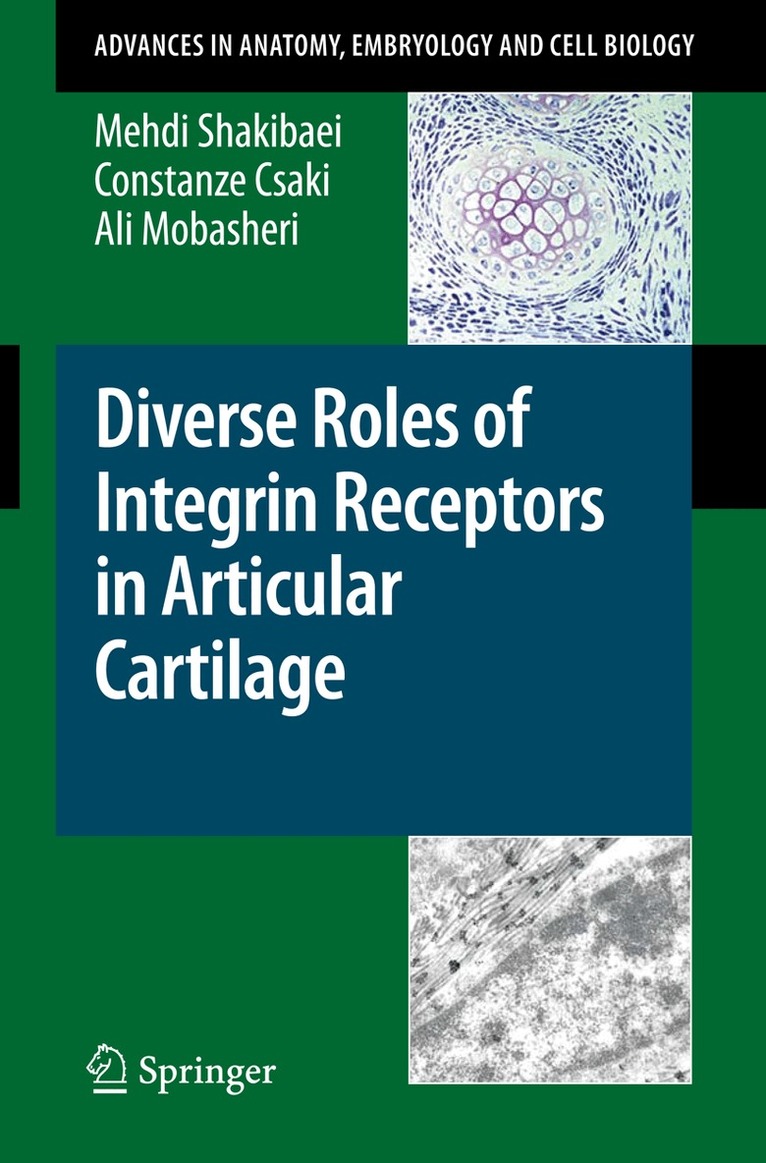
Diverse Roles of Integrin Receptors in Articular Cartilage
Häftad, Engelska, 2008
1 110 kr
Skickas inom 10-15 vardagar
1 Introduction Ar ticular cartilage is a specialised connective tissue with unique biological and mechanical properties which depend on the structural design of the tissue and the interactions between its unique resident cells, the chondrocytes, and the extrac- lular matrix (ECM) that makes up the bulk of the tissue (Buckwalter and Mankin 1998). Chondrocytes (Fig. 1 ) are the architects of the ECM (Muir 1995), building the macromolecular framework of the ECM from three distinct classes of mac- molecules: collagens, proteoglycans, and noncollagenous proteins. Of the collagens present in articular cartilage, collagens type II, IX, and XI form a fibrillar meshwork that gives cartilage tensile stiffness and strength (Eyre 2004; Buckwalter and Mankin 1998; Kuettner et al. 1991), whereas collagen type VI forms part of the matrix im- diately surrounding the chondrocytes, enabling them to attach to the macro- lecular framework of the ECM and acting as a transducer of biomechanical and biochemical signals in the articular cartilage (Guilak et al. 2006; Roughley and Lee 1994).Embedded in the collagen mesh are large aggregating proteoglycans (agg- can), which give cartilage its stiffness to compression, its resilience and contribute to its long-term durability (Dudhia 2005; Kiani et al. 2002; Luo et al. 2000; Roughley and Lee 1994). The extracellular matrix proteins in cartilage are of great significance for the regulation of the cell behaviour, proliferation, differentiation and morphogenesis (Kosher et al. 1973; Kosher and Church 1975; von der Mark et al. 1977; Hewitt et al.
E-bok
PDF, Engelska, 20081 459 kr
Läs direkt efter köp
Del 200 - Advances in Anatomy, Embryology and Cell Biology
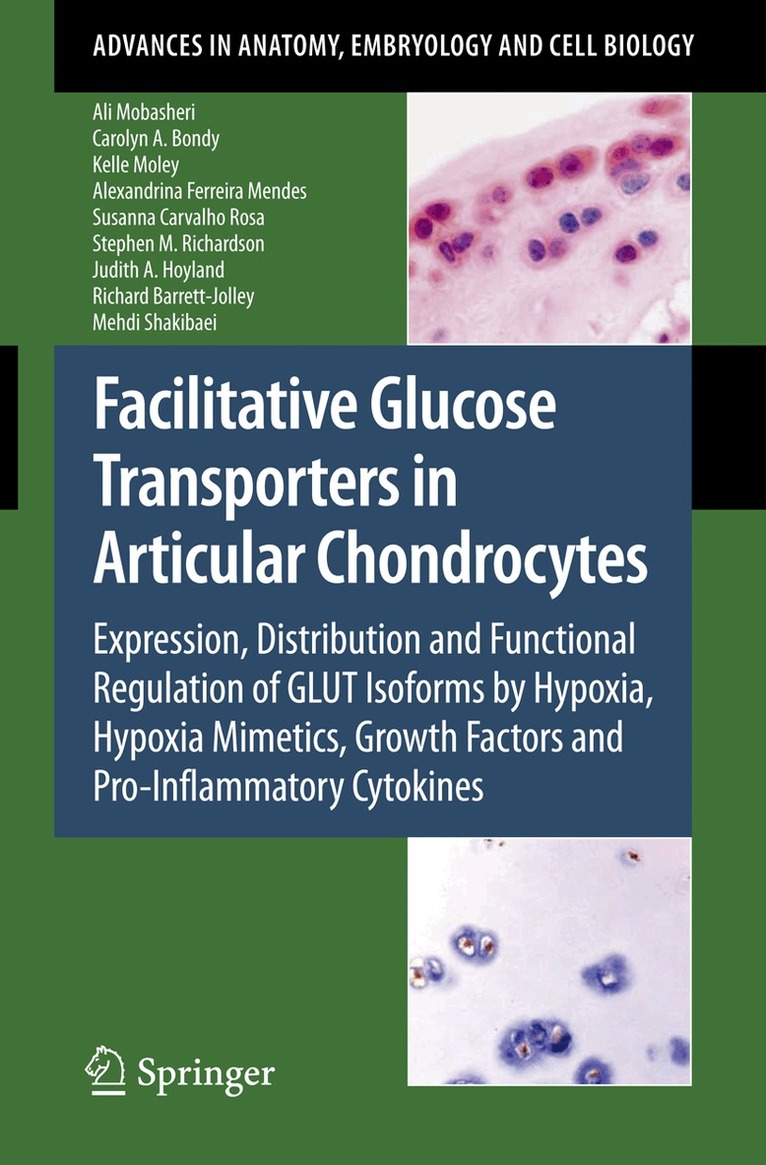
Facilitative Glucose Transporters in Articular Chondrocytes
Expression, Distribution and Functional Regulation of GLUT Isoforms by Hypoxia, Hypoxia Mimetics, Growth Factors and Pro-Inflammatory Cytokines
Häftad, Engelska, 2008
1 078 kr
Skickas inom 10-15 vardagar
1 Introduction The provision of nutrients and oxygen to synovial joints is essential for the ph ysiological and load-bearing functions of articular cartilage and the hom- static control of metabolism within chondrocytes, its resident cells (Mobasheri et al. 2002c; Mobasheri et al. 2006). The transport of nutrients (i. e. , glucose, other h- ose and pentose sugars, amino acids, nucleotides, nucleosides and water soluble vitamins such as vitamin C) into articular chondrocytes is essential for the synt- sis of collagens, proteoglycans, and glycosaminoglycans by chondrocytes (Clark et al. 2002; Goggs et al. 2005; McNulty et al. 2005; Mobasheri et al. 2002a). There are numerous biological mechanisms by which nutritional factors might be expected to exert favorable influences on cartilage function and pathophysiological events in disease processes including osteoarthritis (McAlindon 2006). A decade ago, very l- tle was known about nutrient transport in chondrocytes, particularly the transport of glucose, related sugars, and water-soluble vitamins, which are essential for the synthesis of glycosaminoglycans by chondrocytes.Glucose is a crucial nutrient for cartilage function in vivo as it is for many other tissues and organs. However, it has always been assumed that glucose is important for the in vitro cultivation of chond- cytes, ex vivo maintenance of cartilage explants, and cartilage tissue engineering procedures.
E-bok
PDF, Engelska, 20081 459 kr
Läs direkt efter köp