Mei Kobayashi – författare
Visar alla böcker från författaren . Handla med fri frakt och snabb leverans.
3 produkter
3 produkter
Häftad, Engelska, 1998
795 kr
Skickas inom 5-8 vardagar
This collection of independent case studies demonstrates how wavelet techniques have been used to solve open problems and develop insight into the nature of the systems under study. Each case begins with a description of the problem and points to the specific properties of wavelets and techniques used for determining a solution.The cases range from a very simple wavelet-based technique for reducing noise in laboratory data to complex work on two-dimensional geographical data display conducted at the Earthquake Research Institute in Japan. One case study shows how wavelet analysis is used in the development of a Japanese text-to-speech system for personal computers and another presents new wavelet techniques developed for and applied to the study of atmospheric wind, turbulent fluid, and seismic acceleration data.Although calculus and some junior and senior mathematics courses for scientists and engineers will suffice, a solid background in undergraduate mathematics, particularly analysis and numerical analysis, and some familiarity with the basics of wavelets are helpful for reading this book.
Del 4 - ICIAM2023 Springer Series
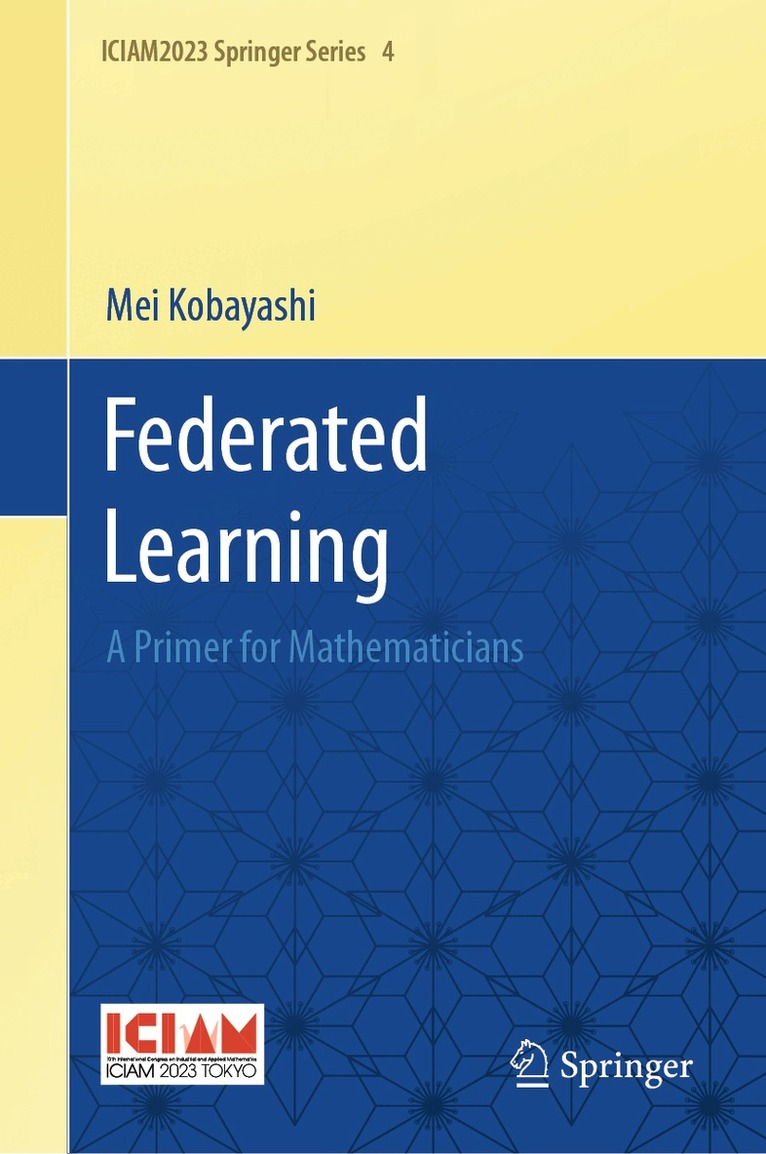
Federated Learning
A Primer for Mathematicians
Inbunden, Engelska, 2025
1 505 kr
Skickas inom 10-15 vardagar
This book serves as a primer on a secure computing framework known as federated learning. Federated learning is the study of methods to enable multiple parties to collaboratively train machine learning/AI models, while each party retains its own, raw data on-premise, never sharing it with others. This book is designed to be accessible to anyone with a background in undergraduate applied mathematics. It covers the basics of topics from computer science that are needed to understand examples of simple federated computing frameworks. It is my hope that by learning basic concepts and technical jargon from computer science, readers will be able to start collaborative work with researchers interested in secure computing. Chap. 1 provides the background and motivation for data security and federated learning and the simplest type of neural network. Chap. 2 introduces the idea of multiparty computation (MPC) and why enhancements are needed to provide security and privacy. Chap. 3 discusses edge computing, a distributed computing model in which data processing takes place on local devices, closer to where it is being generated. Advances in hardware and economies of scale have made it possible for edge computing devices to be embedded in everyday consumer products to process large volumes of data quickly and produce results in near real-time. Chap. 4 covers the basics of federated learning. Federated learning is a framework that enables multiple parties to collaboratively train AI models, while each party retains control of its own raw data, never sharing it with others. Chap. 5 discusses two attacks that target weaknesses of federated learning systems: (1) data leakage, i.e., inferring raw data used to train an AI model by unauthorized parties, and (2) data poisoning, i.e., a cyberattack that compromises data used to train an AI model to manipulate its output.
E-bok
Engelska, 20251 947 kr
Läs direkt efter köp
This book serves as a primer on a secure computing framework known as federated learning. Federated learning is the study of methods to enable multiple parties to collaboratively train machine learning/AI models, while each party retains its own, raw data on-premise, never sharing it with others. This book is designed to be accessible to anyone with a background in undergraduate applied mathematics. It covers the basics of topics from computer science that are needed to understand examples of simple federated computing frameworks. It is my hope that by learning basic concepts and technical jargon from computer science, readers will be able to start collaborative work with researchers interested in secure computing. Chap. 1 provides the background and motivation for data security and federated learning and the simplest type of neural network. Chap. 2 introduces the idea of multiparty computation (MPC) and why enhancements are needed to provide security and privacy. Chap. 3 discusses edge computing, a distributed computing model in which data processing takes place on local devices, closer to where it is being generated. Advances in hardware and economies of scale have made it possible for edge computing devices to be embedded in everyday consumer products to process large volumes of data quickly and produce results in near real-time. Chap. 4 covers the basics of federated learning. Federated learning is a framework that enables multiple parties to collaboratively train AI models, while each party retains control of its own raw data, never sharing it with others. Chap. 5 discusses two attacks that target weaknesses of federated learning systems: (1) data leakage, i.e., inferring raw data used to train an AI model by unauthorized parties, and (2) data poisoning, i.e., a cyberattack that compromises data used to train an AI model to manipulate its output.