Merja Kytö - Böcker
Visar alla böcker från författaren Merja Kytö. Handla med fri frakt och snabb leverans.
5 produkter
5 produkter
Del 263 - Linguistic Insights
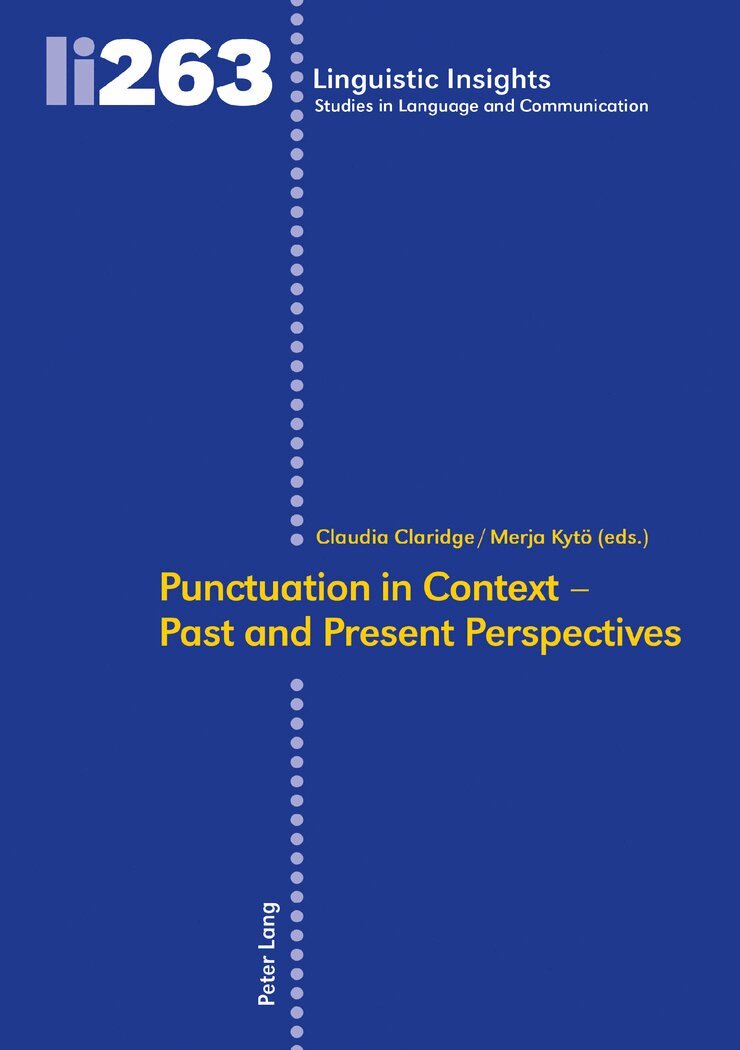
Punctuation in Context – Past and Present Perspectives
Inbunden, Engelska, 2019
1 129 kr
Skickas inom 5-8 vardagar
Punctuation is an integral element in writing and has been so for centuries. The present volume brings together approaches in linguistics, stylistics and other fields to highlight the rich repertoire of issues involved in the study of punctuation. The contributions to the book discuss the grammatical, pragmatic, rhetorical and stylistic functions of punctuation, such as encoding emotion, metalinguistic marking, foregrounding and paralinguistic indication. They also highlight the sensibility of punctuation to genre and the speech-writing continuum, as well as the important role punctuation plays for reader interpretation. They further demonstrate how punctuation conventions change in time. The data is drawn from English, with one investigation devoted to German.
2 398 kr
Skickas inom 7-10 vardagar
No detailed description available for "Grammaticalization at Work".
English in Transition
Corpus-based Studies in Linguistic Variation and Genre Styles
Inbunden, Engelska, 1997
2 259 kr
Skickas inom 7-10 vardagar
No detailed description available for "English in Transition".
5 002 kr
Skickas inom 3-6 vardagar
This volume provides an up-to-date survey of the field of corpus linguistics, a field whose methodology has revolutionized much of the empirical work done in most fields of linguistic study over the past decade.Corpus linguistics investigates human language by starting out from large collections of texts - spoken, written, or recorded. These language corpora, which are now regularly available in electronic form, are the basis for quantitative and qualitative research on almost any question of linguistic interest. Many techniques that are in use in corpus linguistics today are rooted in the tradition of the late 18th and 19th century, when linguistics began to make use of mathematical and empirical methods. Modern corpus linguistics has used and developed these methods in close connection with computer science and computational linguistics.The handbook sketches the history of corpus linguistics, shows its potential, discusses its problems, and describes various methods of collecting, annotating, and searching corpora as well as processing corpus data. It also reports case studies that illustrate the wide range of linguistic research questions addressed in corpus linguistics. The over 60 articles included in the handbook are divided into five sections:(1) the origins and history of corpus linguistics and surveys of its relationship to central fields of linguistics (2) corpus compilation (3) corpus types (4) preprocessing of corpora (5) the use and exploitation of corpora. The final section gives an overview of the results of corpus studies obtained in phonetics, phonology, morphology, syntax, semantics, sociolinguistics, historical linguistics, stylometry, dialectology, and discourse analysis. It also reports on recent advances made in human and machine translation, contrastive studies, computer-assisted language learning, and automatic summarization.The contributors to the volume are internationally known experts in their respective fields. The handbook is intended for a wide audience ranging from teachers, university students, and scholars to anyone interested in the use of computers in linguistic analyses and applications.
4 848 kr
Skickas inom 5-8 vardagar
This handbook provides an up-to-date survey of the field of corpus linguistics, a field whose methodology has revolutionized much of the empirical work done in most fields of linguistic study over the past decade.Corpus linguistics investigates human language by starting out from large collections of texts - spoken, written, or recorded. These language corpora, which are now regularly available in electronic form, are the basis for quantitative and qualitative research on almost any question of linguistic interest. Many techniques that are in use in corpus linguistics today are rooted in the tradition of the late 18th and 19th century, when linguistics began to make use of mathematical and empirical methods. Modern corpus linguistics has used and developed these methods in close connection with computer science and computational linguistics.The handbook sketches the history of corpus linguistics, shows its potential, discusses its problems, and describes various methods of collecting, annotating, and searching corpora as well as processing corpus data. It also reports case studies that illustrate the wide range of linguistic research questions addressed in corpus linguistics. The over 60 articles included in the handbook are divided into five sections:(1) the origins and history of corpus linguistics and surveys of its relationship to central fields of linguistics (2) corpus compilation (3) corpus types (4) preprocessing of corpora (5) the use and exploitation of corpora. The final section gives an overview of the results of corpus studies obtained in phonetics, phonology, morphology, syntax, semantics, sociolinguistics, historical linguistics, stylometry, dialectology, and discourse analysis. It also reports on recent advances made in human and machine translation, contrastive studies, computer-assisted language learning, and automatic summarization.The contributors to the volume are internationally known experts in their respective fields. The handbook is intended for a wide audience ranging from teachers, university students, and scholars to anyone interested in the use of computers in linguistic analyses and applications.